
Taybeh, a historic hilltop town situated in the West Bank, is recognized as one of the oldest Christian communities globally. In light of increasing aggressions from Israeli settlers, the town now faces existential threats and is striving to preserve its identity and heritage.
Originally known as Ephraim in ancient Greek, Taybeh is believed to be the location where Jesus sought refuge with his disciples from the Sanhedrin prior to his final journey to Jerusalem, as mentioned in the gospels.
A church was established in Taybeh during the fifth century, and the predominantly Christian population has endured various historical challenges, including the Crusades, the conquest by Saladin, and the rule of the Ottoman and British empires, as well as three Arab-Israeli conflicts. However, local residents express concern for the community’s long-term viability.
The town is surrounded by four significant Israeli settlements, along with numerous unofficial outposts established by messianic Jewish groups. These groups, known as the “hilltop youth,” engage in acts of harassment and intimidation against the Palestinian residents in the surrounding areas.
This consistent pattern of land appropriation and intimidation has been observed throughout the West Bank, a situation that the United Nations has labeled as ethnic cleansing. This campaign has been largely driven by hardline members of the Israeli government, including Finance Minister Bezalel Smotrich and National Security Minister Itamar Ben-Gvir.
Father Bashar Fawadleh, the parish priest of Christ the Redeemer church in Taybeh, reported, “In the past three years, we have witnessed the expulsion of Bedouins and the establishment of their caravans and livestock on our land without any consent.” He added that settlers have also begun to allow their animals to graze in the olive groves that have sustained Taybeh for generations.
“We have been prohibited from accessing our land or caring for our olive trees for three years now,” he lamented. The local community’s only opportunity to access their fields occurs when diplomats from the French and Italian consulates accompany them during harvest season.
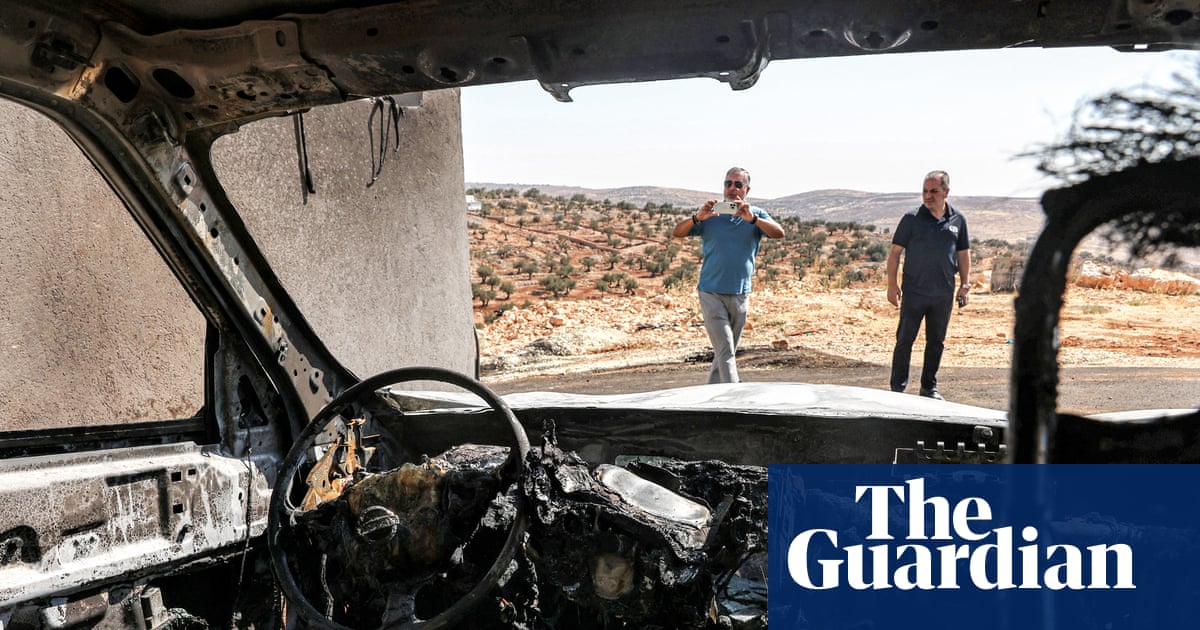
In the last year, the situation has worsened. In July, settlers set fire to the grounds of the ancient St. Peter’s church, which dates back to the fifth century. Following this incident, groups of hilltop youth have invaded Taybeh multiple times, vandalizing vehicles and damaging property.
On March 19, parish representatives reported that approximately 30 settlers occupied a concrete factory and stone quarry on Taybeh’s outskirts, raised the Israeli flag, and conducted prayers at the site, which many locals interpreted as a signal of intentions to assert control over parts of the town.
In February, the Israeli security cabinet endorsed measures to permit Israelis to purchase property in the occupied West Bank, marking a significant step toward potential annexation.
What distinguishes Taybeh from other beleaguered towns in the West Bank is its identity as an entirely Christian community with deep historical roots. This unique characteristic offers some degree of protection, such as during harvest visits by diplomats, but it simultaneously heightens the community’s vulnerability. Generally, Western nations have been more supportive of Palestinian Christians than their Muslim counterparts, facilitating emigration, which has been occurring at an alarming rate.
The church, affiliated with the Latin Patriarchate of Jerusalem, actively promotes small business initiatives to generate employment and develops affordable housing. Despite these efforts, the community continues to dwindle, with 15 families having departed in the past two years, reducing the population to around 1,100.
Following the arson at St. Peter’s church, U.S. Ambassador Mike Huckabee visited Taybeh to denounce what he characterized as “an act of terror” and urged for accountability. However, no prosecutions have been reported, and Huckabee has remained silent on subsequent incidents targeting Taybeh. As a Southern Baptist minister, Huckabee is a staunch advocate for Israel’s territorial claims, which he believes are divinely sanctioned.
His unwavering support for Israel’s expansionist policies has drawn criticism from various American Christian groups, including those on the political right. Notably, far-right commentator Tucker Carlson confronted Huckabee regarding the treatment of Palestinian Christians during a heated two-hour discussion in February.
Huckabee dismissed allegations of mistreatment as “a lie” and highlighted the rapid growth of the Christian population in Israel, which now stands at around 184,000, primarily consisting of Palestinian Israelis.
Conversely, in the West Bank, the Christian demographic has dramatically decreased from 5% of the total population in 1967 to approximately 1% today, equating to about 45,000 individuals.
The surge of religious nationalism promoted by the Israeli government in recent years has primarily targeted Palestinian Muslims, yet there has been a concerning increase in anti-Christian incidents as well. The Religious Freedom Data Center (RFDC), an organization based in Israel that monitors such occurrences, reported a 65% rise in harassment cases, many involving aggression towards Christians.
“We see a link between the national sentiment, escalating tensions, and governmental support, which together create an environment of superiority among Jews, contributing to the increase in attacks against non-Jewish individuals,” stated Yisca Harani, the RFDC’s director, on the organization’s website.
In response to dwindling support from the U.S. public since the onset of the Gaza conflict, Israel has sought to engage American evangelicals, who, like Huckabee, view Israeli territorial expansion as rooted in biblical prophecy. In November, the Israeli foreign ministry hosted over 1,000 evangelical pastors and Christian leaders on an all-expenses-paid tour.
“Israel is the only country in the Middle East and one of the few places on Earth that…”