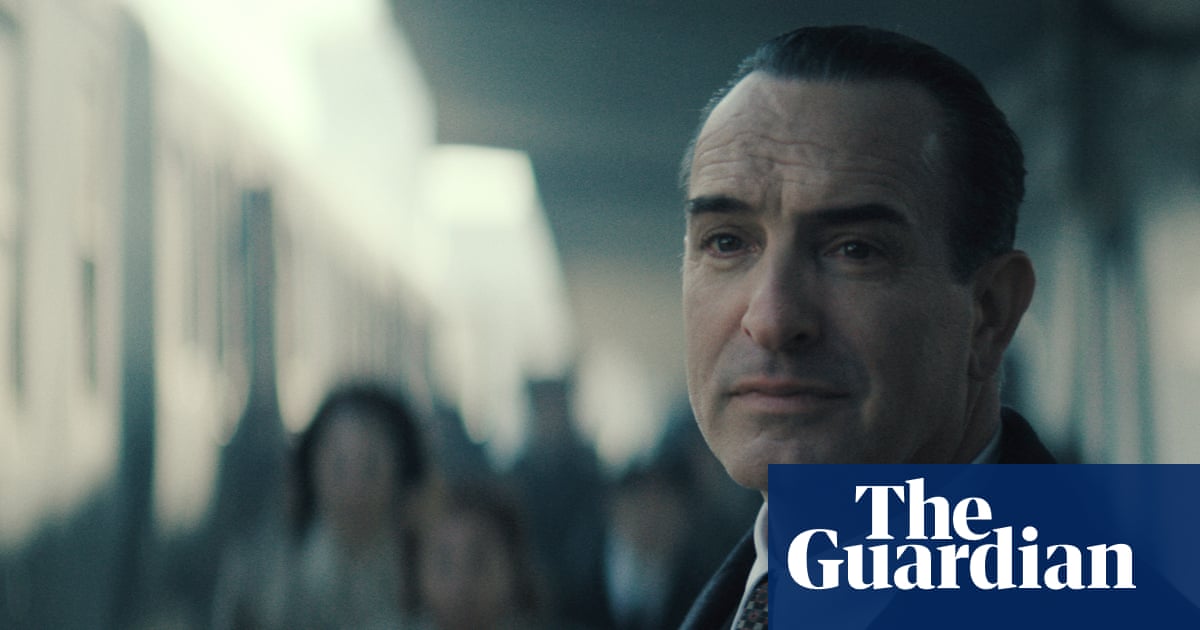

Xavier Giannoli’s latest film, “Les Rayons et les Ombres” (Rays and Shadows), presents a narrative from the perspective of Corinne Luchaire, a French actress who, after World War II, grapples with her past affiliations during the Nazi occupation. Corinne, once celebrated as “the new Garbo,” confronts her conflicting emotions regarding her father, Jean Luchaire, a prominent press tycoon executed for treason in 1946. As she records her reflections on a borrowed tape recorder, she finds it difficult to reconcile her loyalty to her father with the circumstances of his downfall.
Her self-imposed ignorance is shattered during a visit from a Jewish director who played a significant role in her rise to fame. When Corinne, portrayed by newcomer Nastya Golubeva Carax, inquires about his sister, he reveals her tragic fate in a concentration camp. Corinne’s stunned reply, “I didn’t know,” is met with the piercing question: “Did you even try to find out?”
Despite its lengthy runtime exceeding three hours, “Rays and Shadows” attracted over 300,000 viewers in French cinemas during its opening week in mid-March. However, it has ignited intense discussions surrounding the Vichy regime. While some centrist and right-leaning critics have praised the film for its intricate historical portrayal, left-leaning publications like Libération and L’Humanité have accused it of downplaying the actions of individuals who collaborated with the Nazi regime until the very end.
The film presents Jean Luchaire not merely as a staunch ideologue but rather as a disillusioned spendthrift whose reckless lifestyle contributes to his demise. Giannoli explains, “I aimed to create this film to illustrate the various traps that individuals can fall into and how easily personal fears and cowardice can shape history.”
Giannoli, whose father was a notable French journalist who passed away in 2022, has long been intrigued by the corruption of media and affluent individuals in promoting harmful ideologies. His previous work, an acclaimed adaptation of Honoré de Balzac’s “Lost Illusions,” explored the transformation of journalism in 19th-century Paris from a platform for enlightenment into a profit-driven entity pushing “fake news.” In “Rays and Shadows,” he delves deeper into the moral decline of a once-pacifist journalist who becomes complicit with an extremist regime.
In the film, Jean Luchaire is portrayed by Oscar-winning actor Jean Dujardin (The Artist), with Giannoli emphasizing the importance of casting a charismatic actor to convey the allure of betrayal. Fieschi notes that Luchaire represented a certain Parisian charm reminiscent of Jean Renoir’s “La Règle du Jeu,” highlighting his numerous affairs and his position within an immoral societal fringe. “Had he been played by someone less charming, it would not have accurately reflected the character’s reality,” he adds.
The film’s core revolves around Luchaire’s enduring friendship with Otto Abetz (August Diehl), a former art teacher who leverages his connections to become the German ambassador to France. The story begins in the Black Forest during the early 1930s, where Luchaire and Abetz, bonded by a shared leftist pacifism born from the horrors of World War I, establish the Sohlberg Congress—a Franco-German forum for youth that later lays the groundwork for their deadly propaganda alliance.
Giannoli asserts, “Without Otto Abetz, there is no Jean Luchaire.” Abetz appointed Luchaire as the “press tsar” of occupied France and financially supported the launch of the collaborationist newspaper “Les Nouveaux Temps.” Giannoli drew from various memoirs, including that of Rudolf Rahn, a senior Nazi diplomat who underscored Abetz’s profound appreciation for French culture and his efforts to entice French elites into the idea of collaboration.
The film does not shy away from depicting the most sensational aspects of the collaboration into which Jean and Corinne become entangled. It features scenes of black-market millionaires mingling with Nazi officials, lavish embassy parties, drug-fueled orgies, and extravagant meals at prestigious venues like Maxim’s and Fouquet’s. Giannoli remarks, “We invested significantly in the food design to ensure authenticity, showcasing the stark contrast between the opulence of these elites and the widespread food shortages in France at that time.”
Historically, French filmmakers have often hesitated to confront the topic of collaboration directly. This reluctance is partly rooted in the enduring “résistancialisme” myth propagated by Charles de Gaulle to unite France post-war, which rendered collaboration a taboo subject. When filmmaker Louis Malle attempted to examine the moral compromises of occupied France in his 1974 film “Lacombe, Lucien,” he faced severe backlash that forced him to relocate to the United States. Giannoli admits to experiencing sleepless nights during the production of “Rays and Shadows,” questioning the implications of his work.
While praising Giannoli for his film’s nuanced exploration of ambiguity, Laurent Joly, a prominent historian of the Vichy regime, expresses skepticism about the portrayal of Jean Luchaire. He argues, “It was not pacifism that led Luchaire to collaborate, but his inherent amorality and greed.” Joly emphasizes that Luchaire’s moral failings were evident from an early age, influenced by his father, a university professor. This complexity adds another layer to the film’s portrayal of a challenging historical period.