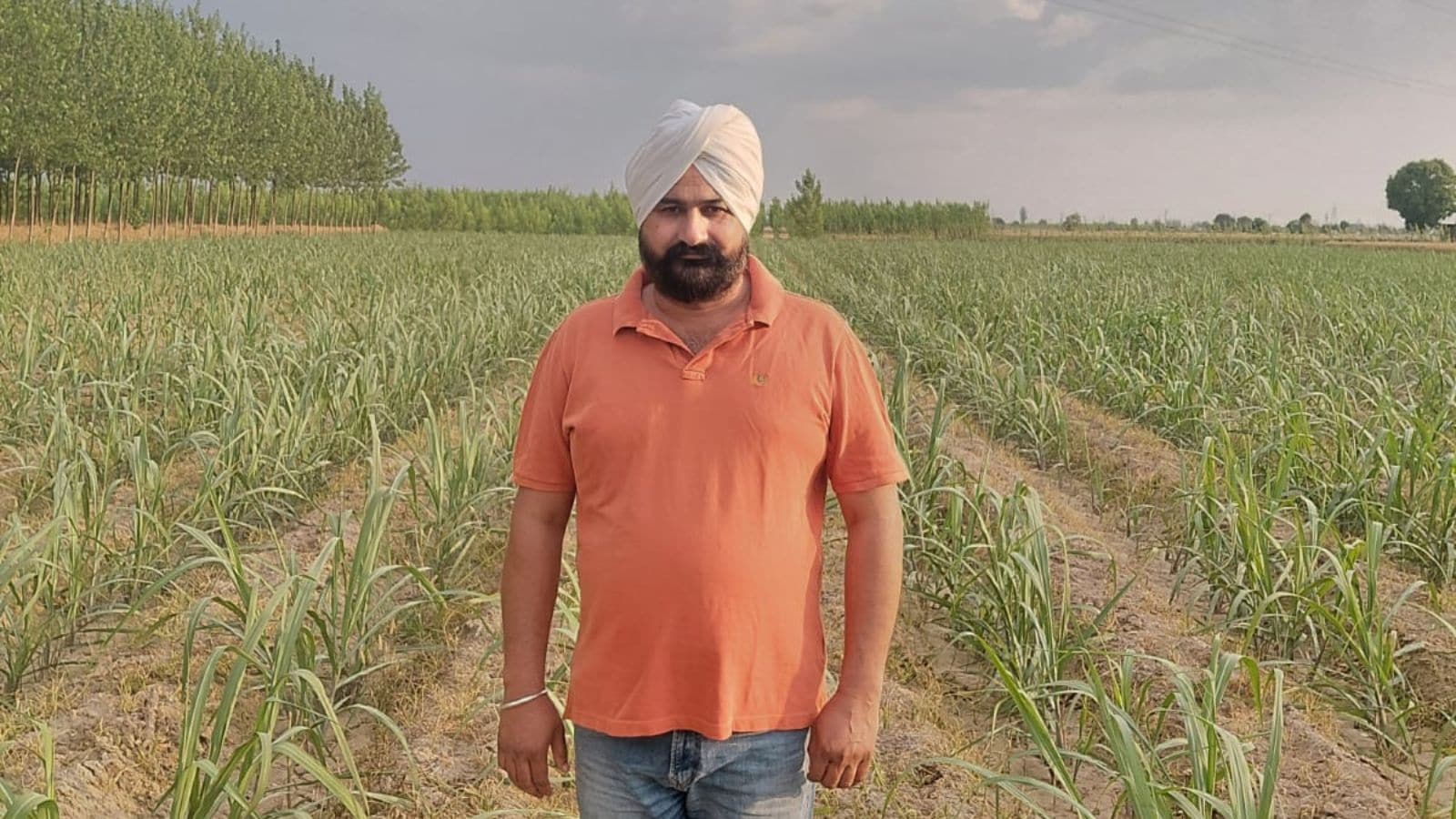

In the Yamunanagar district of Haryana, innovative farmer Nirmal Singh has achieved significant financial success by implementing the wide row spacing technique in his sugarcane farming. This approach has enabled him to generate an impressive income of approximately Rs 15 lakh each year, producing an average of 425 quintals of sugarcane per acre across 30 acres of land. The method also contributes to water conservation, which is crucial for sugarcane, a crop known for its high water consumption throughout its lengthy growing season.
At 41 years old, Nirmal, a graduate, began assisting his father with farming at the age of 17 in the village of Gillor Majri. He eventually made the decision to pursue farming as a full-time career. For the past 15 years, he has been implementing the wide row spacing method, which involves planting sugarcane in rows spaced four feet apart, compared to the traditional spacing of 2.5 feet. The outcome has been extraordinary; Singh reports earning nearly Rs 15 lakh annually from his 30 acres, with profits reaching Rs 50,000 per acre, significantly higher than the Rs 30,000 profit typically realized by conventional farmers.
The Haryana state government has set the current maximum State Advised Price (SAP) for sugarcane at Rs 415 per quintal.
Nirmal explains that this wide row technique reduces the number of rows planted per acre from 90 to 50, resulting in healthier, more robust crops. “Labor requirements are minimal, as nearly all tasks, including harvesting, are performed using machinery,” Nirmal states.
This method also significantly decreases input costs. For sowing per acre, only 18-20 quintals of cane are needed, compared to 35 quintals with traditional practices. Water usage is reduced by nearly 50%.
Agriculture Department officials note that cultivating sugarcane with wide rows can cut water consumption down to about 9-10 lakh liters per acre, a stark contrast to the 18-20 lakh liters required by conventional methods.
“With wide row cultivation, irrigating an acre takes just 50 minutes, whereas traditional methods can exceed two hours. Considering that sugarcane requires around 20 irrigation cycles during its growing season, the potential for water conservation is substantial. If all sugarcane growers adopted this technique, the impact on water conservation would be significant,” Nirmal emphasizes.
Mahavir Singh, Haryana’s Additional Cane Commissioner, stated that the state government has increased incentives for farmers embracing the wide row spacing technique from Rs 3,000 to Rs 5,000 per acre this year. This method not only enhances profitability and conserves water but also improves the quality of juice produced from the sugarcane, while addressing the persistent labor shortages in agriculture.
However, despite its advantages and government support, the adoption of the wide row spacing technique remains limited, with Singh estimating that only about 10% of farmers are utilizing this approach.
On March 7, Haryana’s Cooperation Minister Arvind Kumar Sharma noted a continuous decline in the average yield of sugarcane in the state from 2020-21 to 2024-25, with the exception of the 2022-23 season.
He reported that the total sugarcane production for the 2025-26 period is projected to be 536.24 lakh quintals, which represents a decrease of 37.55% (322.54 lakh quintals) compared to the 858.78 lakh quintals produced in 2020-21. The area dedicated to sugarcane cultivation was 246,357 acres in 2020-21, rising to 263,499 acres in 2021-22 and reaching 266,142 acres in 2022-23, before experiencing a decline post-2022-23. “The reduction in cultivated area has led to decreased availability of sugarcane for processing at sugar mills, with current estimates at 509.47 lakh quintals. Consequently, the operational days for sugar mills are expected to be restricted to 108 days,” Sharma explained.
He highlighted that sugarcane farming is labor-intensive and requires considerable manpower from planting to harvesting.
Sukhbir Siwach’s comprehensive coverage of farmer protests against three agricultural laws during 2020-21 garnered significant attention.
Stay informed with the latest updates – follow us on Instagram.