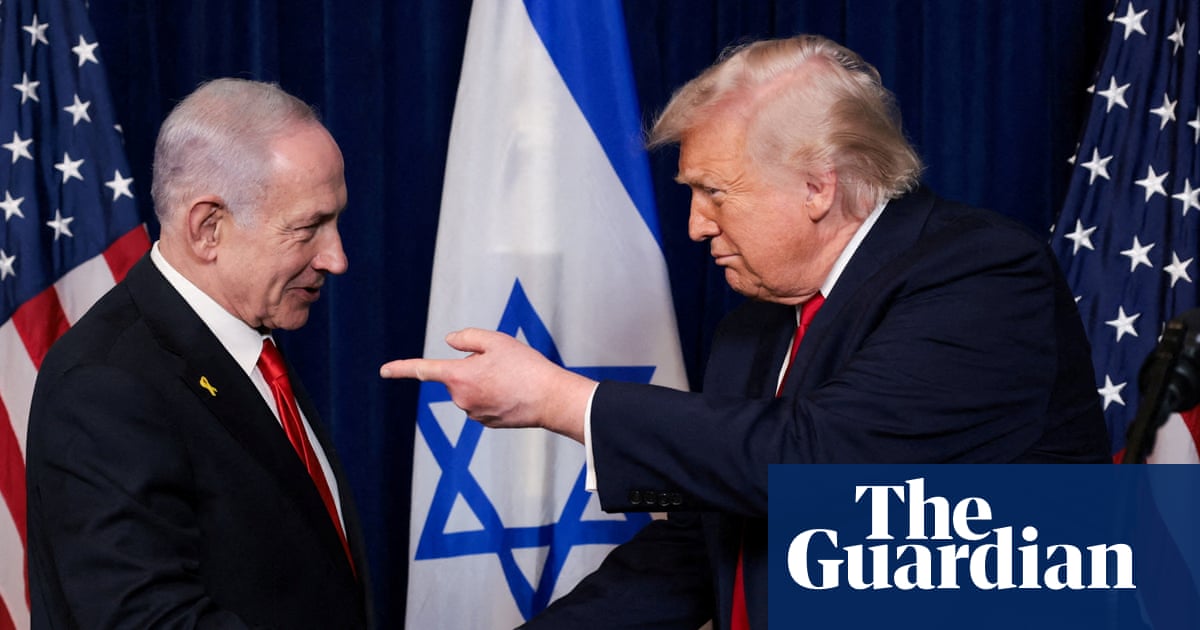

On December 29 of the previous year, Israeli Prime Minister Benjamin Netanyahu visited Donald Trump at his Mar-a-Lago resort, presenting not only a request but also a rather transparent incentive.
Following a 12-day military conflict in June, during which the United States assisted in targeting Iran’s nuclear installations, Israel had replenished its arsenal of air defense and various missile systems, gearing up for a new set of goals.
During their joint press conference, Trump echoed Netanyahu’s familiar rhetoric, stating, “I hear that Iran is trying to build up again. We’ll have to knock them down. We’ll knock the hell out of them. But hopefully, that’s not happening.”
In an effort to flatter Trump, Netanyahu brought forth an offer of Israel’s highest honor, the Israel Prize, which is rarely awarded to non-Israelis, in recognition of Trump’s “tremendous contributions to Israel and the Jewish people.”
As reported by the Atlantic, Netanyahu also proposed an additional advantage for the pragmatic president: a successful confrontation with Iran could allow Israel to reduce its dependency on American military support.
This meeting marked the beginning of several interactions between Netanyahu and Trump in the subsequent weeks, as Trump sought to secure U.S. involvement in a broader conflict with Iran, aiming for objectives that surpassed those of the previous engagement.
According to a report from Mossad, Israel’s intelligence agency, Iran’s government was perceived as vulnerable, facing internal unrest fueled by public outrage over its heavy-handed response to protests. This situation presented a historic opportunity for a swift military campaign.
Netanyahu alluded to an additional motivation for Trump: a chance to retaliate against Iran for alleged assassination plots against him.
Subsequent reports indicate that Netanyahu, who considers himself an “expert” on Iran, and the Israeli military were fully committed to promoting the prospect of an uncomplicated war.
On February 28, the war commenced, with unnamed Israeli officials informing Haaretz that the Iranian threat would diminish within days as their missile capabilities were dismantled.
Another piece in the same publication indicated that Israeli military strategists had prepared for a conflict they believed would last no more than three weeks.
While the conflict can be viewed as a separate entity, it bears responsibility for both the U.S. and Israel, fitting into Netanyahu’s ongoing state of conflict since Hamas’s attack on Israel on October 7, 2023.
This assault forced Israel to reevaluate its strategic approach. In the wake of escalating tensions in Gaza, Lebanon, and now Iran, along with involvement from the Houthis in Yemen and conflicts in Syria, a recurring theme has emerged: Netanyahu has proclaimed victories that often appear to be more optimistic than factual.
In Gaza, despite a devastating military campaign, Hamas remains active amidst the ruins. In Lebanon, despite claims of Hezbollah’s defeat, the group retains the capability to launch rockets into Israel, compelling the nation to once again consider occupying southern Lebanon—a strategy that previously contributed to Hezbollah’s rise.
In Iran, despite the assassination of Supreme Leader Ali Khamenei and other high-ranking officials, the anticipated “decapitation” strategy has not yielded the regime change Netanyahu promised, but rather a consolidation of power within the Islamic Revolutionary Guards Corps.
Although the precise dynamics of influence between the leaders remain unclear, it is evident that even among senior officials in the Trump administration, there is a belief that Netanyahu’s expectations were overly ambitious. Reports reveal a tense exchange between Vice President JD Vance and Netanyahu, reinforcing this perspective.
A source cited by Axios remarked, “Before the war, Bibi really sold it to the president as being easy, as regime change being a lot likelier than it was. The VP was clear-eyed about some of those statements.”
However, some analysts take a more tempered view. Daniel C. Kurtzer, a former U.S. ambassador to Israel, and Aaron David Miller, writing for the Carnegie Endowment for Peace, characterized Trump as “a willing and full partner” in the conflict. They noted, “He was risk-ready and caught up in a self-generated aura of military power and invincibility after dealing with President Nicolás Maduro of Venezuela.” They acknowledged that while Netanyahu likely influenced the timing of the conflict, Trump was “likely already on his way to war.”
As the conflict stretches into its second month without resolution and the global economy suffers from the closure of the Strait of Hormuz, the fallout from Netanyahu’s assurances of an “easy” war has begun to extend beyond the immediate region.
In this context, the perception of Netanyahu’s role is significant, especially considering his prolonged advocacy for the conflict, as is Trump’s willingness to engage.
According to security analysts Richard K. Betts and Stephen Biddle in a recent Foreign Affairs article, “In just its first weeks, the war has cost many billions of dollars in direct expenditure, reduced support for Ukraine, put dangerous strains on inventories of the most advanced U.S. weapons, and shocked the global economy.”
The conflict has also strained NATO and may have emboldened nations like China, Russia, and North Korea. While Netanyahu has boasted about delivering “10 plagues” to Iran, the reality that Iranian and Hezbollah missiles continue to strike Israel has not gone unnoticed, suggesting that Passover will be spent with vigilance towards potential attacks.
For both Netanyahu and Israel, the situation remains precarious and uncertain.