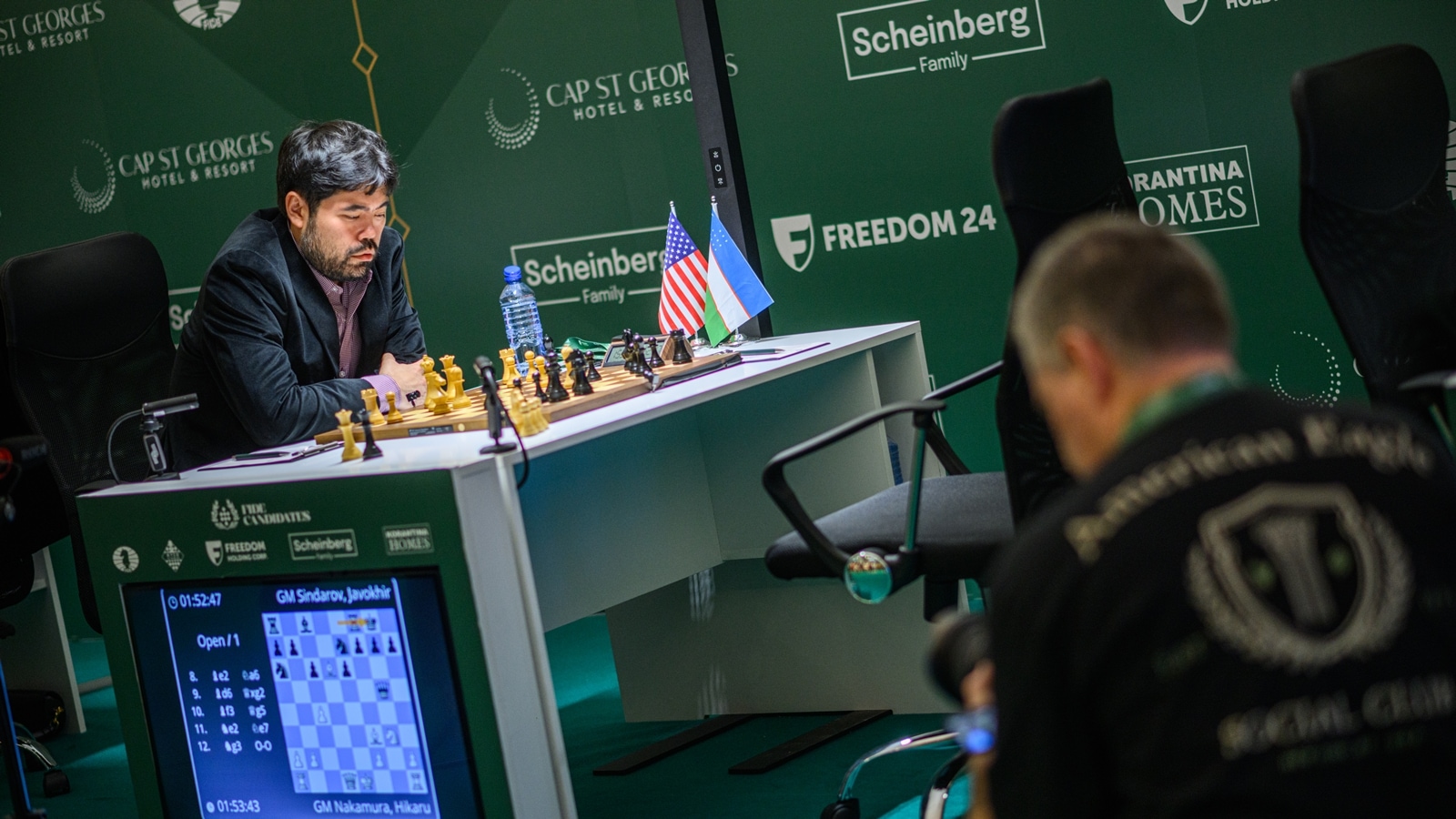

When American Grandmaster Hikaru Nakamura expressed his concerns regarding what he termed FIDE’s excessive anti-cheating procedures at the Candidates Tournament in Cyprus, a division emerged within the chess community.
Nakamura’s criticisms were directed at the protocols set by FIDE, the international governing body of chess. However, officials defend these measures as essential to maintaining the game’s integrity. Over recent years, numerous cheating allegations have arisen, including accusations from some of the sport’s leading players, alongside confirmed instances of individuals caught cheating in over-the-board (OTB) competitions. Such events necessitate stringent security measures for FIDE.
Although the security process may seem intrusive, involving multiple scanning checkpoints and continuous player monitoring, it is fundamentally straightforward and comparable to airport security procedures.
Upon entering the playing venue, players typically undergo a walk-through scanner followed by a manual inspection. For the Candidates Tournament, in addition to these standard checks, FIDE implemented advanced screening technologies. According to FIDE, these protocols do not violate players’ privacy or compromise the integrity of the competition.
“This tournament is a qualifier for the World Championships, which is the pinnacle of the sport. Therefore, we must ensure that players feel secure and comfortable in their environment,” stated Andy Howie, FIDE’s Deputy Chief Arbiter and Fair Play Officer, in a YouTube video released by the organization.
Nakamura has labeled the extensive security checks as “complete nonsense.” He expressed his views on his YouTube channel, stating, “Regarding the whole issue of delays and cheating in over-the-board play, I genuinely find it absurd. Given the number of machines scanning players, I truly believe it’s all nonsense.”
As the leading player at the World Championship challenger event in Cyprus, Nakamura sarcastically questioned whether players were being treated like Mossad agents in Iran. “I don’t have an issue with the checks; I think the concerns raised by some players are exaggerated. We go through scans before and after games, and with the metal detectors and various scanners—are we really being treated like spies? We are chess players, after all,” he remarked.
Howie responded by clarifying that while FIDE employs advanced anti-cheating technologies, the extent of these measures is reasonable. He noted that players only need to pass through two scanners as a minimum requirement. “As technology progresses, we must stay ahead. We have new scanners in use, but they are standard, not excessive. We utilize both overt devices, which are visible, and covert devices to monitor incoming signals in the hall,” he explained.
For the Candidates Tournament, FIDE has installed four covert scanners at the Cap St Georges Hotel and Resort in Pegeia to detect any incoming signals that could pose a risk.
Ana Srebrnic, another Deputy Chief Arbiter and Fair Play Officer for FIDE at the Candidates 2026, mentioned that players might be subject to checks even after their games. “If we observe anything suspicious during the game, we certainly conduct checks. If something seems off before the game, we will inspect it afterward. These post-game scans can be more detailed, as we examine bags, jewelry, and other items,” she shared with FIDE.
While Nakamura’s frustrations can be understood from a player’s standpoint, especially when facing rigorous scrutiny during their profession, his ongoing complaints appear somewhat disingenuous.
Ironically, Nakamura previously made unsupported accusations against the current top-rated Indian Grandmaster, Arjun Erigaisi. Years later, he faced allegations from Vladimir Kramnik regarding cheating in online matches.
Following Nakamura’s comments about the security measures, Hans Niemann criticized him, suggesting that Nakamura was opposing the stricter protocols he once advocated for others. In a post on X, Niemann remarked, “Historically, Hikaru Nakamura has publicly accused numerous players without substantial evidence or facing significant accountability. Now that stricter anti-cheating measures are in place, he seems to be against them.”
While Nakamura’s complaints may come across as ironic, they underscore ongoing tensions regarding anti-cheating regulations. As technology advances, the discussion surrounding the balance between necessary security and player privacy is becoming increasingly heated.