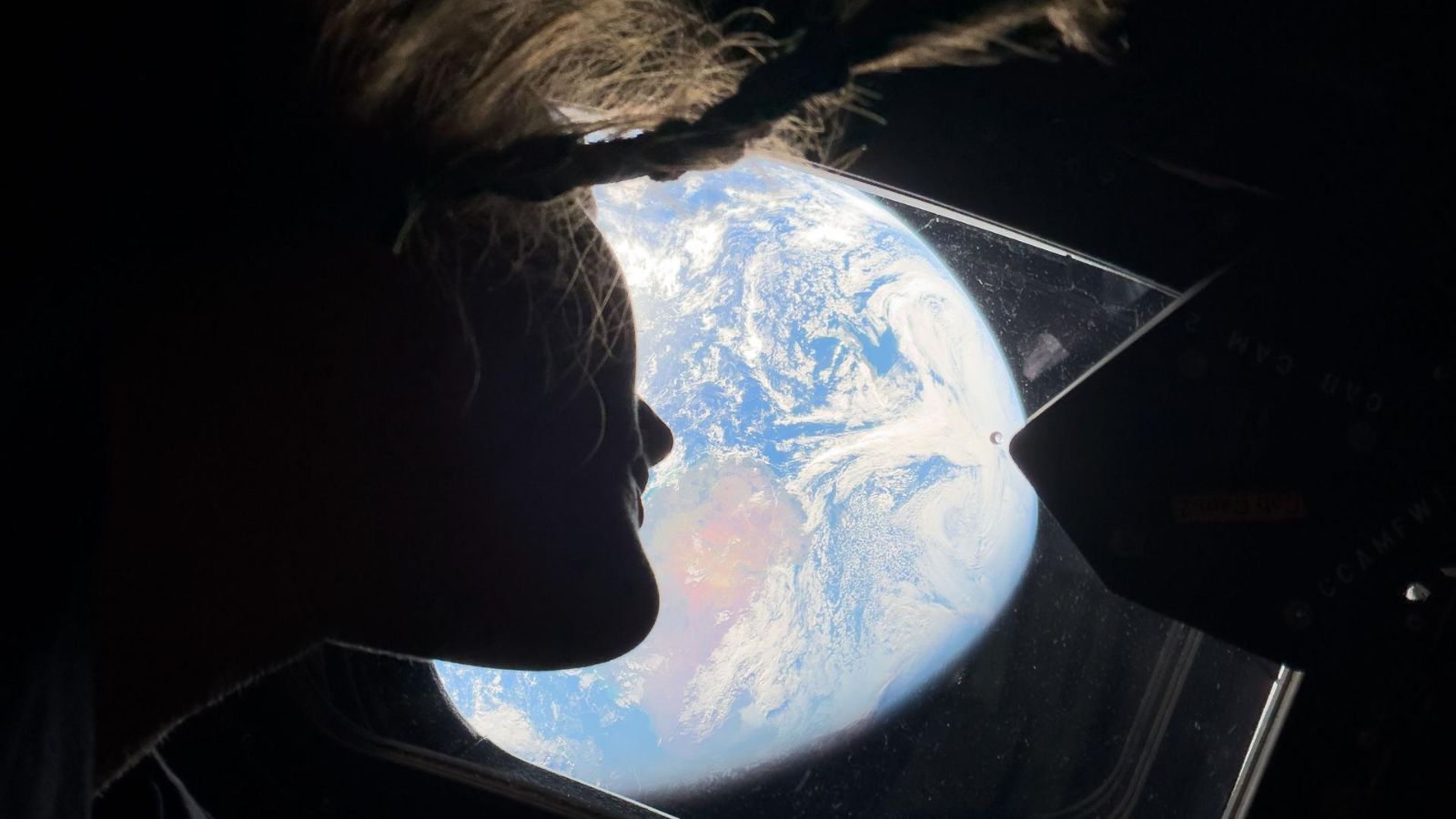

On Monday, the Artemis II astronauts made history by becoming the furthest humans from Earth during a lunar flyby, offering breathtaking views of the moon’s far side that have never been seen before. This six-hour flyby marks NASA’s return to lunar exploration since the Apollo missions, featuring a crew of three Americans and one Canadian as they advance toward a planned landing near the moon’s south pole within the next two years.
Just before commencing their flyby and detailed lunar observations, the four astronauts broke the previous distance record of 248,655 miles (400,171 kilometers) that was set by Apollo 13 in April 1970. As they continued their journey, Mission Control anticipated that Artemis II would exceed this record by over 4,100 miles (6,600 kilometers).
The crew began their day with a recorded greeting from Jim Lovell, the Apollo 13 commander, who passed away last August. Lovell welcomed them to “my old neighborhood” and reminded them to enjoy the spectacular views amidst their busy schedule. The crew carried with them a silk patch from Apollo 8, which Lovell had taken to the moon, showcasing it as they approached the flyby. Commander Reid Wiseman expressed his honor in having the patch onboard, motivating the team for an exciting day ahead.
Artemis II employed the same free-return lunar trajectory used by Apollo 13 after its oxygen tank mishap, which prevented a moon landing. This trajectory utilizes the gravitational pull of both Earth and the moon, minimizing fuel requirements. The astronauts were set to pass as close as 4,070 miles (6,550 kilometers) from the moon, with their Orion capsule making a U-turn before heading back to Earth, where they are expected to complete their four-day journey with a splashdown in the Pacific Ocean on Friday.
As they approach the moon, the astronauts anticipate reaching speeds of 3,139 mph (5,052 kph). In preparation for this mission, the crew dedicated years to studying lunar geography, and they recently incorporated an observation of a total solar eclipse from behind the moon into their plans.
Their primary scientific target is the Orientale Basin, an expansive impact feature characterized by three concentric rings, with the outermost spanning nearly 600 miles (950 kilometers). Other points of interest include the landing sites of Apollo 12 and 14 from 1969 and 1971, as well as areas near the south pole, which is a favored site for future lunar missions. Additionally, they will have visibility of Mercury, Venus, Mars, Saturn, and Earth during their flyby.
Nasa geologist Kelsey Young, serving as their lunar mentor, expects the crew to capture thousands of images. She emphasized the universal connection people have with the moon, stating, “This is something that every single person on this planet can understand and connect with.” Artemis II represents NASA’s first crewed lunar mission since Apollo 17 in 1972 and lays the groundwork for next year’s Artemis III, which will involve further practice for docking with lunar landers. The ultimate goal is to land two astronauts near the moon’s south pole in 2028 with Artemis IV.
While Artemis II follows the path of Apollo 13, it also evokes memories of Apollo 8, which orbited the moon on Christmas Eve 1968 when the crew read passages from the Book of Genesis. Astronaut Victor Glover reflected on the significance of traveling to the moon during Christianity’s Holy Week, remarking on “the beauty of creation” and how Earth exists as an oasis in the vastness of the universe, uniting humanity. Glover expressed the mission as a reminder of our shared existence and the importance of collective perseverance, as he joined hands with his fellow astronauts.