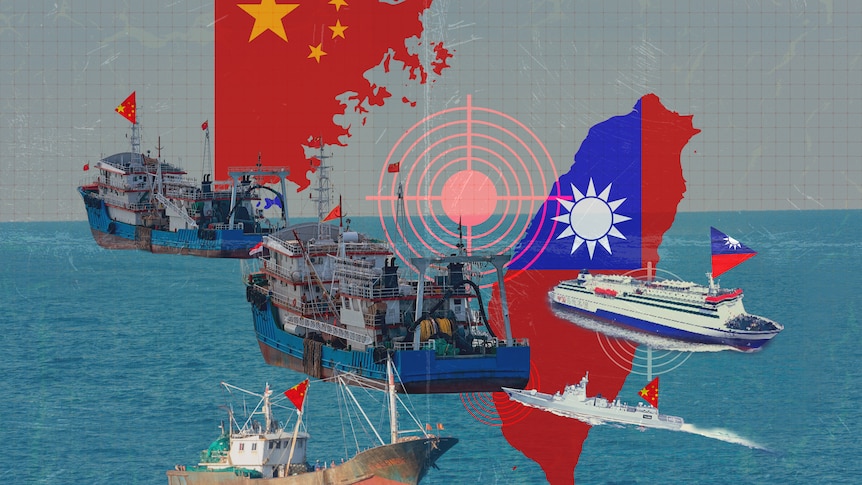

In December of the previous year, a remarkable assembly of 2,000 Chinese fishing vessels formed an extended, winding line north of Taiwan. Unlike typical fishing operations characterized by erratic movements, these boats maintained a relatively fixed arrangement.
A similar gathering took place in January, involving over 1,200 vessels. Analysts and intelligence experts informed ABC News that these activities represent a significant indication of China utilizing its commercial shipping capabilities for strategic purposes.
Thomas Shugart, a former officer in the US Navy and a senior fellow at the Center for a New American Security, noted that such coordinated formations are unprecedented. He emphasized that deploying hundreds or even thousands of vessels in a synchronized manner can create obstacles, congestion, and confusion without the need to formally declare a blockade. This approach illustrates a broader strategy in which Beijing is using a “shadow fleet” to exert pressure on Taiwan.
While the prospect of a conflict over Taiwan often evokes images of missiles, fighter jets, and warships, increasing research indicates that China’s preparations may be more conventional, involving fishing boats, car ferries, and commercial barges. Isaac Kardon, a senior fellow specializing in China studies at the Carnegie Endowment for International Peace, remarked that this development highlights how China’s commercial maritime sector is enhancing its capabilities concerning Taiwan. He described the situation as one of sheer mass.
Satellite monitoring data has revealed that large clusters of Chinese fishing vessels have been forming dense lines in parts of the East China Sea between December 2025 and January 2026. A leaked Pentagon report from last year expressed concerns that China was bolstering its commercial ferry fleet in anticipation of a potential invasion of Taiwan. US intelligence agencies discovered that Chinese leader Xi Jinping had instructed the military to be ready for such an eventuality by 2027.
China views Taiwan as an essential part of its territory, while Taiwan regards itself as an independent nation. ABC News reached out to various Chinese maritime experts, researchers, and representatives from the Ministry of Foreign Affairs, but did not receive any responses. In a previous interview with ABC News, Professor Hu Bo, a maritime expert, stated that it is “common sense” that China is preparing for a potential crisis regarding Taiwan. However, he added that preparation does not equate to immediate action.
The Chinese fishing fleet, recognized by the UN Food and Agriculture Organization as the largest in the world, has been partially categorized by Pentagon assessments as part of the People’s Armed Forces Maritime Militia—a state-controlled reserve force that can be mobilized for strategic missions. Moreover, the Pentagon has described how China incorporates civilian maritime resources into its large-scale military planning.
Some commercial vessels have had to adjust their routes to navigate around these formations. Shugart pointed out that such arrangements could significantly hinder maritime traffic around Taiwan, potentially preventing other navies from providing assistance. He noted that there is no need to sink ships; merely forcing traffic to slow down, reroute, or operate under uncertain conditions can apply both economic and psychological pressure.
For Australia, which relies heavily on open sea routes for its trade with North Asia, the implications of these tactics are significant. In 2024, over 60 percent of Australia’s export shipping was affected. Gregory Polling, director of the Asia Maritime Transparency Initiative, stated that dismissing these developments or accusing those who highlight them of overreacting overlooks the reality acknowledged by Chinese leadership. He emphasized the importance of recognizing China’s repeated signals that it intends to employ ‘civil-military fusion’ as a tactical advantage in any conflict.
Dr. Kardon, a maritime security expert focusing on China’s naval and maritime evolution, explained that this ambiguity is a central aspect of Beijing’s strategy. He asserted that these vessels are not merely engaged in fishing; they are part of a larger framework in which the state can mobilize commercial assets to achieve national strategic goals. This system allows China to operate below the threshold of armed conflict while effectively reshaping the maritime landscape—an approach referred to as grey zone warfare.
In addition to fishing vessels, analysts argue that China’s roll-on/roll-off (Ro-Ro) ferries represent preparations for potential military action. These large commercial ships, designed to transport trucks, buses, and cars, can be rapidly mobilized to support military operations as needed under local regulations. Open-source imagery has revealed armored vehicles and military trucks being loaded onto commercial ferries during exercises, with analysts noting that these drills included practices of unloading onto temporary platforms—skills pertinent to amphibious operations.
Shugart indicated that while these ferries are not specifically designed as warships, their considerable numbers are significant. He explained that dedicated amphibious ships are limited in number, but access to a large civilian ferry fleet dramatically increases logistical capabilities.
Moreover, recent satellite imagery and analyses have identified the emergence of specialized landing barges that, while appearing civilian, possess clear military applications. Naval analysts studying imagery from 2024 and 2025 have pinpointed barges outfitted with extendable features that enhance their utility for amphibious operations.