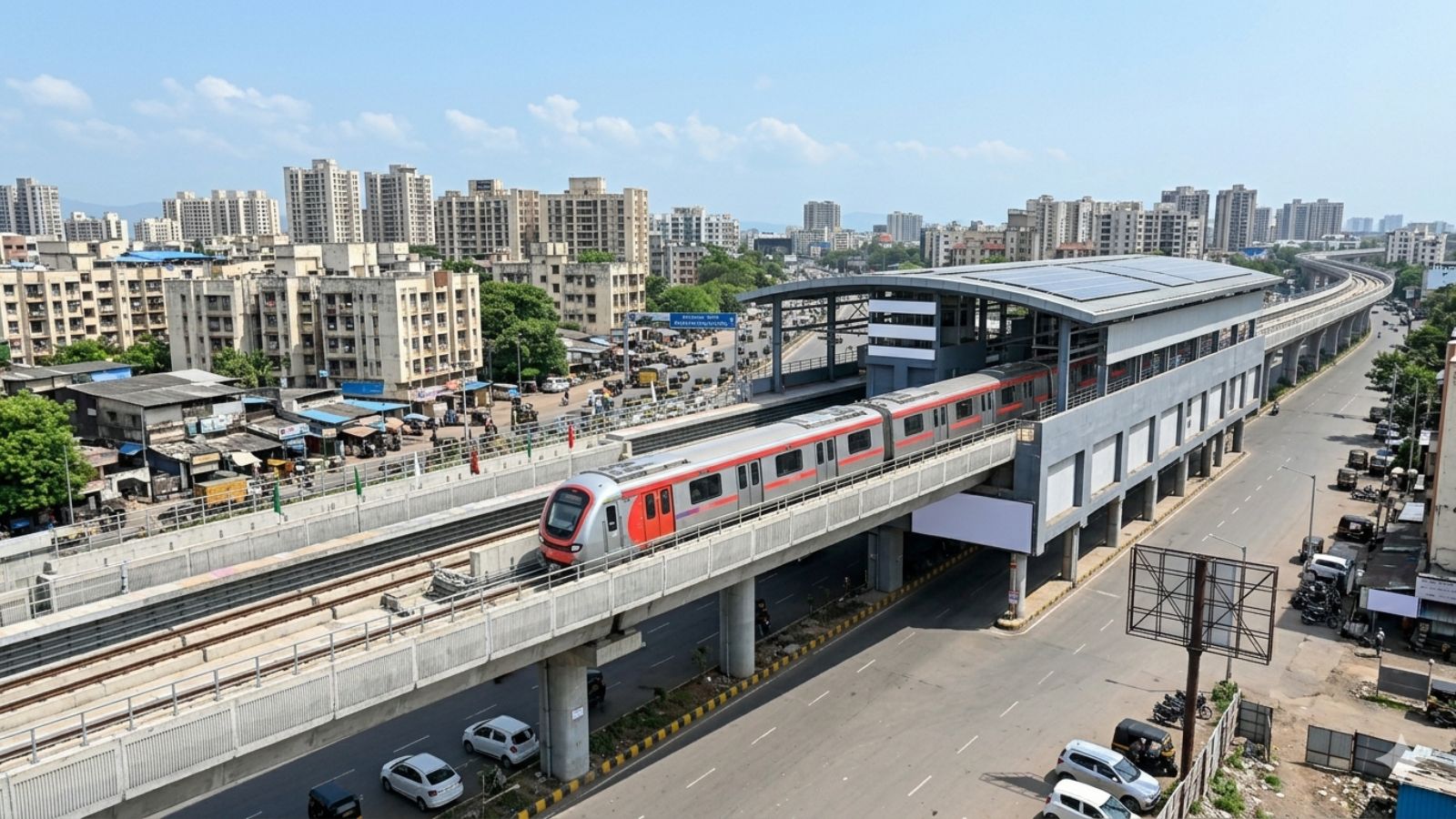

After several years of delays, Mumbai has inaugurated two new Metro lines on Tuesday, providing Mira Bhayandar with its inaugural Metro service and contributing a fifth operational line to the city’s expanding urban rail system. Here’s what residents can anticipate.
The ceremony will commence at 10 am, led by Chief Minister Devendra Fadnavis alongside Deputy Chief Ministers Eknath Shinde and Sunetra Pawar at Dahisar. The inauguration includes four stations along Line 9, which stretches 4.5 km from Dahisar to Kashigaon on Mira Road, and five stations on Line 2B, covering 5.53 km from Diamond Garden in Chembur to Mandale.
In addition to the Metro openings, the day will mark the beginning of tunneling for the Thane-Borivali Twin Tunnel project, as well as a groundbreaking event for the pod taxi initiative at Bandra Kurla Complex.
Line 9 is particularly significant for the residents of Mira Bhayandar, who until now lacked any Metro connectivity. The four new stations—Dahisar, Pandhurang Wadi, Miragaon, and Kashigaon—run alongside the Western Express Highway, presenting a quicker and more economical option compared to the often congested Dahisar checknaka.
Commuters heading to and from Mira Road will enjoy seamless connectivity to Line 7, which operates between Dahisar East and Andheri East, without the need for transfers. At Dahisar, passengers can also switch to Line 2A for travel to Andheri West, while at Gundavali, there is an interchange available for Line 1. A future connection to Line 6 at JVLR is also in the works. Officials anticipate that between 50,000 and 100,000 individuals will utilize this line from its first day of operation.
The remaining four stations on Line 9 are projected to open within six months, with plans to extend the line further as Line 7A to the international airport, although this extension will not be completed before 2027.
On Tuesday, the five stations of Line 2B will also be inaugurated, making it the fifth metro line in Mumbai. The stations—Diamond Garden, Shivaji Chowk, BSNL Metro, Mankhurd, and Mandale—span 5.53 km through Chembur and into Mandale to the east.
Mankhurd is notable for being the only station with a direct interchange to the suburban railway network. The MMRDA is hopeful that the Chembur station, which connects with the monorail, will become operational again in the coming months.
Due to the limited extent and connectivity at this point, initial ridership figures are expected to grow gradually. A significant transformation is anticipated once the complete 23.643 km line, comprising 20 stations, is finished, which will connect Mankhurd through Chembur, Kurla, BKC, Bandra, Khar, all the way to Andheri West. This is scheduled for completion by 2027.
Upon its completion, Line 2B is projected to become one of the key east-west corridors in Mumbai’s metro system, featuring interchanges at BKC with Line 3, at DN Nagar with Line 1, and at Kurla with both the suburban railway and Line 4. The projected daily ridership for the entire line is estimated to reach 890,000, increasing to 1,050,000 by 2031. The total expenditure for this line is approximately Rs 10,986 crore.
For Line 9, the anticipated daily ridership across the entire corridor is expected to be around 1,112,000 by 2031, with a combined project cost of Rs 6,607 crore for both Lines 9 and 7A.
Sabah Virani serves as a journalist for The Indian Express in Mumbai, focusing on infrastructure, housing, and urban development issues. She highlights human experiences within the context of ongoing changes in the city.
Her expertise lies in monitoring infrastructure developments in Mumbai and the broader Mumbai Metropolitan Region (MMR), where she tracks the progress of various projects, including metros, bridges, and the bullet train. Sabah also closely follows the activities of the Mumbai Metropolitan Region Development Authority (MMRDA) and its initiatives.
In addition, she covers housing developments, particularly the operations of the Slum Rehabilitation Authority (SRA), and major redevelopment projects in Mumbai, such as the Dharavi Redevelopment Project and others.
Occasionally, she reports on environmental issues, biodiversity, waste management, and cultural topics.
Before her tenure at The Indian Express, Sabah reported on municipal and civic matters for Hindustan Times and covered various issues related to Mumbai for the online publication Citizen Matters. She also gained experience as an editorial assistant at FiftyTwo.in.
Stay informed with the latest news – Click here to follow us on Instagram.