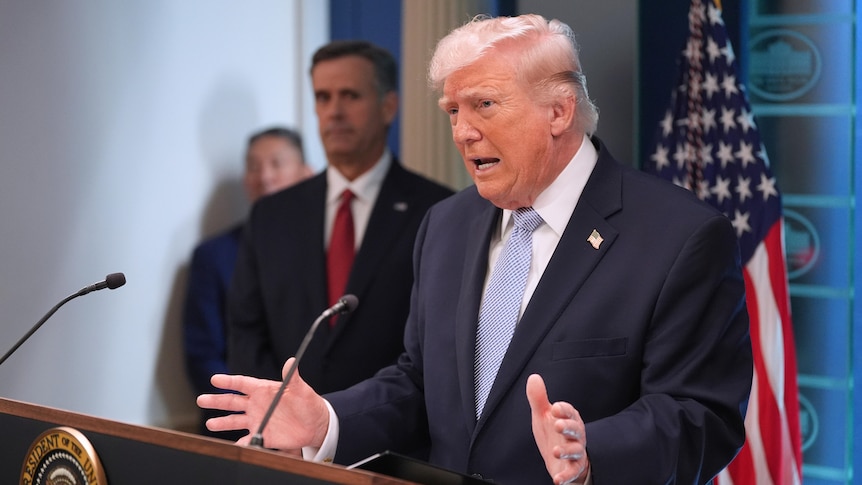

Donald Trump has issued a stark warning regarding Iran, stating that the civilian infrastructure of the country could face severe destruction if a diplomatic agreement is not achieved promptly. In a press conference held at the White House, he emphasized that any potential deal must include the reopening of the Strait of Hormuz.
Setting a deadline for negotiations, Trump indicated that a consensus must be reached by 8 p.m. Tuesday, Washington time, which aligns with 10 a.m. Wednesday in Australian Eastern Standard Time (AEST). He escalated his rhetoric by asserting that if an agreement is not established by the specified time, Iran would face significant military action.
During the extended press briefing, Trump reiterated his stance, suggesting that the United States possesses plans to target critical infrastructure in Iran, including bridges and power plants. He stated, “The entire country could be taken out in one night,” hinting that such an operation could occur swiftly. He also mentioned the possibility of assisting in the reconstruction of Iran if hostilities were to escalate.
In response to these threats, Iranian military spokesperson Ebrahim Zolfaghari cautioned that any attacks on civilian targets would lead to a more forceful and extensive retaliatory response from Iran.
Earlier in the day, Trump had acknowledged ongoing negotiations with Iran, noting that while Iran had submitted a proposal, it did not meet the expectations of the U.S. administration. The head of Iran’s diplomatic mission in Cairo, Mojtaba Ferdousi Pour, remarked that Iran demands guarantees against future attacks before agreeing to any cessation of hostilities.
In his remarks, Trump also criticized allied nations for not supporting the U.S. in the conflict, specifically naming Australia, Japan, and South Korea. He stressed the importance of ensuring the unobstructed flow of oil through the Strait of Hormuz, contrasting this with his previous statements suggesting that the matter was not a U.S. concern.
When questioned about the legality of targeting civilian infrastructure, Trump deflected the inquiry and instead criticized the media outlet posing the question. He claimed that the Iranian populace would be willing to endure hardships for the sake of freedom, asserting, “They want us to keep bombing.”
Earlier, at an Easter gathering, Trump expressed his desire to seize Iranian oil resources, while acknowledging public sentiment favoring a return of U.S. troops home. He stated, “If it were up to me, I’d take the oil,” underscoring a profit motive alongside a humanitarian approach towards the Iranian people.
Additionally, Trump used the press conference to discuss a recent rescue operation involving two air force personnel, one of whom had been missing in Iran after their fighter jet was downed. He recounted the risks taken to facilitate the rescue, highlighting the complexities involved, including the need for strategic deception to protect the mission’s integrity.
The rescue operation was extensive, utilizing a large number of aircraft, including bombers and refueling tankers. Trump noted the challenges posed by media coverage of the operation and expressed determination to identify individuals who leaked information about the mission. He acknowledged that some military personnel had reservations about the risky nature of the rescue.