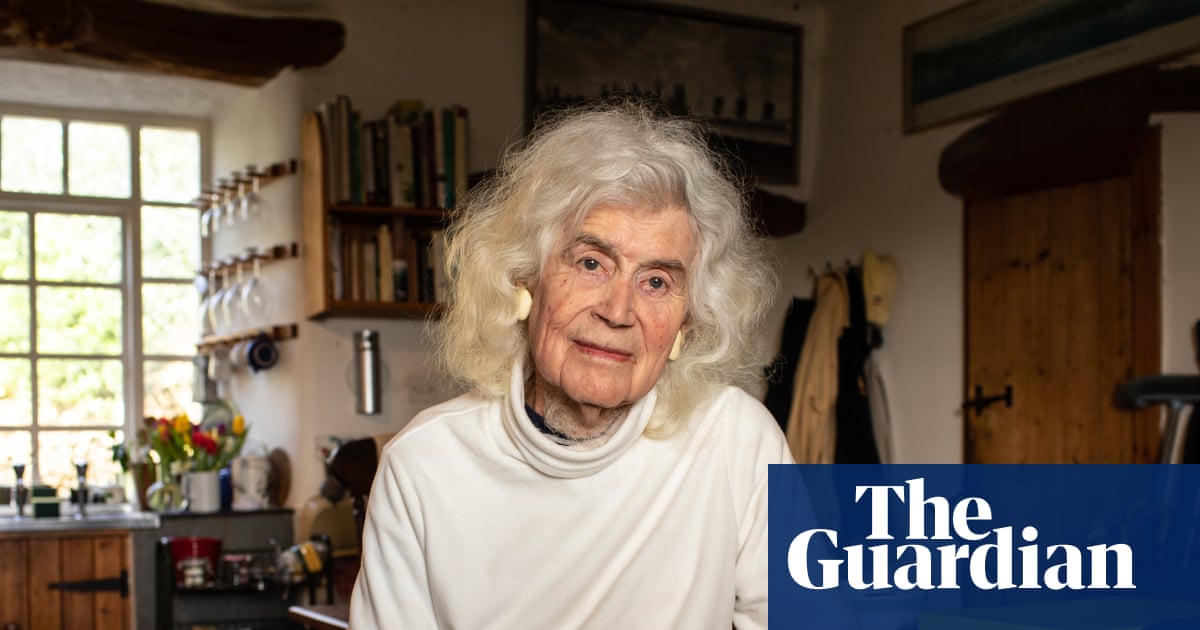

Jan Morris had two specific requests before she agreed to be painted for the National Portrait Gallery in London: her Norwegian forest cat, Ibsen, must be included, as well as one of her calves. The gallery obliged, resulting in a portrait capturing Morris, then just shy of 80 years old, dressed in a yellow sweater and dark green skirt, with Ibsen glaring beside her exposed legs. While she appreciated the artwork, Morris felt it could have been slightly larger.
How can one encapsulate the essence of Jan Morris? Simply labeling her as two-faced would not suffice. She was a compassionate historian of empire who evolved into a republican Welsh nationalist, despite accepting a CBE. With a prolific body of work comprising over 50 books that span travel writing, biographies, history, memoirs, and fiction, she was a dedicated writer who, as some of her works reveal, could also exhibit shocking laziness. Advocating for the “religion of kindness,” she nonetheless displayed cruelty towards her children.
“’Do you like her?’ is the query I encounter most frequently,” writes Sara Wheeler in this authorized biography. “But it’s not that simple. I am human. She was human too.”
Morris’s life appears incredibly rich and multifaceted. Born as James Morris in 1926, she initially navigated the world as a man, benefiting from the opportunities that came with it. During this time, he earned scholarships to prestigious schools and served in the army, enjoying desirable postwar assignments in Venice and Trieste. Following his military service, he attended Oxford and subsequently joined the Times, where he gained recognition as a prominent foreign correspondent.
His career soared during the 1953 Everest expedition, where he broke the news of the British team’s success while his wife, Elizabeth, gave birth back home. This moment brought him fame and a degree of financial success typical for a writer. He conducted interviews with notable figures like Che Guevara, witnessed the trial of Adolf Eichmann, and began producing popular and critically acclaimed works, including Coast to Coast, Coronation Everest, and Venice. He purchased a manor and sent his son to Eton. Over the following two decades, he transitioned from James to Jan.
Regardless of the name used, writing remained Morris’s primary identity. “It will make an excellent and entertaining memoir!” she noted to Elizabeth the day after undergoing vaginoplasty in a Casablanca clinic in the summer of 1972. That same month, she signed a contract with Faber for the memoir, receiving an advance of £10,000, equivalent to approximately £118,000 today.
The media reaction to her memoir, Conundrum, was predictable. Germaine Greer, writing in the Evening Standard, referred to Morris as “still a man” despite her transition. The New York Times even published a satirical piece about a woman becoming a horse, while the BBC offered a harsh critique. Nevertheless, friends supported her, letters from readers poured in, and the book continues to be read today.
As for the Morris marriage, Elizabeth, whose dementia had progressed significantly by the time Wheeler wrote this biography, remains an enigmatic figure. She raised five children, one of whom, Virginia, passed away in infancy, often managing their upbringing alone. Morris displayed selfishness and a domineering nature. When asked why Elizabeth remained, she responded, “Because I made a vow to God.” Despite this, their correspondence overflowed with declarations of love, although less so regarding their children. Suki, one of their daughters, remarked that Morris was a poor parent who caused damage to her surviving children.
Wheeler, like a skilled family therapist, provides space for the complexities of these relationships, mostly without casting judgment, though personal evaluations can be hard to avoid. Despite her unique life experiences, Morris ultimately emerges as a familiar figure: one who diligently responded to enthusiastic fans while avoiding family closeness; who concealed her fears of intimacy behind charm; and who used her literary talents to navigate uncomfortable truths. This biography is a sensitive, elegantly written, and expertly crafted portrayal of Morris, presenting a vast image that sometimes makes her seem rather small.
Jan Morris: A Life by Sara Wheeler is available from Faber for £25. To support the Guardian, you can order your copy from guardianbookshop.com, though delivery charges may apply.