
A cyclist arrives with a gas cylinder secured to his bike. I inquire about the price, and after some back-and-forth, we agree on 3,500 rupees, which is just over $50. This amount is nearly four times the official rate for gas.
After exchanging the money, he drags the cylinder closer before pedaling away. This brief transaction, lasting less than an hour, reflects just one of many similar deals occurring on the streets of Delhi amid the ongoing conflict involving Iran.
India imports approximately 60% of its liquefied petroleum gas (LPG), making it the second-largest importer globally. A significant portion of this gas is transported from the Middle East through the Strait of Hormuz, a crucial maritime route currently affected by tensions among the United States, Israel, and Iran.
Despite the circumstances, the Indian government firmly asserts that there is no issue with gas availability. In a statement released by the Ministry of Petroleum and Natural Gas in late March, officials emphasized that “India’s petroleum and LPG supply situation is fully secure and under control.” They urged the public not to fall victim to a coordinated misinformation campaign designed to induce unnecessary panic.
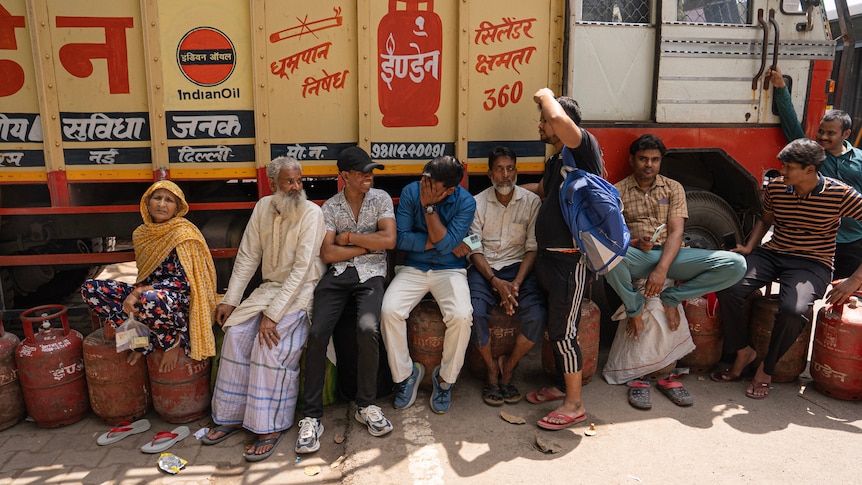
However, many residents are experiencing delays of days or even weeks for their scheduled gas deliveries. The ABC has observed that the same gas can quickly be procured through a thriving black market, accessible to those who can afford the inflated prices.
At a government gas depot in south-west Delhi, a crowd has been waiting since early morning, with little movement by noon. Rahul Kumar shares his frustration with the ABC, stating, “I’ve been here since 8 a.m. and we still don’t know if the systems are operational.”
As time ticks by, impatience grows. Riyasat Ali expresses his anger: “If it were up to me, I’d set this place on fire.”
To obtain a gas cylinder, consumers must present a Delivery Authentication Code (DAC)—a unique code sent to their phone when they book a cylinder, which is verified at the time of pickup. This measure is designed to ensure that deliveries reach the correct individuals and to prevent unauthorized transactions.
Officials attribute the long lines to individuals lacking these codes and to panic buying. “If your DAC has been issued, you will receive a cylinder,” assures depot worker Amrinder. Nonetheless, many waiting in line report having valid codes for days without receiving their gas.
Another customer, Komal, complains, “We come every day, and they just send us away, telling us we’ll receive some kind of number. It’s been 30 days now. They are torturing the public and they’re going to starve us to death.”
Alternative cooking methods include using induction stoves, which are costly due to high demand and depend on a stable electricity supply, or utilizing a clay oven fueled by firewood, which is inefficient, time-consuming, and sometimes hazardous.
Pooja, a 30-year-old resident of an informal settlement in south-west Delhi, highlights the struggle of her community to find cooking gas. “We have to go into the jungle for firewood, and I’m scared to go there alone. It’s really difficult,” she explains. “This has never been a problem since we started using gas, but now we’re helpless.”
The ABC conducted interviews with numerous individuals, all of whom insisted that there is no genuine gas shortage in India. Instead, many allege that supplies are being redirected to the black market.
According to police and industry insiders, this diversion typically follows a recognizable pattern. Cylinders designated for households are often siphoned from the official supply chain by distributors or delivery personnel. Gas can then be extracted from multiple cylinders using transfer pipes before being sold separately. In some cases, stock is deliberately hoarded to create an artificial scarcity, enabling sellers to charge significantly higher prices.
This underground system operates through informal networks, frequently utilizing small businesses such as stove repair shops, grocery stores, or private storage facilities. “If I ask them to provide one illegally, they’ll charge me 3,500 or even 5,000 rupees and deliver it immediately,” Komal mentions regarding government gas depot officials.
The regulated price for a 14.2-kilogram domestic LPG cylinder in New Delhi stands at 913 rupees, approximately $14. “We can’t afford it,” Komal laments, noting that her family’s monthly income is 12,000 rupees, with 4,000 rupees spent on rent. “If we buy from the black market, what will we eat? They’ve turned our lives into a spectacle of suffering.”
While officials maintain that supply remains stable, the delays in accessing gas seem to be pushing some consumers toward informal markets, where gas is available more promptly—but at considerably higher prices. The ABC attempted to acquire a gas cylinder outside the official system to investigate these claims.
After contacting several suppliers, one informed us, “There is none available.” We approached a street vendor with a truck full of cylinders, who reiterated, “Without a code, you can’t get one.” Following several dead ends, we visited another government depot, where a man eventually approached us, offering to arrange a cylinder without requiring a DAC—once the price was settled, he moved on to his next delivery.
The ABC has submitted detailed inquiries to the Delhi Police regarding the illegal gas trade, seeking clarification on the situation.