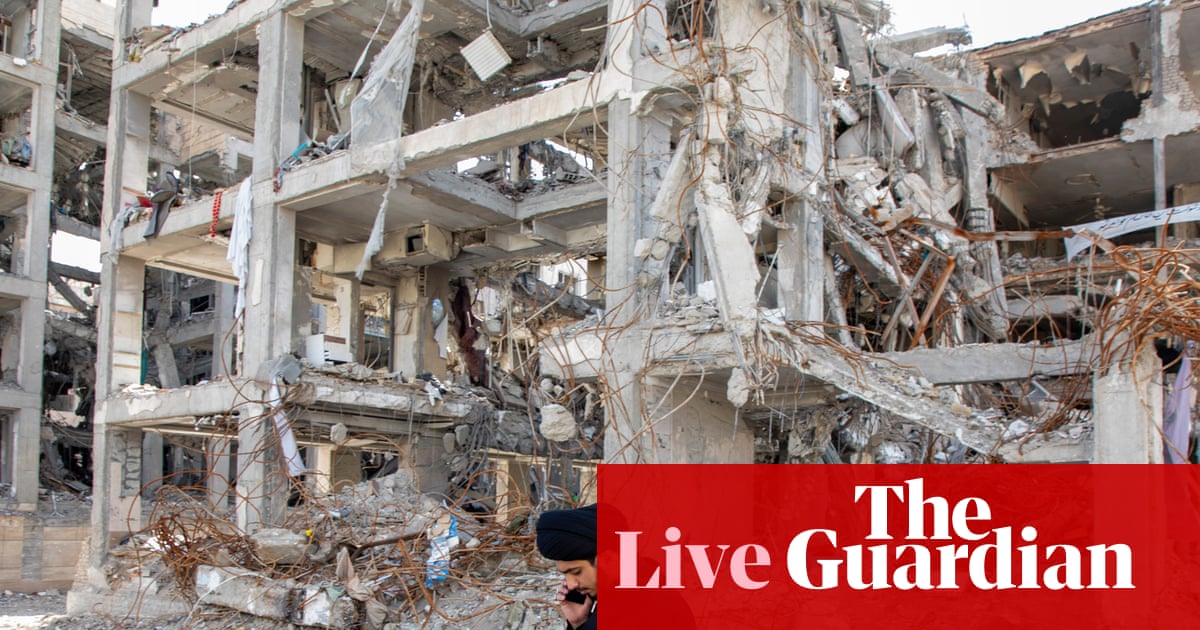

Welcome to our ongoing live coverage of the conflict between the US, Israel, and Iran, along with its ramifications for the region, global relations, and the world economy.
Former President Donald Trump expressed he was “not at all” worried about facing potential war crimes as he reiterated threats to obliterate Iran’s bridges and power plants if Tehran fails to comply with his deadline of 8 p.m. ET on Tuesday to reopen the Strait of Hormuz.
“I have no concerns about it,” Trump stated. “What constitutes a war crime? Possessing a nuclear weapon.” During a press briefing at the White House, he avoided clarifying whether civilian targets would be spared. Iran dismissed a proposal for a 45-day ceasefire earlier on Monday, insisting instead on a definitive cessation of hostilities.
“We will only accept an end to the conflict if we receive assurances that we will not be attacked again,” said Mojtaba Ferdousi Pour, the head of Iran’s diplomatic mission in Cairo, in comments to the Associated Press.
At the same press conference, Trump claimed that Iran could be “completely taken out” in a single night, suggesting that could happen as early as Tuesday. He threatened that if no agreement was reached with Tehran, “every bridge in Iran will be obliterated” by midnight ET (0400 GMT) on Wednesday, and that “every power plant in Iran will be destroyed, burning, exploding, and permanently rendered useless.”
On Monday, the US and Israel conducted a series of attacks on Iran, resulting in the deaths of over 25 individuals. In retaliation, Iran launched missiles targeting Israel and its Gulf Arab allies.
In other significant developments: the UN Security Council is anticipated to vote on a resolution aimed at safeguarding commercial shipping in the Strait of Hormuz; however, the measure has been considerably weakened due to opposition from China regarding the use of force, according to diplomatic sources cited by Reuters.
The Israeli Defense Forces announced early Tuesday that they had completed a “wave of airstrikes” focused on damaging Iranian infrastructure in Tehran and other regions of Iran. Shortly thereafter, they reported missile fire from Iran targeting Israel, which prompted the activation of defense systems to intercept the threats.
Additionally, the Israeli military confirmed strikes on three airports in Tehran, targeting Iranian aircraft and helicopters.
The World Health Organization (WHO) halted medical evacuations from Gaza to Egypt via the Rafah crossing following the death of a WHO contractor in Gaza on Monday. Separately, an Israeli airstrike resulted in the deaths of at least 10 individuals near a school sheltering displaced Palestinians in central Gaza, according to health officials. Reports indicated that some Palestinians had engaged in confrontations with members of an Israeli-supported militia who allegedly attacked the school.
Oil prices surged again on Tuesday amid Trump’s intensified threats against Iran. The head of the International Monetary Fund (IMF) warned that the ongoing conflict would contribute to “increased inflation and slower global growth.”
The president of the International Committee of the Red Cross emphasized that “intentional threats against critical civilian infrastructure and nuclear facilities must not become the standard in warfare.” Mirjana Spoljaric remarked, without naming any specific country or leader, that “any conflict waged without limits is incompatible with legal standards.”
Israel reported that it targeted Iran’s largest petrochemical facility on Monday, with Prime Minister Benjamin Netanyahu claiming the site had been “destroyed” as the country systematically dismantles the financial operations of the Revolutionary Guards.
Furthermore, the Iranian Revolutionary Guards confirmed the death of Maj Gen Majid Khademi, its intelligence chief, in US-Israeli strikes early Monday.
In Saudi Arabia, authorities intercepted seven ballistic missiles aimed at its eastern region, with debris landing near energy facilities, the defense ministry stated on Tuesday.
In Iraq’s northern Kurdistan region, two explosions were reportedly heard near the Erbil airport, which hosts advisers from the US-led coalition against terrorism, according to an Agence France-Presse journalist.
Malaysia’s foreign ministry announced that one of seven Malaysian commercial vessels trapped in the Strait of Hormuz has been permitted to pass and is now en route to its destination. This development followed diplomatic discussions with Iranian officials led by Malaysian Prime Minister Anwar Ibrahim, although further details were not disclosed.
Malaysia reiterated its commitment to ensuring safe and open maritime routes in accordance with international law and called for ongoing dialogue to foster peace and stability in the area.
Iran has officially rejected a proposed ceasefire agreement, as state media confirmed that diplomatic efforts seem to be stalling just a day before Trump’s deadline, in which he has threatened to target Iran’s infrastructure.
According to the Iranian news agency Irna, Iran communicated its response to Pakistan concerning the US proposal for ending the conflict, although the details of the American offer remain undisclosed.
Several nations have been engaged in mediation efforts to bring an end to the ongoing hostilities, which have persisted for over five weeks following US-Israeli strikes on Iran.
Irna reported that Iran’s response, outlined in ten points, has rejected the ceasefire while emphasizing the necessity for a conclusive resolution to the conflict. The agency also noted that Tehran’s demands included “an end to regional conflicts, protocols for safe passage through the Strait of Hormuz, reconstruction efforts, and the lifting of sanctions.”
The New York Times, citing unnamed senior Iranian officials, indicated that Tehran seeks guarantees against future attacks and an end to Israeli strikes on its ally Hezbollah in southern Lebanon.
On Tuesday, oil prices rose further while stock markets showed mixed results as investors evaluated Trump’s latest ultimatum for Iran to reopen the vital Strait of Hormuz or face severe consequences.
The US president cautioned that if Tehran does not facilitate the passage of vessels, its civilian infrastructure would be subjected to destruction.