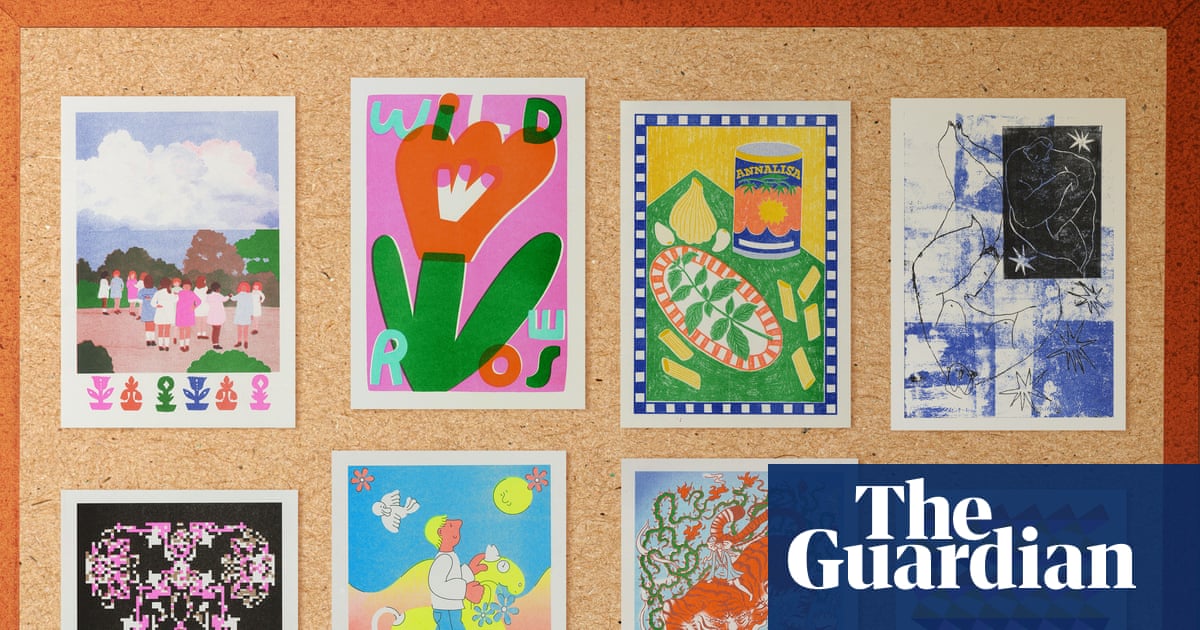

Gabriella Marcella experienced a pivotal moment when she first operated a risograph printer. The Scottish-Italian designer remarked, “The process and immediacy really struck a chord with me,” adding that much of her artistic style is influenced by this particular machine. This sentiment is shared by many artists, and now Marcella has organized an exhibition that highlights international artworks at the Glue Factory Galleries in Glasgow.
The risograph, which originated in Japan during the 1980s, resembles a photocopier but functions similarly to a screen printer. The device was developed by Riso Kagaku, a company founded by Noboru Hayama, who aimed to create user-friendly and affordable printing solutions. Utilizing soy-based inks, the risograph is known for producing small batches of prints that have a handcrafted appearance and unique character, making it a popular choice among zine creators, activists, and independent artists.
“I purchased my first risograph on eBay for around £200,” Marcella recounted. “Once I won the auction, my father drove me to the seller’s home, where I picked it up from an elderly couple who used it to print football magazines for their grandchildren.”
Marcella’s passion for the risograph blossomed during her studies at Pratt Institute in New York, after which she returned to Glasgow to establish her design studio, Studio Risotto, in 2012. The vibrant colors and striking forms typical of risograph prints have become hallmarks of her work, attracting clients such as Stüssy, Apple, and Swatch, in addition to her own creative projects.
In 2017, she launched Riso Club, a non-profit initiative aimed at promoting artists worldwide, particularly those who specialize in risograph printing. “I have always wanted to spotlight creators outside major cities like London and New York, where talented illustrators continue to thrive. There exists a niche yet global community of riso artists that I have come to know over the years, and I wanted to showcase their work,” she explained.
Members of the club pay an annual fee to receive a set of four postcards monthly, each featuring artwork from different riso artists around the globe. This includes contributions from cities such as Lille and Lima. Marcella emphasized the significance of physical postcards, stating, “Tangible items have a different impact. A postcard arriving in the mail has a certain weight, texture, and intimacy that digital messages lack—particularly in an age dominated by social media, where stunning images can easily be overlooked.”
Moreover, postcards serve as an accessible means for individuals to explore various cultures. “This approach allows for a discovery of places through the lens of artists, rather than through clichéd tourism,” Marcella noted. “Additionally, certain cities carry more political or diasporic significance for artists and club members, as is the case with Kyiv and Damascus.”
Marcella believes this aligns with the historical context of risograph printing. “The risograph has its roots in political printing—many older machines were utilized by political parties or educational institutions—as it served as a quick and economical way to disseminate ideas and information.”
Designer Mari Kinovych curated the Kyiv edition of Riso Club, which functioned as a fundraiser for the charity Razom for Ukraine. She aimed to depict Kyiv as a lively city while acknowledging the harsh realities of wartime. “I selected a piece by Anna Gavryliuk that juxtaposes tank traps with flowers to convey this duality. My own contribution reflects the deep feelings of love, acceptance, and care that emerged within the community during the second year of the war. I have never sensed such a strong community spirit and wanted to capture that essence,” she stated.
Kinda Ghannoum, who curated the Damascus issue, sought to present Syria in a manner distinct from its often negative media portrayal. “Each artist provided a personal insight into the city, reflecting the nostalgia many of us hold while living abroad. The outcome surpassed my expectations, and I felt honored that we could collectively express the spirit of Damascus in such a heartfelt way,” she shared.
To commemorate the release of the 100th issue of Riso Club, Marcella compiled a special edition featuring her design inspirations: Nathalie Du Pasquier, founder of the Memphis Group; artist Peter Shire; and architect Barbara Stauffacher Solomon. All 400 postcards from the collection will be exhibited in Glasgow, aiming to introduce more people to the joys of risograph printing. “I hope visitors recognize that design can be generous, approachable, and communal, and that print continues to forge meaningful connections in our daily lives,” Marcella concluded.
The Riso Club 100 exhibition will be held at the Glue Factory Galleries in Glasgow from April 11 to April 19. For more details, visit risottostudio.com.