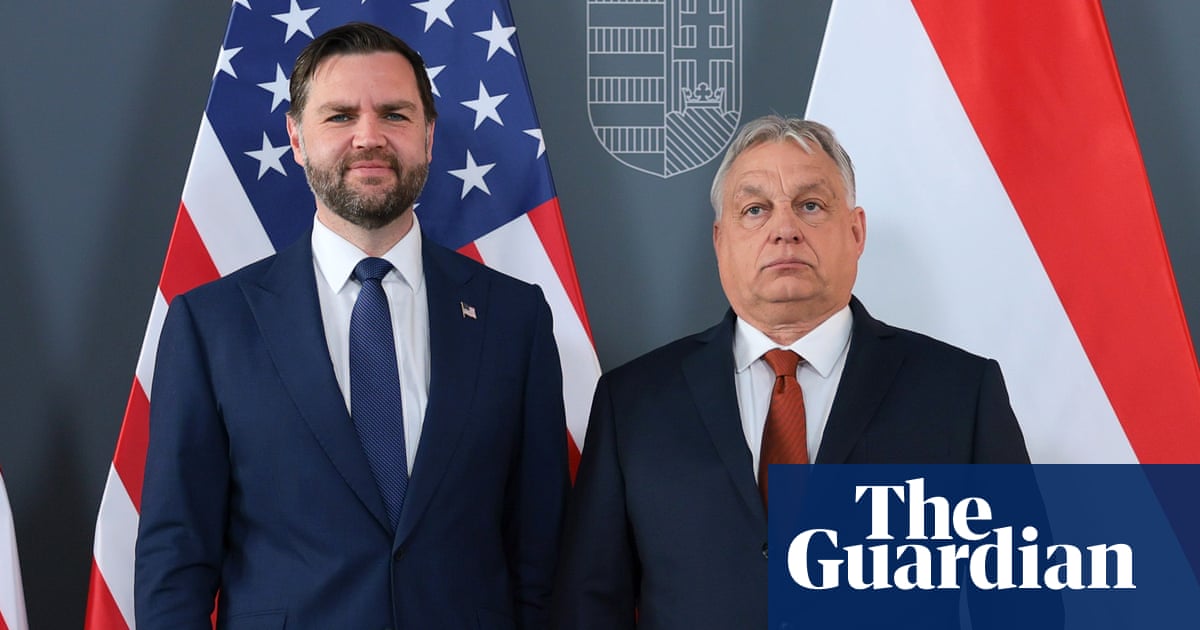

JD Vance has strongly criticized the European Union, accusing it of overt interference in Hungary’s upcoming elections, despite the U.S. Vice President stating that his visit to Budapest was aimed at supporting Viktor Orbán in the upcoming vote on Sunday.
Upon arriving in Budapest on Tuesday, Vance adopted a confrontational stance, claiming that the EU’s actions represented “one of the worst instances of foreign election interference” he had encountered. He asserted, “The bureaucrats in Brussels have attempted to undermine Hungary’s economy,” and pointed to Orbán, saying, “They have sought to diminish Hungary’s energy independence and inflate costs for consumers, all because of their disdain for this leader.”
Vance was candid about his purpose for visiting Hungary just days before a critical election, where Orbán faces the possibility of losing power after 16 years. He stated, “Naturally, I want to assist the Prime Minister in any way I can during this election period.”
This Sunday, Hungarian citizens will participate in a significant parliamentary election, with Orbán facing a notable challenge from Péter Magyar, a former senior member of the ruling Fidesz party.
The election represents a clash of visions for Hungary’s future, as Orbán and Fidesz aim to convince voters that the ongoing war in Ukraine poses a serious threat to the nation, and that Orbán is best equipped to manage this challenge. In contrast, Magyar and his Tisza party are urging voters to prioritize pressing domestic issues such as economic stagnation, deteriorating social services, and corruption.
During the press event on Tuesday, Vance aligned himself with Orbán’s narrative that Ukraine presents a significant threat to Hungary. He informed reporters of his awareness regarding Ukrainian intelligence efforts to influence U.S. elections, asserting, “This is simply their modus operandi,” while standing next to Orbán. He specifically mentioned “individuals within the Ukrainian system” who had campaigned alongside Democrats ahead of the 2024 U.S. presidential election.
Vance’s criticism of Brussels comes amid increasing scrutiny of Hungary’s connections with the Kremlin. Reports emerged on Tuesday alleging that Russian intelligence and disinformation networks were attempting to sway the election in Orbán’s favor. A transcript revealed that during an October call, Orbán told Vladimir Putin, “I am at your service.”
According to Bloomberg News, the transcript indicated that Orbán likened his relationship with Putin to that of a “mouse” ready to assist the Russian “lion” as needed. He reportedly expressed, “Yesterday our friendship reached such a level that I can help in any way,” and assured Putin, “In any matter where I can be of assistance, I am at your service.”
Orbán has consistently been the most pro-Moscow leader within the EU, maintaining Hungary’s significant dependency on Russian oil and gas. His foreign minister has allegedly kept his Russian counterpart informed about confidential EU discussions and has worked to tailor EU sanctions to favor Moscow.
On Tuesday, Vance commended Orbán as a “great example” in Europe regarding energy security and independence, seemingly acknowledging Hungary’s ongoing reliance on Russian energy imports. He criticized European leaders for making a “huge mistake” by cutting off oil and gas supplies from the east, noting that Hungary’s dependence on Russian imports has grown since the onset of the full-scale invasion of Ukraine, with Russia now accounting for 93% of Hungary’s crude oil imports compared to 61% in 2021.
In the transcript of the October call, Putin praised Hungary’s “independent and flexible” position regarding the war in Ukraine, expressing confusion about why such a balanced approach would provoke criticism. He stated, “It is incomprehensible to us that such a balanced, middle-ground position only generates counterarguments.”
Vance also recognized Hungary’s position on Ukraine, asserting, “Your leadership has been a far more constructive partner for peace than almost anyone else in the world,” as he addressed Orbán.
He characterized Orbán, whose “illiberal democracy” has led to declines in press freedom and accusations of corruption, as a key ally to Donald Trump in the defense of Western civilization.
When questioned about the potential for U.S. collaboration with a new Hungarian government should Orbán lose, Vance affirmed his willingness to work with anyone, but expressed confidence that Orbán would secure another term. “Viktor Orbán is going to win the next election in Hungary, so I feel very confident about that and our ongoing positive relationship,” he stated.
As Orbán and Fidesz face declining poll numbers, right-wing leaders from across the globe have rallied in support of him, elevating this election in Hungary, a nation of approximately 9.5 million people, to a stage of international significance as a symbol of the resilience of far-right movements.
On Tuesday, Magyar, whose Tisza party is currently leading in many polls, responded directly to Vance’s visit, stating on social media, “No foreign nation should interfere in Hungarian elections. This is our country. Hungarian history is not written in Washington, Moscow, or Brussels; it is written in the streets and squares of Hungary.”