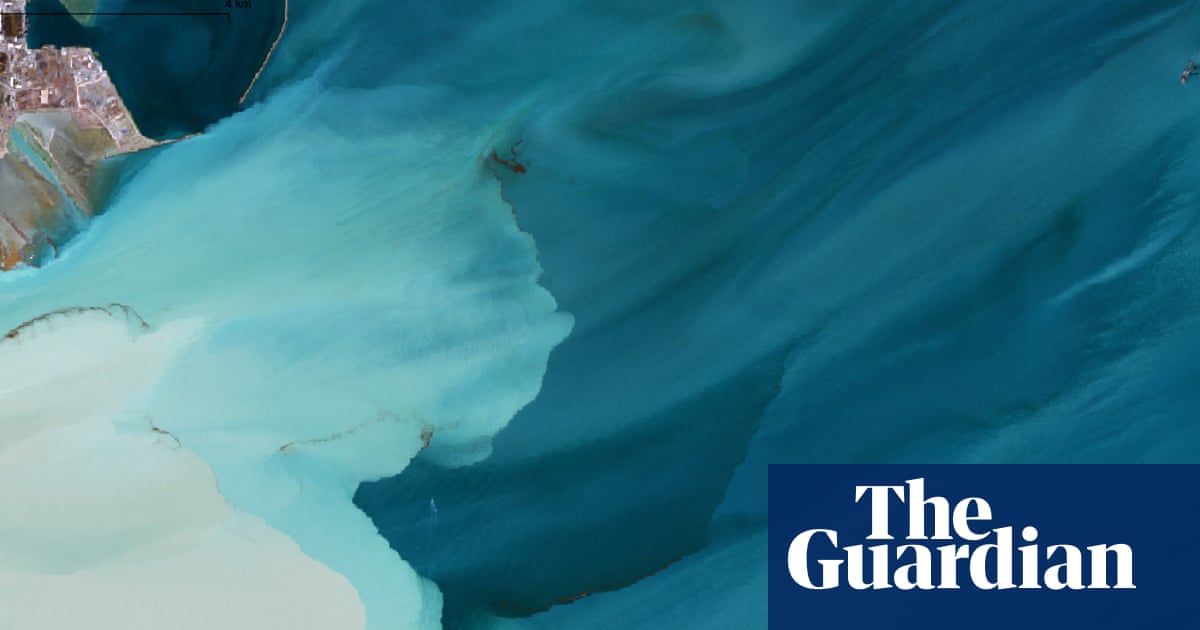

An oil spill from an Iranian vessel in distress poses a significant threat to one of the Middle East’s crucial wetland areas, as indicated by satellite imagery analysis. This incident is part of a series of oil spills that jeopardize the livelihoods of coastal communities in the Gulf region.
The vessel in question, the Shahid Bagheri, a drone carrier, started leaking heavy fuel oil in Iranian waters close to the Strait of Hormuz after being struck by a US military aircraft during the initial days of the US-Israel offensive against Iran.
With ongoing military operations affecting Iran, cleanup efforts have yet to commence, allowing the oil to drift slowly towards the Hara biosphere reserve, which hosts the largest mangrove forest along the Gulf coast.
Characterized as “one of the most conceptually significant vessels” in Iran’s naval fleet, the Shahid Bagheri is a modified container ship equipped with a short runway for drone launches. The ship’s fuel capacity was reportedly substantial, with Iran’s Revolutionary Guards stating it had an operational range of 22,000 nautical miles and could go up to a year without refueling.
On March 6, the vessel was targeted and damaged by US airstrikes, as depicted in a video released on social media by the US military. Since the attack, it has been stranded in shallow waters within the Khuran strait, a narrow and ecologically vital channel between mainland Iran and Qeshm Island.
As of March 18, the oil slick had moved approximately 16 miles southwest towards Hara, according to Tim Richards, a retired satellite remote sensing expert who is monitoring the spill’s trajectory. He noted that this incident could be one of the most ecologically devastating to occur in the region since the first Gulf War.
The circular currents in the strait where the modified container ship is located have caused the oil to spread gradually. “The current flows into the Gulf from the Indian Ocean around the northern part of the strait,” Richards explained. “It then moves through the Khuran strait, where the vessel is situated and where the mangroves are located. Consequently, there is a general westward movement of the water, despite the tides fluctuating.”
On March 27, rainfall appeared to introduce sediment into the strait, which subsequently mixed with the oil. Richards observed that by March 28, the oil had potentially traveled an additional 20 kilometers, with the possibility that it might have moved even further due to the current’s speed and the influx of water from the recent rainfall.
The spill’s effects on the Hara ecosystem, which is crucial for migratory birds, critically endangered turtles, and various fish and crustacean species, could be profound. The local fishing communities rely heavily on the sea for their livelihoods.
This spill is among several significant incidents currently impacting the Gulf. At the onset of hostilities, the US sank several Iranian ships, while Iran retaliated by targeting container vessels and oil tankers with drones and missiles as part of its blockade of the Strait of Hormuz.
Environmental analyst Wim Zwijnenburg, who is maintaining a record of environmental damage resulting from the conflict, reported three small spills near the coasts of Iraq and Kuwait, along with another incident in the Strait of Hormuz from a sunken container ship. Additionally, a torpedo strike by the US on the Iranian navy ship Dena off the Sri Lankan coast resulted in another spill, which was subsequently addressed by local authorities.
Zwijnenburg cautioned that the environmental situation may deteriorate further. “If attacks on oil and chemical tankers continue, a catastrophe could eventually occur if something goes awry. In general, targeting oil and chemical vessels with missiles and drones poses a serious risk. Fortunately, the environment has so far avoided a disaster amidst these assaults,” he said.