
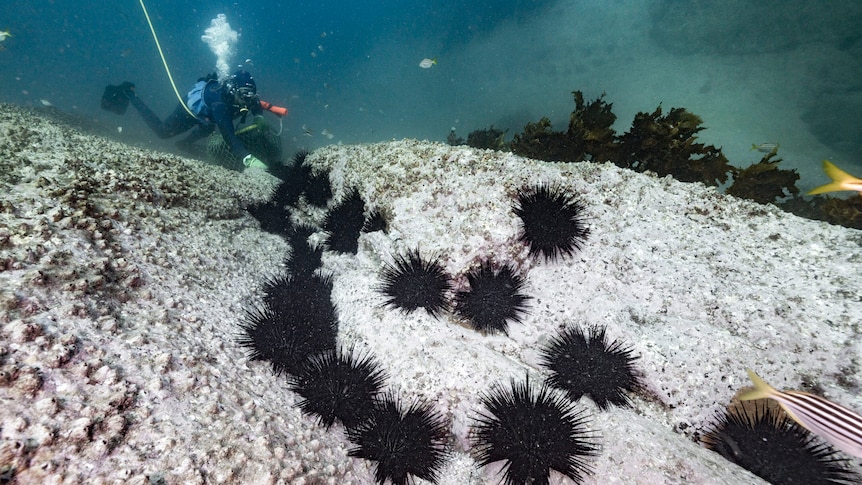

Warming ocean temperatures attributed to climate change are enabling sea urchins to migrate southward from New South Wales, posing a significant threat to reef ecosystems in Victoria and Tasmania.
A recent Senate inquiry has released a 2023 report advocating for a $55 million investment to combat this ecological crisis. However, while the federal government has recognized the issue in its response, it has not allocated any new funding for the proposed measures.
Long-spined sea urchins, known scientifically as Centrostephanus rodgersii, are indigenous to New South Wales. Over recent decades, rising ocean temperatures have contributed to a dramatic increase in their population, with estimates suggesting hundreds of millions have dispersed along the coastlines of Victoria and Tasmania through ocean currents.
These invasive sea urchins are notorious for their aggressive competition for resources, leading to the depletion of kelp forests and the transformation of vibrant reef ecosystems into barren landscapes devoid of marine life.
The Senate inquiry has urged for immediate funding of $55 million over five years to tackle the issue effectively. However, nearly two and a half years later, the chair of the inquiry, Greens senator Peter Whish-Wilson, remains impatiently awaiting significant governmental action.
Whish-Wilson highlighted the gravity of the situation by drawing parallels to a hypothetical scenario where a highly biodiverse forest, crucial for local economies and ecosystems, vanished without consequence. “If such a forest disappeared, there would be public outrage. Unfortunately, when it happens in our oceans, it often goes unnoticed,” he stated.
The inquiry proposed utilizing the recommended funds for reef restoration, the development of a commercial sea urchin fishery, and support for Indigenous communities. However, the government’s response has garnered criticism.
Last week, the federal government subtly presented its response, acknowledging that climate change-induced warming waters pose new threats to marine life. This includes the ongoing algal blooms in South Australia and the increasing range where sea urchins can thrive.
Out of the four recommendations made by the inquiry, the government endorsed only one: collaborating with states to harness the benefits of a developing sea urchin fishery. The other suggestions, which included forming a new advisory group and leveraging the existing national task force for coordinated funding, were not supported. No new financial resources have been allocated, as the government has opted not to endorse an immediate national investment to manage the sea urchin issue.
In its response, the federal government claimed to have already made substantial investments in sea urchin research and related business initiatives, citing over $12 million directed toward various projects aimed at bolstering temperate marine ecosystems, including kelp forest monitoring and restoration efforts.
Senator Whish-Wilson acknowledged some positive elements in the government’s response, such as the continuation of a national task force. However, he emphasized that the absence of new funding would allow the destructive spread of sea urchins to persist. “This administration fails to recognize the urgency of addressing this invasive marine species, which is wreaking havoc on our communities from New South Wales to Tasmania,” he remarked. “This policy appears robust, yet the political will is lacking.”
Marine ecologist Stefan Andrews, co-founder of the Great Southern Reef Foundation, emphasized that controlling sea urchins could yield environmental benefits while also creating economic opportunities for local communities. The report indicated that sea urchin roe, a sought-after delicacy, can command prices ranging from $200 to $400 per kilogram in domestic markets.
“Investing a few million dollars per processor could spark a more sustainable industry, enabling them to scale up operations and remove more urchins from critical reef areas,” Andrews stated. “While it’s encouraging that the government has recognized the crisis, we urgently need them to invest in solutions.”
Wally Stewart, an elder from Walbunja, has witnessed the detrimental effects of the unchecked sea urchin population on the far south coast of New South Wales. “If the government fails to invest now, we may lose the chance to rectify this issue entirely,” he warned. “The most severe damage is occurring right in our territories.”
The federal government has acknowledged that engaging First Nations communities can provide valuable insights to enhance environmental outcomes and foster partnerships. However, Stewart, who is also a founding member of the Joonga Land and Water Aboriginal Corporation, stressed that direct funding for Indigenous-led organizations is essential to effectively tackle the problem. “We have a narrow window to address this crisis, yet the government continues to turn a blind eye,” he said. “What more research is necessary when the evidence is clear and we are ready to take action?”