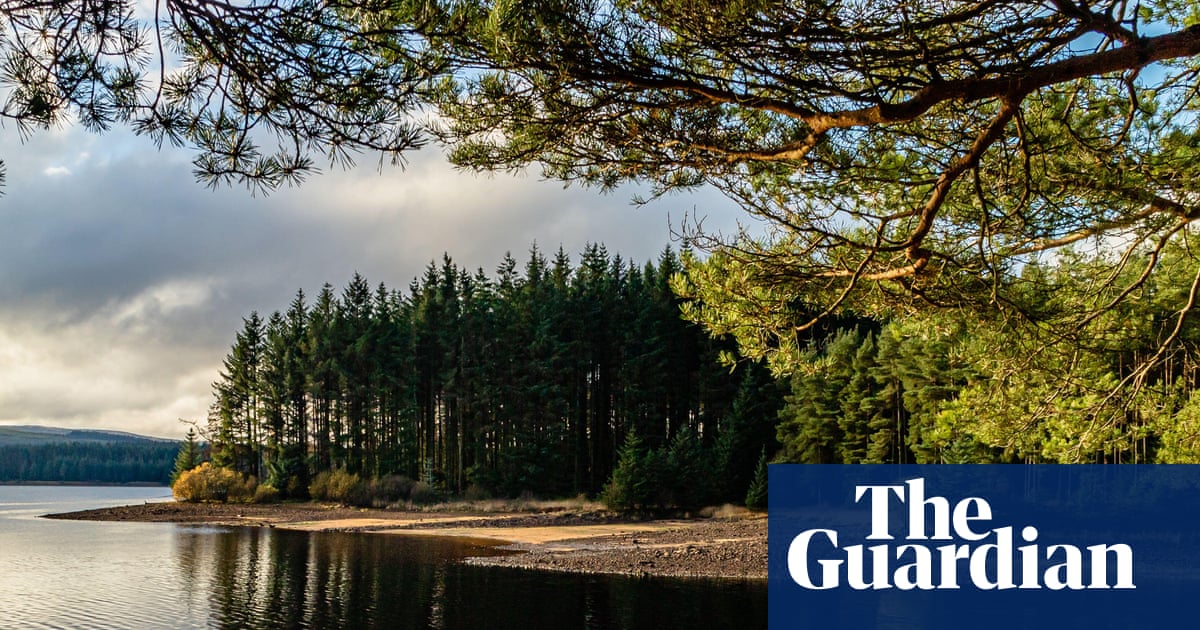

Nestled within the expansive Kielder Forest, on the northern shore of the extensive Kielder Water, stands Silvas Capitalis—a monumental, two-story wooden sculpture that captivates visitors with its striking presence. Its mouth is agape as if in awe of its surroundings. During my initial visit to Kielder, I found myself mirroring the sculpture’s stunned expression, overwhelmed by the grandeur of the landscapes that unfolded as soon as I stepped out of my vehicle by the lakeside.
Kielder presents a different landscape than one might typically associate with England. Covering an area of 250 square miles (648 square kilometers) and home to approximately 158 million trees—primarily hand-planted Sitka spruce—this region conveys a sense of expansive wilderness reminiscent of Finland or Canada. Although it is a managed forest, the area retains a raw natural beauty. It serves as a working forest, providing around 500 full-time positions outside of tourism, and 2026 will mark the 100th anniversary of the initial tree plantings, a response to the timber shortages following World War I.
The barren moorland surrounding Kielder Castle was identified as a prime location for forestry development by Roy Robinson, a key figure in establishing the Forestry Commission in 1919. “He was a visionary,” remarks Alex MacLennan, who has been part of the Kielder team for over two decades. “It was challenging farmland, but ideal for forestry purposes. Initially, plans included eight villages to accommodate timber workers. However, by the time the first trees were ready for harvest three decades later, advancements in mechanization and tools such as chainsaws meant only three villages were necessary.”
This historical context has resulted in minimal development within the forest. The primary tourist hub is Kielder Waterside, featuring 50 discreet lodges nestled among the trees. Some lodges suffered damage during Storm Arwen five years ago, which felled a million trees across the forest and the greater Northumberland National Park. “The storm altered the atmosphere of the area,” explains Gary Storey, general manager of Kielder Waterside, “and it has provided an opportunity to replant with a variety of species native to the UK, such as silver birch, oak, aspen, and wild cherry, moving beyond the Sitka spruce.”
The meticulous stewardship of Kielder has set a standard for forestry practices across the UK, particularly for sustainable tourism integrated into the landscape. Beyond Kielder Waterside, there are a few accommodations available, including Calvert Kielder, which not only offers self-catering lodges but specializes in respite care breaks that incorporate accessible, forest-based activities. Additionally, there are remote locations equipped with facilities for camper vans at a rate of £15 per night, along with a campsite offering pitches for two at £20. “We’re not Center Parcs, and we don’t aspire to be,” states Liz Blair, director of the Kielder Partnership, during our coffee discussion. “Our goal is to ensure that the forest is accessible and welcoming to everyone, regardless of how they choose to experience it.”
Many visitors, myself included, embark on the Lakeside Way—a 26-mile (42-kilometer) path that encircles Kielder Water, connecting various sculptural installations while immersing walkers and cyclists in the lush forest environment. During my visit, the profound silence enveloping the trees felt palpable, occasionally interrupted by the distant drumming of a woodpecker seeking a mate.
While Kielder is tranquil by day, it transforms into an almost surreal setting at night; a deep darkness devoid of most signs of life, save for the twinkling stars that grace England’s first dark sky park—the Northumberland International Dark Sky Park. As we drove to the observatory, I was grateful for my sister Caroline’s company, as her lively conversation helped ease the tension of navigating the two-mile off-road trail deeper into the hushed forest.
Our visit coincided with the Northumberland Dark Skies Festival, where we attended an engaging (if somewhat technical) presentation on exoplanets—celestial bodies beyond our solar system—before braving the frigid temperatures to reach the telescope room. Unfortunately, the clouds obscured our view, but the observatory remains a remarkable site, staffed by a blend of professional astronomers and enthusiastic volunteers.
Kielder is a region of superlatives: it boasts England’s largest forest, the UK’s biggest artificial lake by volume, and some of the darkest skies, alongside potentially the most challenging mountain biking trails in the nation. The Deadwater Double Black Downhill will officially open on May 1, featuring a rugged, precarious course that I would hesitate to traverse, let alone cycle. This is just one of several upcoming initiatives celebrating the centenary, including a new Room on the Broom trail for children based on the beloved book by Julia Donaldson and Axel Scheffler, a Kielder celebration weekend from September 4-6, and the anticipated reopening of Kielder Castle this summer after extensive renovations.
While Kielder Forest is expansive, it is merely one component of the Northumberland National Park, the least populated and least frequented among the UK’s 15 national parks. Transitioning from the densely populated southeast, I was struck by the extraordinary beauty of the unspoiled landscapes—an unparalleled tranquility that is a stark contrast to areas closer to home. The region’s historical significance is also impressive; we explored the remnants of the Roman fortress at Vindolanda, strolled along Hadrian’s Wall, and enjoyed a hearty lunch of Cumberland sausage, mustard mash, and rich onion gravy at the historic Twice Brewed Inn.
However, nothing compared to my exhilarating afternoon ascent to the summit of Deadwater Fell in Alex’s Forestry Commission vehicle. Standing at an elevation of 571 meters (1,900 feet) above sea level, the panoramic view was breathtaking, stretching from the Cheviot Hills in the northeast to the peaks of the western Lake District, with the snow-capped Pentland Hills rising in the distance toward Edinburgh like giant meringues. The sight was genuinely awe-inspiring, and I was relieved not to have to bike back down.