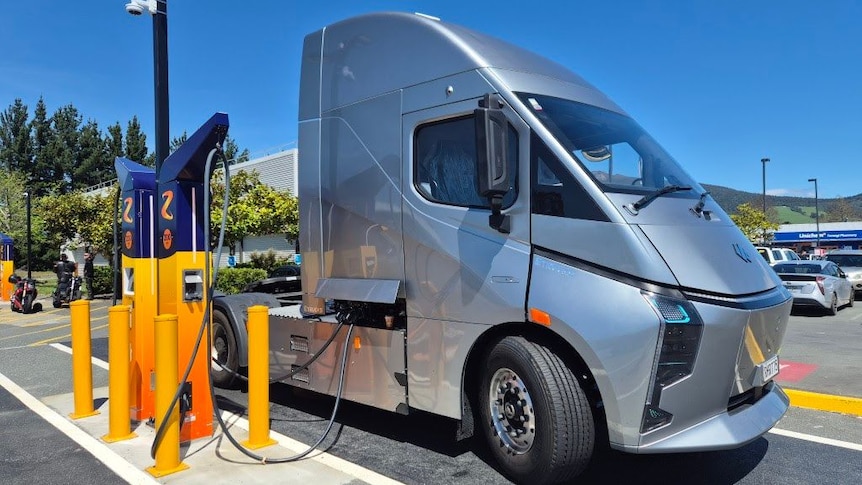

Electric trucks achieved a record sales month in March 2026, marking a notable shift in the market, although they still represent a minor share of overall truck sales. For the first time, electric models can be purchased at comparable upfront prices to their diesel counterparts, including for larger road trains.
There are emerging reports indicating a heightened interest in electric trucks as businesses aim to mitigate the risks associated with potential future increases in diesel prices. While diesel trucks currently remain essential to Australia’s supply chain, recent sales data suggests we may be witnessing a significant turning point for these traditional vehicles.
In March 2026, electric truck sales soared to 44 units, reflecting a remarkable increase of over 500 percent compared to the previous month. Although electric trucks still hold a minor position in a market largely dominated by diesel, they have achieved a milestone where, for the first time, they constituted more than one percent of new truck sales.
Additional indicators of change are emerging. A report by freight decarbonization consultants Mov3ment highlights that electric trucks are now available at price parity with diesel vehicles. This means that some electric trucks have similar initial purchase costs to diesel variants, combined with lower long-term expenses due to savings on fuel.
The range of electric trucks now includes smaller models suitable for grocery deliveries as well as heavy-duty prime movers capable of towing semi-trailers for up to 300 kilometers on a single charge. This landmark price parity has materialized years ahead of earlier forecasts.
Tim Washington, CEO of JET Charge, a company focused on developing truck charging stations, noted that numerous enterprise clients have expressed a desire to expedite their transition to electric trucks. He emphasized that this shift could signify the beginning of a rapid increase in truck sales.
The earlier-than-anticipated drop in prices for electric trucks is largely attributed to changes occurring in China, which are reshaping global energy demand. Over the past five years, electric truck sales in China surged from negligible numbers to over 230,000 by 2025, representing more than 25 percent of total truck sales. This transition is expected to significantly reduce the country’s oil consumption by over one million barrels per day.
The swift adoption of electric trucks in China is driven by falling battery prices, increased competition among manufacturers, substantial government incentives, and investment in charging infrastructure for heavy vehicles. Major highways have been transformed into “supercharging corridors,” featuring ultra-fast chargers positioned every 50 kilometers, capable of adding 200 kilometers of range in just 15 minutes of charging.
Chinese manufacturers are now eyeing expansion into international markets, and the influx of affordable electric trucks that revolutionized China’s trucking sector is making its way to Australia. Mov3ment director Mark Gjerek characterized these trucks as “second-generation,” indicating they are built specifically on electric platforms rather than adapted from diesel bases. He remarked that these second-generation electric trucks pose a significant advantage, as they are priced closely to diesel trucks, unlike the first-generation models that typically cost twice as much.
However, transitioning away from diesel will require more than just affordable electric trucks. Approximately 75 percent of trucks in Australia are medium-duty or light-duty models utilized for urban deliveries. These trucks can be replaced with existing electric options, according to JET Charge’s Tim Washington, who stated that there are already companies actively pursuing electrification for last-mile delivery.
Conversely, Mark Hammond, the chief technical officer at the Trucking Industry Council, pointed out that the main barrier preventing many urban logistics firms from making the switch to electric trucks is the lack of charging infrastructure. Most logistics providers do not own their depots, which limits their ability to install chargers, and depot owners have little incentive to provide this service.
One potential solution involves the establishment of public truck-charging infrastructure. Plans to create three truck-charging hubs in Melbourne, featuring a total of 24 charging bays, are underway with an estimated cost of $60 million, including $25 million in public funding.
Transitioning larger trucks remains a more complex challenge. About 20 percent of trucks in Australia are prime movers utilized for long-distance freight transport. While battery-powered alternatives exist, their operational capacity is currently limited. According to Hammond, achieving a range of 300 kilometers on major transport routes often necessitates a two-hour charging session. Although more powerful chargers could reduce recharge times, they would also place increased demands on regional power networks.
To fully electrify intercity freight operations, hundreds of dedicated charging stations would need to be established, a process that would incur significant expenses. Recently, the federal government announced a fast-tracked approval process for Australia’s first zero-emission heavy road freight depot, set to be located in Wilton, south-west of Sydney. Experts believe that a comprehensive charging network for heavy freight is still several years away, with assessments indicating that Australia lags behind China by at least five to ten years in this transition.