
Mark Rutte, NATO’s Secretary General, indicated that Donald Trump appeared “clearly disappointed” with the lack of support from U.S. allies in the conflict against Iran, following a private meeting in Washington on Wednesday.
In an interview with CNN after his discussion with Trump, Rutte refrained from explicitly stating whether the President mentioned his threat to withdraw from NATO regarding the Iran situation. He characterized the dialogue as a “very frank, very open” conversation between “two good friends.”
This meeting occurred at a critical juncture, just hours after the U.S. and Iran reached a temporary ceasefire lasting two weeks, which involves reopening the Strait of Hormuz. This fragile agreement was made after Trump warned of consequences for Iran’s civilian infrastructure if safe passage through the strait was not ensured by a Tuesday evening deadline.
Prior to this meeting, Trump had intensified his critiques of NATO, labeling it a “paper tiger” and suggesting that the U.S. might consider withdrawing from the alliance since member nations did not respond to his calls for military assistance to reopen the vital waterway, which has caused a significant spike in global oil prices.
“He clearly told me what he thought about the events of the past few weeks,” Rutte stated during the CNN interview, while avoiding specific inquiries about whether Trump indicated a desire to exit NATO. “It is a nuanced picture.”
Although Rutte and Trump have generally maintained a cordial relationship, the meeting did little to mitigate Trump’s disdain for transatlantic allies who did not support the U.S. stance in the Iran conflict.
Following their discussion, Trump took to Truth Social to express his frustrations, stating, “NATO WASN’T THERE WHEN WE NEEDED THEM, AND THEY WON’T BE THERE IF WE NEED THEM AGAIN. REMEMBER GREENLAND, THAT BIG, POORLY RUN, PIECE OF ICE!!!” Earlier in the week, Trump cited his frustrations with NATO as beginning with their opposition to his proposed acquisition of Greenland.
White House Press Secretary Karoline Leavitt acknowledged earlier in the day that Trump had mentioned the possibility of leaving NATO. “I think it’s something the president will be discussing in a couple of hours with Secretary General Rutte,” she remarked.
Trump has long been critical of NATO, having previously suggested he could independently withdraw the U.S. from the alliance. However, a law enacted in 2023 prevents any president from exiting NATO without congressional approval.
The key commitment among the 32 NATO member states is a mutual defense agreement, which stipulates that an attack on one member is considered an attack on all. This agreement was only invoked once, in 2001, following the September 11 attacks.
Despite this, Trump has expressed dissatisfaction during the conflict with Iran, claiming that NATO has not been a reliable partner for the U.S.
Before the meeting, Republican Senator Mitch McConnell released a statement reaffirming his support for NATO, highlighting that after the September 11 attacks, NATO allies sent troops to fight alongside American forces in Afghanistan and Iraq. McConnell, who is a member of the defense spending committee, urged Trump to maintain a “clear and consistent” stance, asserting that it is not beneficial for the U.S. to harbor grievances against allies who share its interests.
It remains uncertain whether the Trump administration would challenge the law restricting a president’s ability to withdraw from NATO. This legislation was backed by Trump’s current Secretary of State, Marco Rubio, who was a senator at the time.
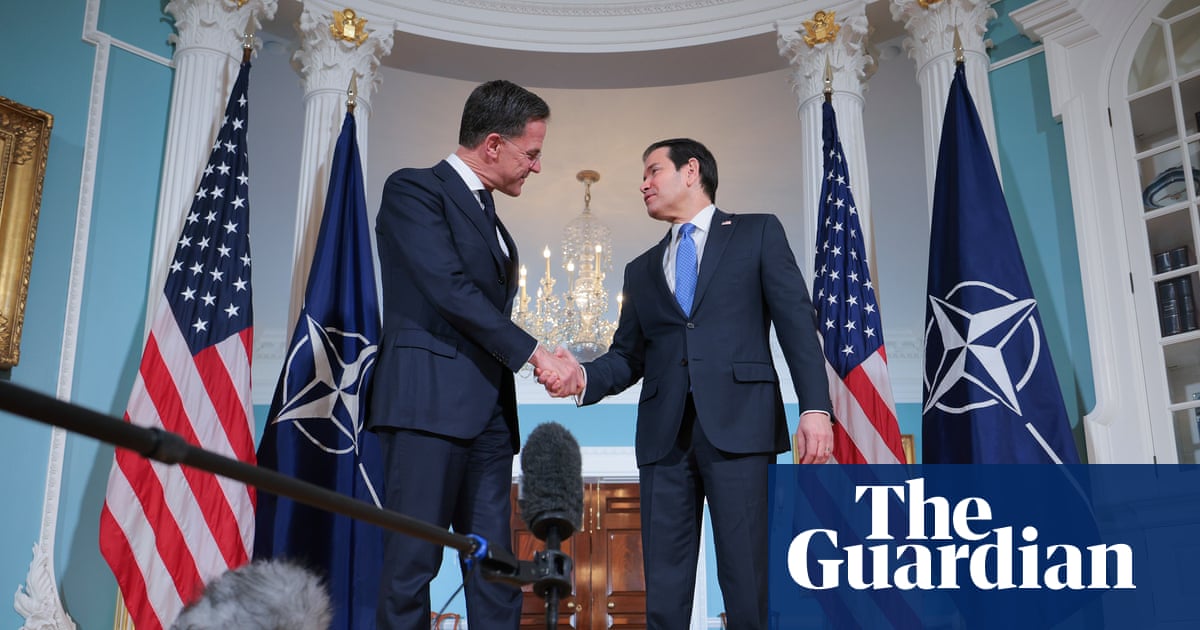
Rubio met separately with Rutte earlier on Wednesday at the State Department, where they discussed the conflict in Iran, U.S. efforts to negotiate an end to the Russia-Ukraine war, and “increasing coordination and burden sharing with NATO allies.”
The alliance has faced challenges over the past year as Trump has reduced U.S. military support for Ukraine and has threatened to take Greenland from Denmark.
Trump’s criticisms of NATO intensified following the onset of the Iran conflict in late February, as he insisted that securing the Strait of Hormuz was not solely the responsibility of the U.S., but rather of the nations reliant on the oil flow.
“Go to the strait and just take it,” Trump stated last week.
Additionally, Trump was frustrated by NATO allies Spain and France, who restricted the use of their airspace and military facilities during the Iran conflict. However, these countries, along with others, have agreed to support an international coalition to reopen the Strait of Hormuz once the fighting concludes.
British Prime Minister Keir Starmer, a particular source of Trump’s frustration, is scheduled to travel to the Gulf region to support the ceasefire. The UK is also working on a security plan for the Strait post-conflict.
Reporting contributed by the Associated Press.