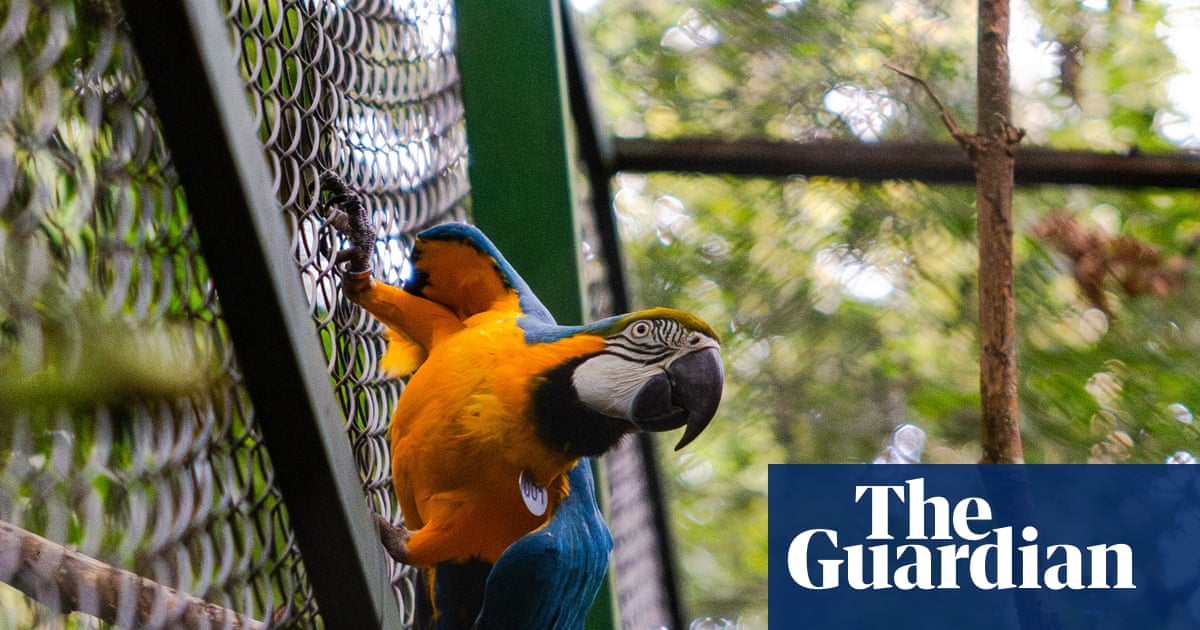

In Rio de Janeiro, the vibrant blue-and-yellow macaw is a familiar image, yet sightings of the actual bird have become increasingly rare, leading some to question its existence in the city. Historical accounts from the 16th century by French explorer Jean de Léry noted the presence of these magnificent parrots among Indigenous tribes, and in 1818, Austrian naturalist Johann Natterer reported seeing the Ara ararauna in Rio. However, documentation of the species in the area ceased afterward, with experts attributing its decline to extensive deforestation that also threatened other wildlife, including tapirs, jaguars, and peccaries.
Now, two centuries later, flashes of blue and gold are reappearing in the forest as conservationists work to revive both the macaw population and the surrounding ecosystem. Viviane Lasmar, director of Tijuca National Park, expressed enthusiasm over the macaws’ return, stating, “They are so magnificent. It’s no surprise that all the visitors are constantly asking how they can see them. For me, as the head of the park, it’s special. But even more so as a carioca, it’s a dream come true.”
Tijuca National Park is among the largest urban parks globally, encompassing nearly 4,000 hectares (10,000 acres) of lush greenery that embraces the granite mountains of Rio, blending seamlessly with the urban landscape. This area is a remnant of Brazil’s Atlantic rainforest, which faced significant degradation due to 19th-century exploitation for resources like coffee and charcoal. In a pioneering tropical reforestation effort, Emperor Dom Pedro II initiated tree replanting in Tijuca during the 1860s, though many species had already disappeared, including the blue-and-yellow macaw, which also fell victim to wildlife trafficking.
Marcelo Rheingantz, executive director of Refauna, noted that the extinction of the macaws in Rio was likely a result of both wildlife trade and deforestation during the colonial period. He also highlighted that approximately two-thirds of the large and medium-sized mammals that once inhabited Tijuca have been lost. However, efforts are underway to restore these populations, as various species are progressively returning to the forest. For example, giant rodents, yellow-footed tortoises, and howler monkeys have been spotted once again, their calls resonating through the trees.
Currently, only four macaws have been reintroduced, yet their distinctive squawks fill the air, creating a sense of biodiversity in the park. Rheingantz expressed joy in revitalizing the ecosystem, stating, “It’s really beautiful to be putting the forest’s orchestra back together again.” Refauna’s “refaunation” initiative began in 2010, starting with the introduction of the red-rumped agouti, a rodent resembling a cat, followed by other native species previously extinct in the park, such as the brown howler monkey and the yellow-footed tortoise.
The return of these species has generated excitement among visitors to the park, with the macaws being particularly adored. Known for their intelligence and lifelong pair bonds, these large parrots, nearly a meter in length, are celebrated in local art and merchandise, symbolizing Brazil’s vibrant culture. Although the animated character from the film Rio is a macaw, Rheingantz clarified that it depicted the Spix’s macaw, which is native to northeastern Brazil. “Now we are correcting the story and putting the right species here,” he remarked with a smile.
So far, the park has welcomed three females and one male macaw, which are currently undergoing monitoring after a 15-day release earlier this year. Refauna plans to release them again in September, marking an important step in the process, although ongoing monitoring will continue to ensure their well-being. The macaws, named Fernanda, Selton, Fatima, and Sueli after characters from popular Brazilian media, exhibit distinct personalities, with Sueli being a particular favorite due to her playful nature.
In addition to these four, Refauna aims to introduce six more macaws soon, ultimately targeting a total release of 50 birds. While the visual of colorful macaws soaring through the sky would be a stunning sight, Vanessa Kanaan, director of Instituto Fauna Brasil, emphasized that the goal is to restore the forest’s ecological integrity rather than merely create a spectacle. “Reintroducing species is not simply about returning animals to the forest. It is about rebuilding ecological relationships and ensuring that these species can once again perform their ecological roles,” she explained.
Similar to rewilding efforts globally, the Refauna team has observed that the return of a single species can lead to broader ecological changes. Rheingantz illustrated this point by picking up the agouti fruit, which symbolizes the “empty forest syndrome” that prompted Refauna’s formation. The agouti tree relies on animals to disperse its seeds, and without the agouti rodents, the forest floor has been littered with decaying fruit. Approximately 90% of the flora in the Atlantic forest depend on animals for reproduction, according to Rheingantz. Through these reintroductions, researchers aspire to gradually restore the entire forest ecosystem.