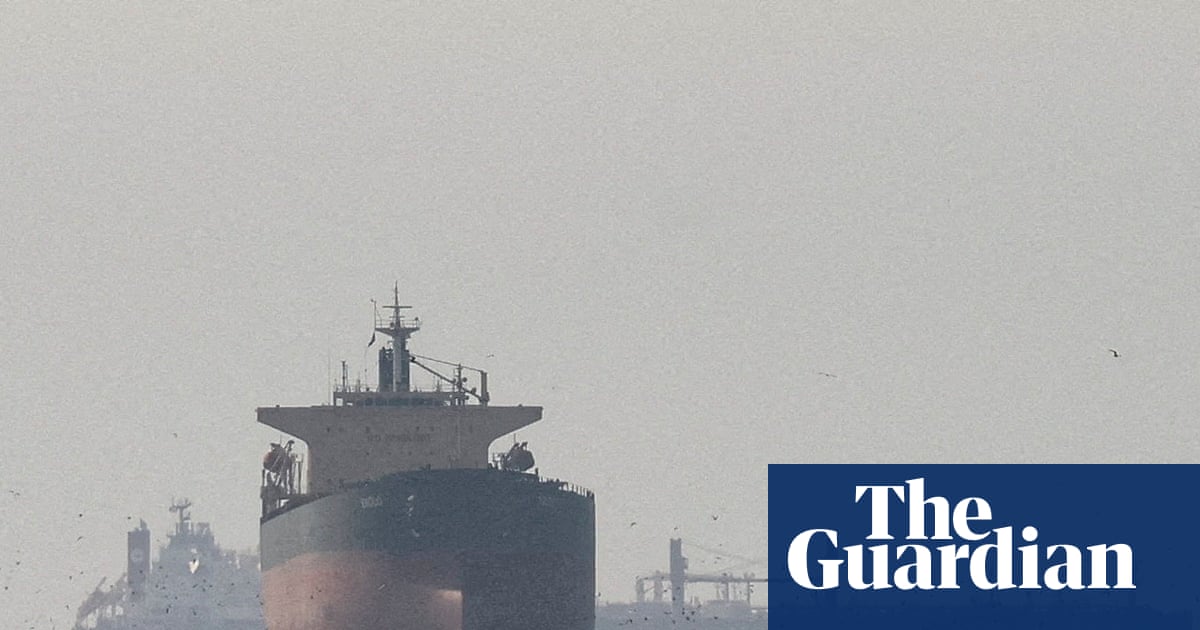

“While it’s possible to try to lessen the impact of this scenario on your mental well-being, it’s becoming increasingly difficult.” After spending six weeks in the Gulf, one of the 20,000 maritime workers caught in Iran’s blockade of the Strait of Hormuz is nearing their breaking point.
With the current ceasefire in the Middle East already showing signs of instability, the oil tanker crew member, who initially spoke to the Guardian a month ago, expressed that any hope of an imminent release had vanished, if it ever felt plausible.
“We remain anchored, surrounded by numerous loaded tankers. No one has moved an inch,” the crew member reported, highlighting their position among several vessels stationed off the coast of the United Arab Emirates, with a clear view of a Kuwaiti oil tanker recently set ablaze by an Iranian missile.
Just hours after the ceasefire was established, the sky above their ships lit up with traces of intercepted missiles. Following weeks of drone strikes and reports of underwater mines, many maritime workers feel hesitant and unable to navigate the strait, even if the ceasefire permits them to do so.
“I submitted my notice exactly one month ago,” the crew member stated. “I have informed the captain that I refuse to sail through the strait. It’s purely a matter of safety.”
Most of the crew aboard the same vessel share this sentiment, with approximately 90% expressing their desire to exercise their right to refuse to sail. One crew member has experienced a “mental breakdown” and is now receiving regular check-ins from fellow colleagues.
“I have no doubt that this issue, this mental breakdown, is occurring on tankers all around us due to the stress of this situation. Support hotlines for seafarers are being utilized, but we have all understood from the outset that it wouldn’t suffice,” the crew member added.
Since the conflict began, the International Transport Workers’ Federation (ITF) has received around 1,000 inquiries from seafarers across 300 different vessels. Approximately 20% of these inquiries pertain to requests for repatriation, while others revolve around issues related to wages or access to vital supplies such as fuel, food, and water.
Following the recent attack on Kuwait’s Al-Salmi oil tanker just a short distance away, the crew member reached out to a helpline for the first time. “I felt overwhelmed and uncertain about managing my emotions. It’s important for me to maintain composure in front of others. Speaking to a stranger helped me vent my feelings,” they recounted.
However, according to David Appleton, a senior representative at Nautilus, which advocates for maritime staff, there are limits to how much remote advice and reassurance can achieve. “Everyone tries their best to offer help, but ultimately, what you truly want is to extract people from the situation,” he remarked.
“In addition to the psychological strain caused by the looming threat of violence—being in a vulnerable position—there’s the added uncertainty of not knowing how long this will last,” Appleton noted.
The deteriorating mental health of crew members stranded on tankers has reignited demands for shipping companies to rotate their crews with mariners willing to take their place. Maritime regulations prohibit shipping companies from mandating that seafarers work in dangerous areas, yet there will still be those eager enough to take on the risk.
“Most of our potential replacements are Ukrainian seafarers, who are away from their homes and spending money in foreign European countries as they cannot return,” the crew member explained.
Shipping companies are obligated to offer double pay to crew members working in perilous regions. They are expected to identify individuals interested in advancement and promote them to higher ranks in order to attract them to sign on. They will also be seeking those who have been ashore for extended periods and are in need of work.
The crew member remarked, “The only distinction between them and us is the ability to choose. At least they will be making a conscious decision to come here, regardless of their reasons for doing so.”
They expressed hope that their tanker will soon be relocated to allow new crew members to replace those unwilling or unable to continue.
“The captain casually discussed with our crew manager about keeping the crew onboard until we reached the discharge port, but that idea was quickly dismissed,” they noted.
“I’m not in a mental state to handle any demanding tasks after everything that has happened. This is the toughest situation I have ever faced,” the worker stated, conveying their uncertainty about ever returning to the sea.
“I have spent my entire career working on tankers. Leaving means relinquishing all I’ve achieved. But remaining in this line of work carries the risk that I may have to come back here eventually. I can only make that decision after several months away from this tanker, back at home,” they concluded.