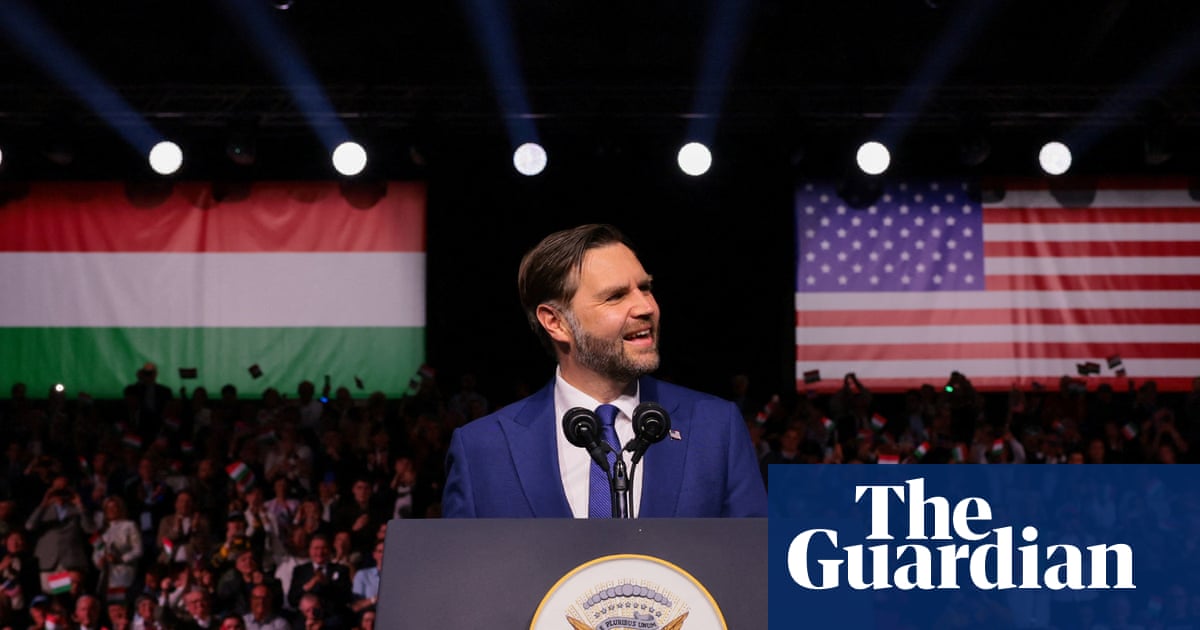

During his recent trip to Budapest, JD Vance, a US senator, expressed strong support for Hungarian Prime Minister Viktor Orbán just days before a critical election in the country. He accused the European Union of engaging in “one of the worst instances of election interference” he had witnessed.
Speaking alongside Orbán on Tuesday, Vance stated, “The bureaucrats in Brussels have attempted to undermine Hungary’s economy. They have sought to reduce Hungary’s energy independence and have raised costs for Hungarian consumers. All of this has been driven by their animosity towards this leader.”
It appears Vance was referring primarily to the European Commission, which is tasked with proposing and enforcing EU legislation. The term “bureaucrats in Brussels” is a common refrain among those critical of the EU, often neglecting to acknowledge that EU laws and policies are shaped by the collective input of 27 member states and the European Parliament.
Vance did not provide extensive details to support his assertions. His most pointed accusation involved claims of “digital censorship” by the EU, suggesting that the EU was directing social media platforms on what information to present to Hungarian voters. However, he did not provide any substantiating evidence for this claim.
His statement also mischaracterizes EU legislation. The Digital Services Act has prompted the EU to investigate companies like Meta, TikTok, and X over various issues. However, these investigations, which follow a clearly defined legal framework, do not equate to the EU dictating what information these companies should share with voters.
In contrast to Vance’s active campaigning in Hungary, EU leaders have been notably cautious, refraining from making remarks that could be interpreted as influencing the electoral process.
Since joining the EU during the significant enlargement of 2004, Hungary has experienced notable economic growth. According to the US government’s International Trade Administration (ITA), Hungary’s strategic location in Europe provides easy access to EU markets, which has attracted numerous American corporations, including Coca-Cola and Microsoft, to establish operations in the country.
Over the past two decades, Hungary has reaped substantial benefits from EU financial support. By 2018, more than 80% of the nation’s public investments were derived from European funds designated to assist less affluent EU members in narrowing the economic gap with their wealthier counterparts.
Despite ongoing concerns regarding state corruption, Hungary continues to be a net beneficiary of EU funds. Approximately €18 billion (about £15.6 billion) of its EU support has been frozen due to worries about judicial independence, discrimination against LGBTQ+ individuals, academic freedoms, and the rights of asylum seekers. Around €1 billion has been permanently lost as a result of these issues.
Notably, these standards are uniformly applied across all EU member nations, and Hungary accepted these conditions upon joining the union.
Recent geopolitical events have contributed to rising energy costs throughout Europe, particularly following Russia’s invasion of Ukraine, with further increases occurring after the onset of the US-Iran conflict. This trend has also been felt in Hungary, where households are facing higher gas prices.
The Orbán administration has made energy prices a focal point of its campaign, attributing the rising costs to EU sanctions imposed on Russian fossil fuels.
Despite Hungary’s resistance, the EU has committed to completely phasing out reliance on Russian fossil fuels. EU officials point out that Russia has proven to be an unreliable supplier, recalling instances in 2006, 2009, and 2014 when gas supplies were cut, affecting millions of consumers, including those in Hungary.
Interestingly, the previous Trump administration, which had a critical stance towards renewable energy, seems to overlook that Hungary benefits from some of the lowest electricity rates in Europe, largely due to a significant increase in solar energy production.
One of Vance’s more revealing statements suggested that the EU’s actions are driven by personal animosity rather than legal or policy considerations: “They’ve done it all because they hate this guy.”
There is indeed frustration among EU leaders towards Orbán, especially after he withdrew his support for a €90 billion loan intended for Ukraine. Additionally, leaked audio suggested that Hungary’s foreign minister indicated a willingness to modify EU sanctions to benefit Russia.
However, it could be argued that Orbán has enjoyed preferential treatment, such as a 2022 exemption allowing continued imports of Russian oil. Moreover, a senior EU legal expert has criticized the commission for its decision to release €10 billion in frozen funds to Hungary, suggesting that the EU has been slow to respond to Orbán’s actions, allowing what some describe as an “electoral autocracy” to take root within the union.