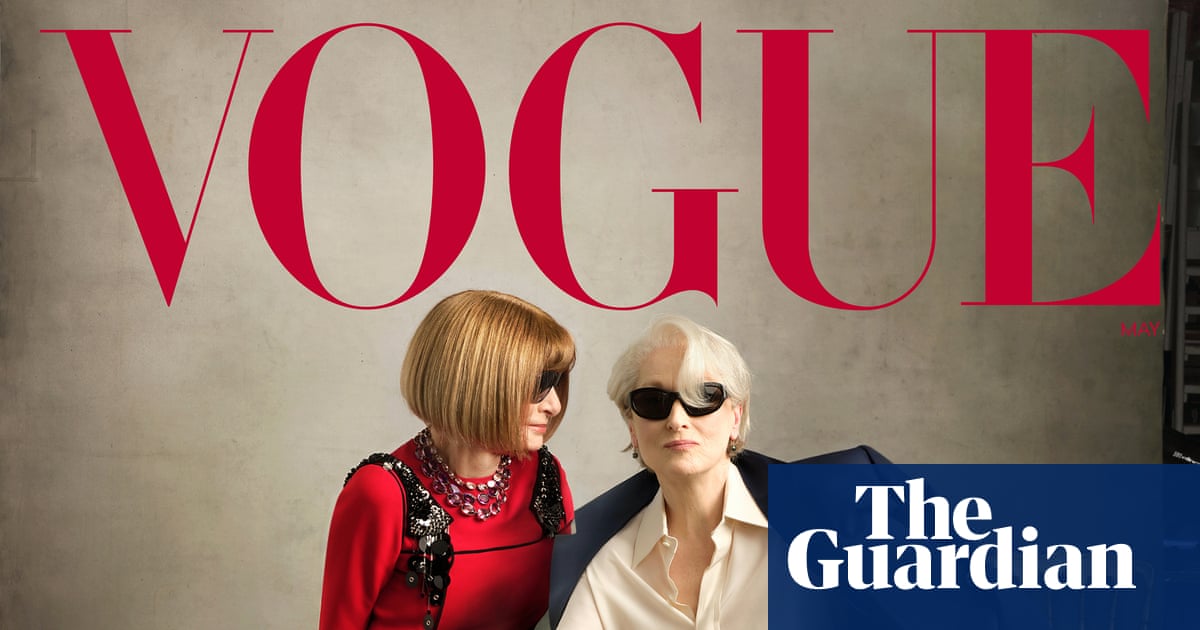

In the magazine industry, it’s customary for colleagues to commemorate a departing staff member by creating a personalized mock-up of the magazine’s front cover, often featuring the individual’s face on a past celebrity cover. This playful tribute typically includes humorous captions that allude to memorable office experiences or the person’s favorite treats. This tradition was recently upheld when Anna Wintour received her own cover, but instead of a lighthearted farewell, it was the official glossy edition set to hit newsstands on April 28.
In an unexpected move to generate buzz for the upcoming sequel, The Devil Wears Prada 2, Vogue’s May edition features Wintour alongside Meryl Streep. Streep’s iconic character, Miranda Priestly, the editor-in-chief of the fictional Runway magazine, is believed to have drawn inspiration from Wintour herself. The cover boldly proclaims, “Seeing Double. When Miranda met Anna.” While Wintour has previously graced the covers of various industry publications, this marks the first occasion in which an editor has made themselves the focal point of the magazine. In a clever nod to the fashion world, both Wintour and Streep are adorned in Prada attire.
The announcement was first shared on Vogue’s Instagram account on Tuesday, and it quickly became a viral sensation, garnering over 1.2 million likes at last count. Prominent figures such as model Gigi Hadid and actress Mindy Kaling expressed their admiration in the comments, which ranged from “Actually groundbreaking” referencing Priestly’s memorable floral line to users declaring intentions to frame the cover.
However, Wintour’s appearance on the cover transcends mere promotion of the highly anticipated sequel; it serves as a strategic assertion of her ongoing influence within the magazine, signaling a new chapter in her career. This cover reveal comes just ten months after she announced her decision to “step back” from her role as Vogue’s editor-in-chief and six months after Chloe Malle was appointed to lead editorial content. This bold move reinforces Wintour’s enduring authority over the publication she has directed for nearly forty years.
When Wintour first disclosed her transition from the editor-in-chief position, many interpreted it as a demotion. Her cover debut now clarifies that this is not the case. As Condé Nast’s chief content officer and Vogue’s global editorial director, Wintour retains substantial power while allowing Malle to manage daily operations.
Media consultant and author Mark Borkowski characterizes Wintour’s cover feature as “a hell of a smart move,” emphasizing that it demonstrates her refusal to relinquish control. “Many individuals in similar roles acknowledge they occupy a powerful position. Wintour, however, sees herself as the power,” he states. “She is not a personality who will fade into the background.”
The creative process behind the cover also illustrates Wintour’s continued influence. In her editorial letter, Malle recounts how the idea emerged while she was in Wintour’s personal car, brainstorming potential cover concepts. Initially, Wintour dismissed the proposal, stating it wasn’t her style, but it was Streep who helped change her mind when Wintour reached out directly—a clear display of her authority.
Wintour was initially reticent about the first film’s release in 2006, despite attending the premiere in Prada. Recently, however, she has shown a willingness to engage with the film’s legacy, suggesting that Priestly is more of a caricature and a delightful one at that. Social media clips from the shoot highlight this, showcasing Streep in character while Wintour presents a more relatable and humorous side, diverging from Priestly’s icy demeanor.
Wintour’s playful engagement with the film was apparent at the Oscars in March when she jokingly referred to Anne Hathaway as “Emily,” paying homage to Emily Blunt’s character. Additionally, Vogue’s upcoming Book Club selection is the novel by Lauren Weisberger that inspired the film. Borkowski suggests these instances indicate that Wintour is beginning to carve out a distinct identity separate from Vogue, transforming from a once-iconic figure defined by her hairstyle and dark glasses into a more personal brand narrative.
Amy Odell, author of Anna: The Biography, also points out that this allows Wintour to reshape her legacy. In her Back Row newsletter, Odell mentions, “Anna is primarily a visual editor—an exceptional one—who recognizes that striking images and viral moments can overshadow past controversies.” She draws parallels to how Hillary Clinton’s 1998 Vogue cover served as a corrective during her husband’s scandal, or how the 2014 cover featuring Kim Kardashian and Kanye West transformed perceptions of Kardashian, enhancing her status in the fashion world.
While Wintour aims to keep her professional commitments distinct, there are still notable intersections between her public persona and the magazine’s branding, marking an intriguing evolution in her career.