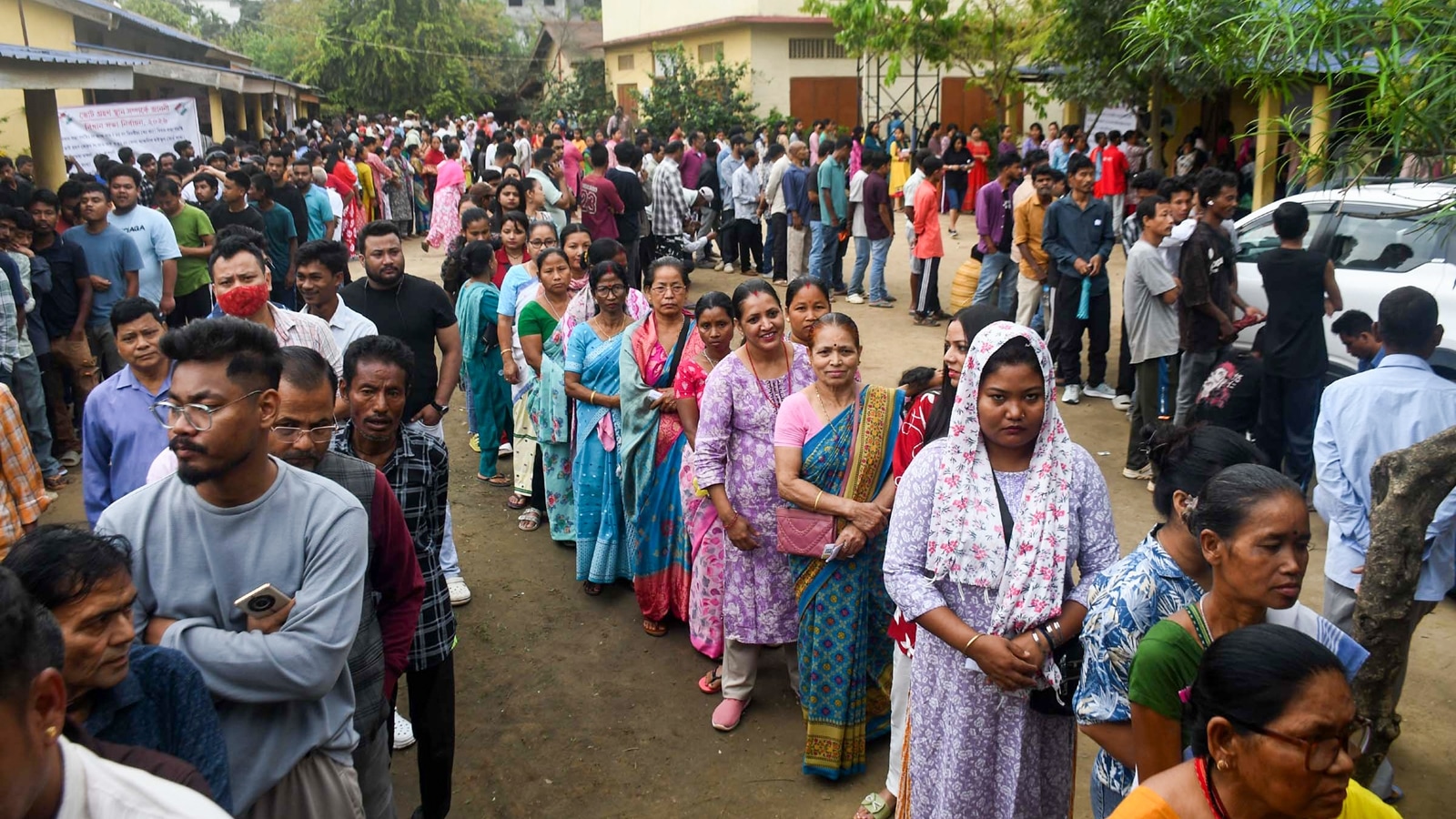

On Thursday, Assam and Puducherry achieved record voter turnout in their respective Assembly elections, with figures reaching 85.38% and 89.83%, as per preliminary data from the Election Commission (EC). Kerala also witnessed an increase, reporting a turnout of 78.03% compared to previous elections.
For both Kerala and Puducherry, this was the first election following the completion of the Special Intensive Revision (SIR) of electoral rolls in February. Assam’s elections marked the first instance of Assembly voting after the delimitation process conducted in 2023.
The EC’s announcement highlighted that Assam’s previous highest turnout was 84.67% during the 2016 elections, with 82.4% in 2021. On Thursday, female voter participation reached 85.96%, while male voter turnout was slightly lower at 84.80%.
In Kerala, the SIR resulted in an 8.63% reduction in the electorate, with female voters achieving a turnout of 80.86%, surpassing the male voter turnout of 75.01%. The overall turnout in 2021 was recorded at 76%.
Puducherry previously recorded a turnout of 86.19% in the 2011 Assembly elections, which fell to 83.4% in 2021. The SIR led to a 10.12% decrease in the number of registered voters in the Union Territory. In this election, female voter turnout was 91.33%, compared to 88.09% for male voters.
Among the 13 states and Union Territories where the EC has conducted the SIR, Assam was excluded due to the pending release of the National Register of Citizens (NRC). Unlike standard revisions, the SIR process involved thorough document verification of each registered voter.
The EC noted that updates were still pending from 3,469 polling stations but described the polling process as largely peaceful, with only a few incidents reported.
Chief Election Commissioner Gyanesh Kumar praised the turnout, stating, “The Assembly Elections 2026 in Assam, Kerala, and Puducherry serve as a significant milestone not only for India but also for democracy globally. I extend my congratulations to the voters of these regions for this remarkable achievement.”
Despite inclement weather, including rain in various areas, Assam reported long queues at polling stations for the 126 Assembly seats, according to the Chief Election Officer’s office. The Dalgaon constituency recorded an impressive turnout of 94.57%, being the most densely populated area with 315,000 registered voters as of February’s electoral list revision.
Other constituencies such as Srinjangram, Jaleshwar, and Mankachar also saw voter turnout exceeding 94%, primarily in areas with significant populations of Bengali-origin Muslims. Conversely, urban constituencies in Guwahati reported lower turnout rates, with New Guwahati at 71.27%, Dispur at 73.98%, and Guwahati at 75.23%. Chief Minister Himanta Biswa Sarma’s constituency of Jalukbari achieved a relatively higher turnout of 80.83% amid competition from Congress’s Bidisha Neog.
In Kerala, all 14 districts recorded above 75% turnout, with several constituencies surpassing 80% even before the final figures were tabulated. The voter list in Kerala was reduced from 2.78 crore to 2.71 crore following the SIR.
The EC announced the Assembly polls on March 15, alongside elections in Tamil Nadu and West Bengal, with Tamil Nadu scheduled for voting on April 23, and West Bengal on April 23 and April 29. The counting of votes for all five elections is set for May 4.
Additionally, bypolls were conducted in four Assembly constituencies across Karnataka, Nagaland, and Tripura on Thursday.
Stay informed with the latest updates by following us on Instagram.