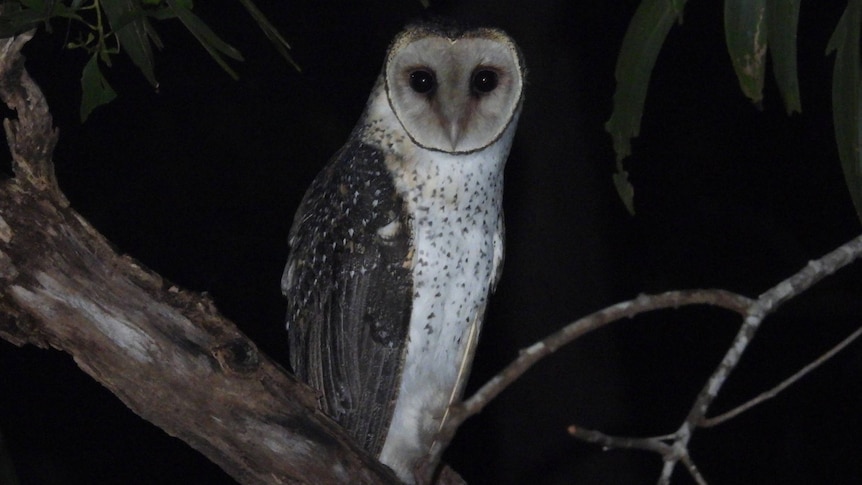

Craig Kurrujuwa Winston, a traditional owner from a northern Australian island, has successfully photographed a rare masked owl, contributing valuable insights into this endemic and culturally significant species.
The local birdwatcher first became aware of the Tiwi Islands masked owl, known as pinjoma in Indigenous culture, when his younger brother spotted it earlier this year. Shortly after, around 9 PM, Mr. Winston encountered the owl in his yard on Melville Island, observing it as it appeared to be hunting a brushtail possum.
“I stepped outside and saw this striking white face gazing at me, and I immediately recognized it,” he recalled. “It felt like a magical moment. The owl was very intelligent and calculating, trying to figure out the best way to approach its prey.”
Prior to Mr. Winston documenting his sighting on iNaturalist, there had been no recorded images of the Tiwi Islands masked owl on the citizen science platform. “I realized there was a lack of data and behavioral insights for this species, so I felt compelled to capture a photograph,” he explained. “It was something I had wanted to do, to document rare wildlife.”
Mr. Winston, who is pursuing a degree in ecology, evolution, and organismal biology, emphasized the cultural importance of the owl, linking it back to Dreamtime narratives. “This connection goes back to the creation stories in our traditions,” he noted. “Many of my tribal mothers from Melville Island regard the masked owl as their totem, which holds special meaning for them. My nieces and nephews also share this totem.”
As a member of Australia’s growing birdwatching community, Mr. Winston described the hobby as his “comfort zone.” He explained that the iNaturalist platform allows users to document various flora and fauna by taking photographs and uploading them along with location data, facilitating identification by scientists and fellow enthusiasts.
His sighting of the masked owl sparked excitement on social media, prompting another birdwatcher to share their own historical images of the species taken on the Tiwi Islands. “Now there are several more publicly available photos, which is fantastic,” Mr. Winston added.
The Tiwi Land Council has classified the masked owl as endangered on both federal and Northern Territory levels. Mr. Winston highlighted that this species is unique to the Tiwi Islands, meaning it cannot be found anywhere else globally.
He described his home as a “biodiversity hotspot,” noting a variety of remarkable plants and insects inhabit the area. “I would like to see my home designated as a protected zone, since many raptors and other rare species thrive here,” he said. “Last year, I photographed a red goshawk, and I plan to revisit its nesting site when the roads improve.”
Rare marsupials, such as the northern brush-tail phascogale, have also been observed on the outstation, although Mr. Winston recently had a brief encounter with one that escaped before he could capture an image. “I locked eyes with it just a few nights ago,” he mentioned.
Mr. Winston believes that achieving priority conservation status or formally recognizing the region as a biodiversity hotspot would promote further research and secure funding necessary to protect these rare species. “Getting the Tiwi Islands designated as a World Heritage site would be amazing,” he expressed. “That would greatly contribute to scientific efforts. My dream is to establish a wildlife or rehabilitation sanctuary because, in the past, a masked owl requiring surgery or veterinary assistance was sent to Darwin but could not return due to biosecurity regulations.”