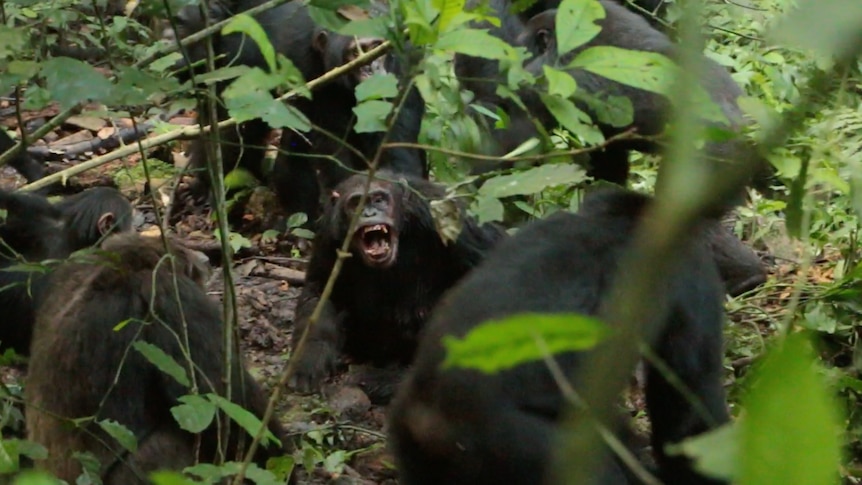

In Kibale National Park, Uganda, researchers have documented a protracted and violent conflict among chimpanzees, referred to as a primitive “civil war.” This park is notable for housing the largest known population of wild chimpanzees globally.
Within the dense forest, these endangered primates engage in various social activities such as grooming, playing, and foraging, while maintaining minimal contact with humans due to the absence of urban development nearby.
Despite their relative isolation, the chimpanzees’ habitat has witnessed a significant upheaval, resulting in a drastic transformation of their social structure. This conflict, characterized by escalating aggression, has been meticulously chronicled for the first time in a comprehensive study published by a research team from the University of Texas.
The peer-reviewed study, which appeared in the journal Science this week, offers a detailed examination of the evolving social dynamics within the chimpanzee community over the past several decades. Aaron Sandel, an anthropologist and co-director of the Ngogo Chimpanzee Project, noted that his team has been observing this group since 1995. Sandel began his own research in 2012, focusing initially on the development of social relationships among young chimpanzees. His findings took a dramatic turn during his fieldwork from 2014 to 2015.
The report indicates that for the initial two decades of observation, the chimpanzees existed as part of a cohesive community in Ngogo. However, between 1998 and 2014, during what is termed the “pre-fission” phase, these chimpanzees formed overlapping social clusters. They frequently transitioned between the “Western cluster” and the “Central cluster,” with many individuals switching groups annually.
Researchers developed a methodology to analyze social bonds, discovering that certain individuals formed tight-knit “cliques.” One significant clique consisted of three adult males who later became pivotal figures in the newly formed Western group, maintaining close associations even when interacting with members of the rival Central group.
The first signs of discord emerged on June 24, 2015, when members of the Western and Central clusters encountered one another. Instead of reconciling, the Western chimpanzees fled while being pursued by the Central group. Following this event, the two groups avoided interaction for six weeks—a marked change in their behavior. This incident initiated a rapid increase in separation, culminating in a clear division between the groups by 2018, as evidenced by social, spatial, and reproductive data.
Dr. Rebecca Hendershott, a lecturer in primatology at the Australian National University, highlighted the significance of the findings, particularly in relation to established beliefs about human and animal aggression. She noted that while aggression towards outsiders is known among chimpanzees, the violence directed at former allies was unprecedented.
Maria Sykes, CEO of the Jane Goodall Institute Australia, remarked that the conclusions drawn from this study align closely with Dr. Goodall’s earlier observations in Tanzania. She emphasized the genetic similarities between humans and chimpanzees, which account for their complex social interactions, cooperation, empathy, and, unfortunately, organized aggression.
The report describes a pattern of violent behavior following the community’s division. The Western chimpanzees engaged in multiple “collective attacks” against members of the Central group, conducting territorial patrols that led to at least six lethal encounters with adult males. By 2021, the scope of aggression escalated to include infants as well.