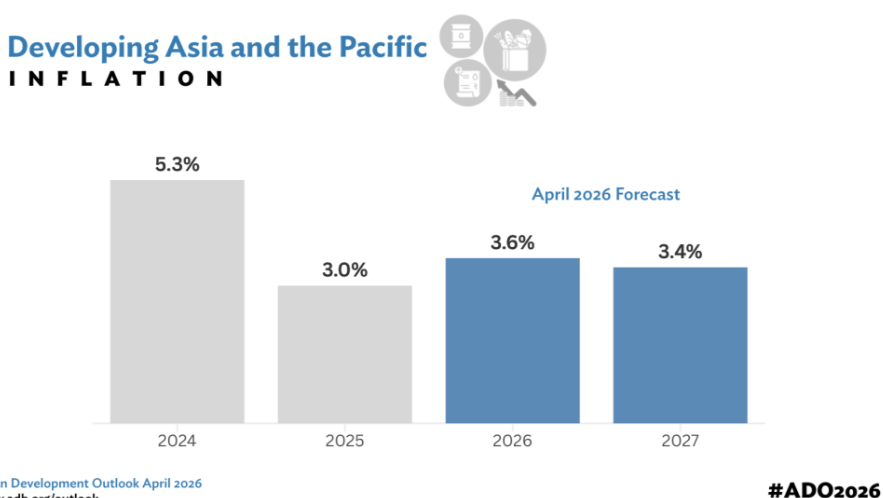

MANILA, PHILIPPINES (10 April 2026) — The Asian Development Bank (ADB) has projected that economic growth in the developing regions of Asia and the Pacific will decelerate to 5.1% for both 2026 and 2027, a decrease from 5.4% recorded in the previous year. This slowdown is attributed to ongoing turmoil in the Middle East and persistent uncertainties surrounding trade. Regional inflation is anticipated to rise to 3.6% in 2026 and slightly decrease to 3.4% in 2027, up from 3.0% last year.
The forecasts, finalized on 10 March amid a backdrop of significant uncertainty, assume a scenario where the conflict in the Middle East stabilizes early. However, recent developments suggest a greater probability of prolonged disruptions.
Despite these challenges, the region is entering a tumultuous global climate from a position of relative strength, characterized by strong domestic demand, stable labor markets, and increased public spending on infrastructure, as highlighted in the Asian Development Outlook (ADO) for April 2026, released today.
According to ADB Chief Economist Albert Park, “The extended conflict in the Middle East poses the most significant threat to the region’s economic outlook, potentially leading to sustained high prices for energy and food, as well as tighter financial conditions.” He emphasized the necessity for governments to adopt sound macroeconomic strategies to promote growth and manage inflation, while providing targeted support to vulnerable households in light of renewed trade policy uncertainties.
The ADO April 2026 report contains an analysis of the conflict’s potential impacts on regional economies under various scenarios. An extended and intensified conflict in the Middle East could negatively influence economic performance through multiple channels, including increased price pressures, disruptions in shipping, and heightened financial volatility.
Most economies across developing Asia and the Pacific are expected to face a deteriorating growth outlook this year and into 2027, despite robust consumer spending and strong demand for artificial intelligence-related products. Growth in the People’s Republic of China (PRC) is projected to drop to 4.6% this year and 4.5% next year, down from 5% last year, as challenges in the property market and sluggish export growth continue to impact economic activity. Meanwhile, India’s growth is forecasted to decrease to 6.9% this year from 7.6% last year, before rebounding to 7.3% next year, supported by strong domestic consumption. Economies in the Pacific are predicted to experience the most pronounced slowdown, with growth expected to decline from 4.2% in 2025 to 3.4% in 2026 and further to 3.2% in 2027.
Oil prices are expected to remain high in the short term but may gradually stabilize if geopolitical tensions dissipate. The recent spike in energy prices, coupled with possible disruptions in fertilizer markets due to the conflict in the Middle East, could exert inflationary pressures on global food prices.