
In 2022, NASA’s Orion spacecraft, part of the Artemis I mission, successfully returned to Earth, splashing down in the Pacific Ocean. Now, the astronauts aboard the Artemis II mission are preparing for their own re-entry, which is expected to produce a dramatic “fireball.” This mission is notable as the four astronauts—Victor Glover, Reid Wiseman, Christina Koch, and Jeremy Hansen—are set to return to Earth after traveling further than any humans have ever ventured. Their planned splashdown off the San Diego, California coast is scheduled for just after 8 PM local time on Friday, which corresponds to 10 AM on Saturday in Australian Eastern Standard Time (AEST).
Throughout their ten-day journey, the Artemis II crew navigated a path that took them around the far side of the Moon, achieving a remarkable milestone of over 405,000 kilometers from Earth. This distance surpasses the previous record held by the Apollo 13 mission for more than half a century.
As they make their way back, the astronauts will experience re-entry speeds of approximately 40,000 kilometers per hour. This phase poses significant risks, as the Orion spacecraft’s heat shield will endure extreme temperatures caused by atmospheric friction. Upon re-entering the atmosphere, the capsule will face conditions exceeding 2,500 degrees Celsius, leading to the formation of superheated plasma around it. During this period, communication may be temporarily lost, and the astronauts will witness bright flashes from the plasma outside their windows.
Chris James, a hypersonics expert at the University of Queensland, noted that the Orion capsule will re-enter the atmosphere at speeds exceeding 30 times the speed of sound. This rapid descent will generate shock waves, resulting in air temperatures of about 10,000 degrees Celsius, nearly double that of the Sun’s surface. The intense heat will ionize the air around the spacecraft into a charged plasma, which can block radio signals and prevent communication during the critical stages of descent.
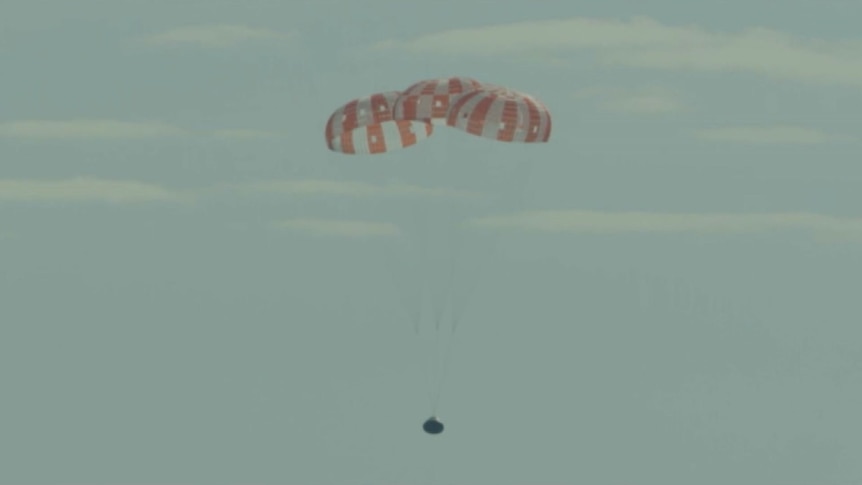
To decelerate, the Orion capsule will deploy a sequence of 11 parachutes at various intervals. By the time it reaches the Earth’s surface, its speed will have reduced to approximately 30 kilometers per hour, similar to that of a fast cyclist. The process begins with the crew module separating from the service module 42 minutes before splashdown, entering the atmosphere from an altitude of 120,000 meters, 13 minutes before landing.
Once through the initial re-entry, the capsule will shed part of its protective cover to allow the parachutes to deploy. At 6,700 meters, two large parachutes will be released to bring the speed down to nearly 500 kilometers per hour, still quite fast. Subsequently, at 3,000 meters, three smaller pilot parachutes will be released, which will trigger the deployment of three main parachutes, each over 35 meters in diameter. This sequence is designed to slow the capsule from an estimated 209 kilometers per hour to around 27 kilometers per hour upon landing.
NASA has indicated that the Orion capsule could land in various orientations—upright, sideways, or upside down. However, if it lands on its side or upside down, five airbags will inflate to right the capsule, ensuring a safe exit for the crew.
Despite the advanced technology, some concerns have been raised about the heat shield’s effectiveness. Charlie Camarda, a former NASA engineer, expressed apprehension, likening the situation to “playing Russian roulette” with the astronauts’ safety. He pointed out similarities between Artemis II and past shuttle disasters. However, NASA Administrator Jared Isaacman has expressed confidence in the heat shield’s performance following thorough investigations.
Since the Apollo missions, significant advancements have been made in space exploration. The heat shield on the Orion is constructed from a re-engineered material called Avcoat, which was also used during Apollo missions. While Apollo spacecraft re-entered the atmosphere at around 35,000 kilometers per hour, the Orion will do so at a record-setting speed of approximately 40,000 kilometers per hour, marking the fastest re-entry for a crewed spacecraft.
Historically, splashdowns have not been without incidents. In 1961, astronaut Gus Grissom’s Liberty Bell 7 capsule experienced a hatch malfunction upon landing, leading to water ingress. The planned recovery helicopter was set to retrieve the capsule, but the mishap underscored the challenges of splashdown operations.