
Ballu Yadav, a 60-year-old security guard from Surat, Gujarat, found himself overwhelmed with emotion as tears streamed down his face. Having gone over 12 hours without a proper meal, each bite of the simple dal chawal he received from a community kitchen struck a deep chord within him.
“I have only consumed a pack of biscuits soaked in water since yesterday evening. My wife managed to borrow a bit of food from our neighbors,” Ballu shared on Thursday. Employed at the Radhey Radhey Silk Mills in the Gujarat Industrial Development Corporation (GIDC) at Pandesara, he hailed from Jaunpur district in Uttar Pradesh. Like many others, he is one of the approximately 2.2 million migrant workers who have made a living in Surat’s thriving textile sector. However, the ongoing conflict in West Asia has severely disrupted the supply of raw materials, leading to a significant downturn in the industry. Consequently, nearly 40 percent of migrant workers in Surat have left the city, struggling to make ends meet without consistent wages and cooking gas.
To support individuals like Ballu, a group of men from various districts in Uttar Pradesh, now residents of Surat, initiated a community kitchen approximately 20 days ago, offering freshly prepared lunches for laborers in the Pandesara GIDC area.
This initiative has provided much-needed relief to many, including 30-year-old Shashi Bhushan Yadav, who operates a fabric folding machine in a local mill. Previously earning Rs 20,000 per month, Shashi’s income has dwindled to Rs 12,000 following a two-day shutdown of his mill and the cancellation of night shifts due to the conflict in West Asia.
“It feels like the old days have returned,” Shashi remarked, referring to the challenges faced at home where his mother and sister have resorted to cooking on a wood stove. “In the 21st century, my family is forced to use wooden logs for cooking on a clay stove. My earnings barely cover rent, utilities, and daily expenses. As the only breadwinner, I feel the weight of responsibility, especially since my mother is a widow and stays home with my sister,” he explained.
Shashi further elaborated on the struggles of cooking with a wood stove, mentioning the challenges of inadequate ventilation in their quarters. He noted that the rising demand for wooden logs has also led to increased prices from local shop owners.
The plight of workers like Ballu and Shashi has garnered attention from the authorities. On Thursday, the state government distributed over 98,000 5 kg LPG cylinders specifically for industrial laborers, with Surat receiving the highest allocation.
Support for the community kitchen has also come from unexpected sources. Police Inspector K D Jadeja contributed by donating 10 gunny bags of rice and three bags of dal to assist in feeding textile laborers.
Key figures in the establishment of the community kitchen include Bhagwati Prasad Dubey, a supplier of imported coal to dyeing and printing units; labor contractor Akhilesh Tiwari; and Ajay Singh, a manager at a dyeing and printing mill. Together, they have worked to ensure that rice and dal, provided through various donations, are prepared for around 2,000 textile workers daily.
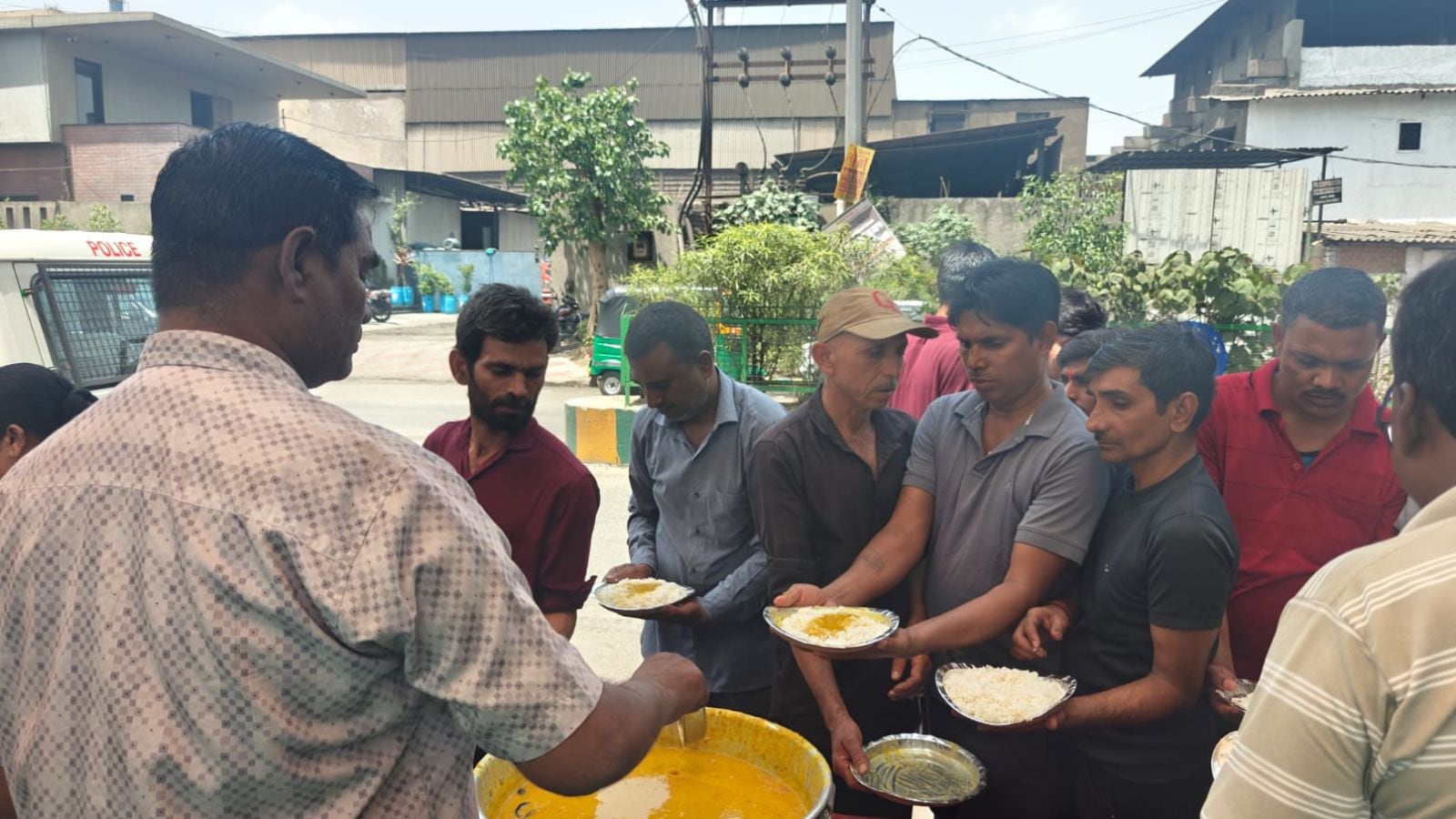
Meals are cooked starting at 8 am by two volunteers using wooden logs and a makeshift stove, ready to be served between 12:30 pm and 1:30 pm. Volunteers set up around 10 tables under a shamiana, where the food is displayed in large containers, and over 15 volunteers assist in distributing the meals on disposable plates.
Tiwari explained the motivation behind this initiative: “As individuals connected to the textile dyeing and printing sector, we understand the hardship of working on an empty stomach. Many of the laborers who benefit from our meals express their gratitude, and we have received numerous donations encouraging us to continue our efforts.” He pointed out that while the Southern Gujarat Textile Processing Association operates a similar community kitchen, they charge Rs 40 per meal.
Discussing the funding behind the kitchen, Dubey stated, “We have a strong commitment to social work. Initially, we covered expenses ourselves, then reached out for donations from friends and other sources. Each day, we prepare over 150 kg of rice and 30 kg of dal for distribution. We contacted more than 25 dyeing and printing mills in Pandesara for support, but only three have contributed. We hope to maintain this service until the situation improves and the supply of LPG cylinders stabilizes.”
Pandesara Police Inspector K D Jadeja commended their efforts, stating, “We are proud to be involved in this noble initiative. Our contributions of rice and dal are helping meet the needs of the community. Although the food is served on the roadside, there have been no issues regarding law and order or traffic.”
Kamal Saiyed serves as a senior correspondent for The Indian Express, offering in-depth coverage from Surat and the wider South Gujarat region, including the Union territories of Daman, Diu, and Dadra Nagar Haveli. With a reporting career at the publication since 2007, he is recognized for his authoritative insights into the industrial, social, and political dynamics of one of India’s rapidly developing urban centers.
Expertise in the Industrial and Economic Beat: Based in Surat, known as the “Diamond City,” Saiyed provides expert reporting on the diamond and textile industries, tracking global market trends and local trade policies impacting the millions of workers in Surat’s manufacturing sectors.
Civic and Infrastructure Coverage: He consistently reports on urban development and public safety in Surat, focusing on traffic management and urban planning, as well as investigating public safety issues and compliance with fire safety regulations in schools and other facilities.