
Nine months and six days prior to a Tomahawk missile striking the vibrantly decorated classrooms of Shajareh Tayyebeh elementary school in Minab, Iran—an incident that claimed the lives of over 175 individuals, predominantly children—U.S. Secretary of Defense Pete Hegseth’s personal pastor delivered a sermon at the Pentagon.
During the initial monthly Christian worship service at the Department of Defense, Brooks Potteiger, Hegseth’s spiritual advisor, warned attendees, particularly military leaders, against the illusion of control that comes with commanding and directing military action. “You may feel responsible for outcomes,” he noted, “but you are not ultimately in charge of the world.”
Referencing a biblical verse from Matthew 10, Potteiger reassured those present: “If our Lord governs even the fall of sparrows, He undoubtedly oversees all events in this world, including Tomahawk and Minuteman missiles… Jesus has the final say over everything.”
Preliminary investigations and available evidence indicate that the U.S. was accountable for the school bombing on February 28, yet neither former President Donald Trump nor Hegseth has acknowledged any responsibility or shown remorse. Instead, Hegseth has framed the ongoing conflict in Iran, which saw a temporary ceasefire following six weeks of hostilities, as divinely ordained. He has consistently referenced “God’s almighty providence” and expressed confidence that divine favor lies with U.S. forces.
While boasting about U.S. military superiority and expressing disdain for what he termed “stupid rules of engagement,” Hegseth vowed to show “no mercy” to the “barbaric savages” of the Iranian regime, urging the American populace to pray for victory “in the name of Jesus Christ.”
The juxtaposition of Hegseth’s fervent faith and combative rhetoric was particularly evident during the worship service on March 25—the first since the conflict’s onset—when he prayed for “overwhelming violence of action against those who deserve no mercy.” This prayer drew a swift rebuke from Pope Leo, who remarked on Palm Sunday that God disregards the prayers of those whose “hands are full of blood.”
However, Hegseth, a 45-year-old U.S. Army veteran and former Fox News host, is part of a lesser-known Calvinist sect of evangelical Christianity, which rejects papal authority and is founded on the belief in predestination, a principle established during the Protestant Reformation initiated by John Calvin in the 16th century.
Julie Ingersoll, a religious studies professor at the University of North Florida, noted that members of this Reformed branch believe that every occurrence is dictated by God’s will, including devastating incidents like a bombing in an elementary school.
Ingersoll cited the Old Testament, suggesting that if God commanded the annihilation of entire cities, as detailed in Deuteronomy 20, it is plausible to think He would ordain an attack on a girls’ school.
The advocates for military action against Iran have consistently found justification for conflict, yet the recklessness associated with the current warfare raises questions about underlying motivations. Historically, the U.S. has managed its interests in the Middle East without resorting to direct attacks on Tehran. The anticipated repercussions—such as assaults on U.S. bases, global economic disturbances from closing the Strait of Hormuz, and the Iranian regime’s consolidation of power—demonstrate the importance of restraint, which has been practiced for 47 years.
Why, then, take such risks now? Could Hegseth’s aggressive demeanor and his apparent contempt for diplomacy have influenced Trump to initiate a conflict viewed by some as a continuation of historical crusades?
In a recent news conference discussing the rescue of a pilot from a downed F-15 fighter jet in southern Iran, Hegseth once again invoked his faith to frame the narrative. He remarked, “Shot down on a Friday, Good Friday, hidden in a cave all Saturday and rescued on Sunday,” describing the pilot’s extraction as a rebirth coinciding with Easter Sunday.
While this narrative attempts to cast a positive light on a series of unfortunate events—including a fighter jet falling weeks after Hegseth claimed U.S. air superiority—the context indicates a potential strategic setback for the U.S. military.
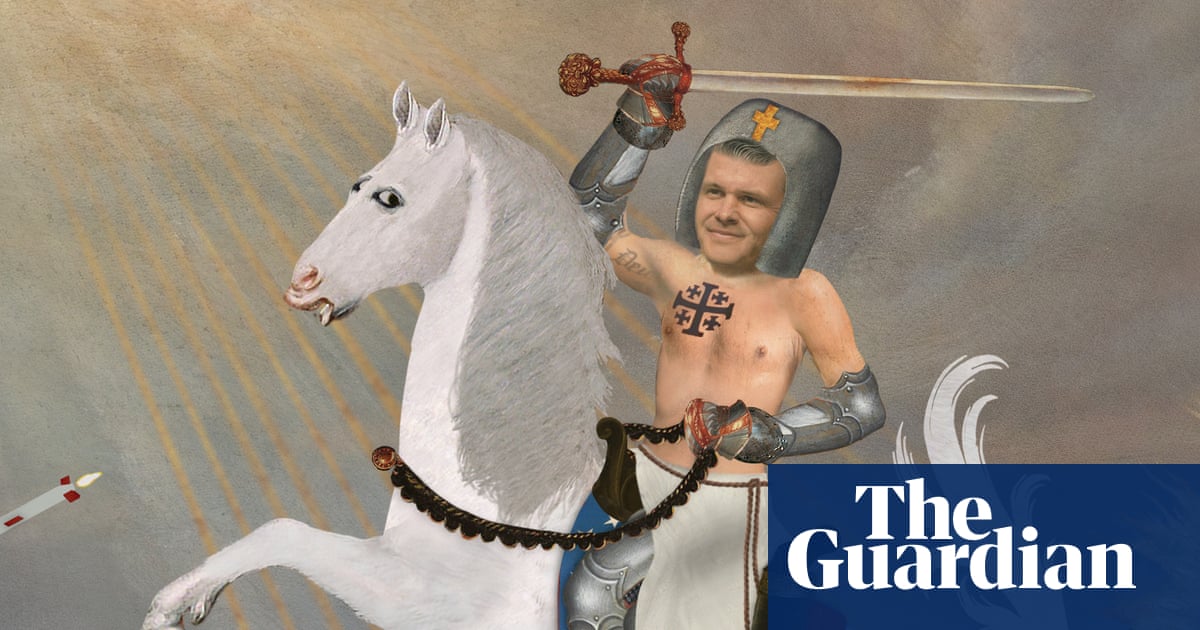
Hegseth bears a tattoo on his right bicep inscribed with “Deus Vult,” a Latin phrase meaning “God wills it,” historically associated with the Christian forces who embarked on the Crusades in the 11th century. As both American and Iranian populations find themselves entangled in this widely unpopular conflict, it is crucial to comprehend what “God wills it” signifies for Hegseth and the potential implications for broader society.
Hegseth has characterized his upbringing as possessing a “Christian veneer but a secular core.” Raised in Minnesota, he underwent officer training at Princeton and served multiple deployments in Iraq, Afghanistan, and Guantanamo Bay. Although a longtime reservist, he departed the service after being reported by fellow service members.