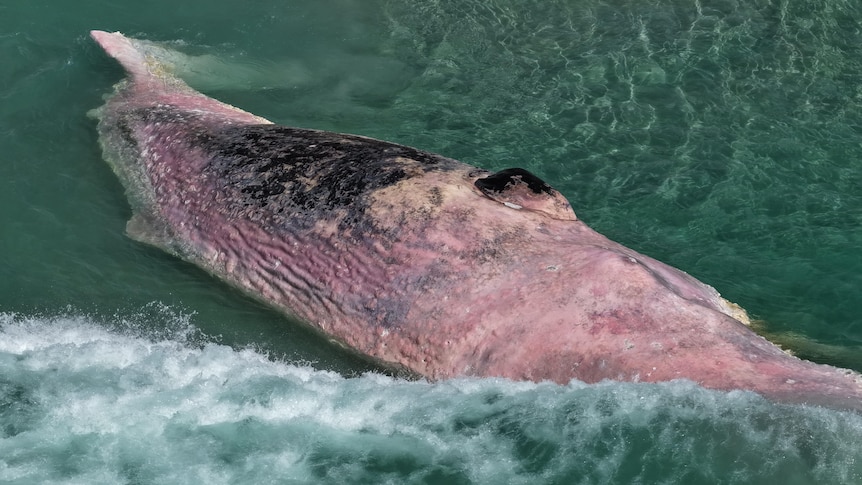

A 40-ton sperm whale carcass has been decomposing on a beach in Tasmania for the last month, and the state’s environmental authorities have determined that relocating it is not practical.
The presence of the carcass, along with concerns regarding potential shark activity, has necessitated the relocation of the annual Devil of a Swim event from Bicheno to Coles Bay.
The environment department is currently monitoring the situation. However, organizers of the swim have reported a significant drop in registrations compared to the previous year.
This event is the largest open-water swim in Tasmania, attracting hundreds of participants each year at Bicheno, located on the picturesque east coast of the state.
The decaying sperm whale, which has been found at Denison Beach, approximately 9 kilometers north of Bicheno, poses a threat to this year’s swimming event. The Natural Resources and Environment Department has opted to allow the carcass to decompose naturally, citing the impracticality of moving such a large animal.
As a precaution, the Devil of a Swim, scheduled for April 26, has been moved 37 kilometers south to Coles Bay due to fears that the carcass might draw sharks.
Former Olympic gold medalist Shane Gould, who resides on Tasmania’s east coast and swims daily, expressed her concerns about the whale carcass attracting sharks. “We’ve been fighting for a month or so to try and get the whale carcass removed because they attract sharks,” Gould remarked to ABC Northern Tasmania.
She added, “The whale has disrupted our daily lives; we’re now only swimming in shallow waters and surfing very close to the shore, which has affected our sense of community safety.”
Gould noted that the whale has decomposed to the point that it has split into two parts, with blubber oils now being detected in Waubs Bay, the traditional location of the swim event she established in 2010.
Registrations for this year’s event are significantly lower than last year’s record of 330 participants from Tasmania and beyond. Hannah Taylor from the Bicheno Surf Life Saving Club reported that only about 127 individuals have signed up so far.
“We received a lot of guidance from Surf Life Saving Tasmania, which strongly suggested we move the event,” Taylor stated. “Many people feel relieved that we aren’t proceeding with it at Bicheno.”
The Natural Resources and Environment Department indicated that the whale had likely been deceased for one to two weeks before it washed ashore. They confirmed they are actively monitoring the situation.
A representative from the department explained, “Whale strandings are natural occurrences, and this carcass was already significantly decomposed when it arrived on the beach. Given the condition of the carcass, its size, and the challenges in accessing the site with heavy machinery, moving it is not feasible; therefore, it will decompose naturally at the site.”
Vanessa Pirotta, a whale scientist at Macquarie University, acknowledged that while it is preferable to remove whale carcasses, it is not always achievable. “In this case, the whale likely perished at sea, which complicates the logistics of removing parts of it rather than the whole carcass at once,” Dr. Pirotta explained.
Deputy Mayor of Glamorgan-Spring Bay, Michael Symons, acknowledged that residents have reported odors emanating from Denison Beach, but these have not been detected in the town of Bicheno. “I certainly recognize the concerns of some community members; there has been an increase in marine activity in the area,” he stated. However, he noted that most local residents and business owners have accepted the situation.
Symons went on to say that water testing in the vicinity has shown no public health risks related to the whale carcass. He lamented the missed opportunities for Bicheno to benefit from the influx of visitors typically associated with the swim event, saying, “It is unfortunate, but even though the risk is minimal, it is a risk that the surf club could not take.”
Dr. Pirotta also highlighted that Tasmania is part of the “humpback highway,” a migration route for humpback whales along Australia’s east coast. “This stranding serves as a reminder of the incredible marine life activity in the area,” she remarked.
The Natural Resources and Environment Tasmania advised the public to maintain a safe distance from the carcass, as wild animals can carry diseases, and also reminded individuals that it is illegal to interfere with the animal or possess any parts without the necessary permits.