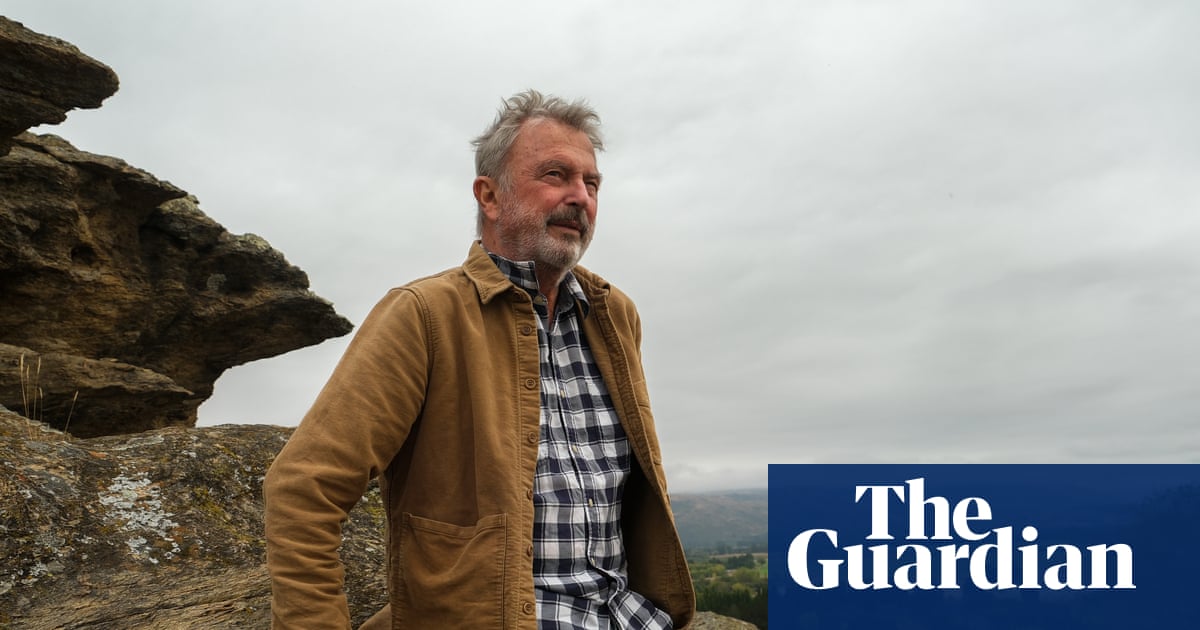

The vineyards owned by Sam Neill in Central Otago, a stunning area celebrated for its rolling hills and fine wines, are currently laden with pinot noir grapes, nearing readiness for harvest as autumn approaches.
At 78 years old, the actor and winemaker expresses a deep connection to this land, stating, “My family has been here for over 150 years. I feel more connected to this place than anywhere else on Earth. It’s ideal for winemaking, attracts tourists, and is one of the most beautiful and unique locations globally.”
However, this pristine environment may soon face irreversible changes.
Just a few kilometers from Neill’s vineyard, the Dunstan mountains rise, often cloaked in clouds. This region has been designated as an “outstanding natural landscape” by the Central Otago district council. Here, the Australian mining company Santana Minerals is seeking to fast-track a contentious open-pit gold mine, known as Bendigo-Ophir, measuring 1,000 meters by 850 meters. In November, the company submitted a request to the New Zealand government for permission to extract an estimated $6.75 billion worth of gold deposits.
The proposed site, situated 20 kilometers north of Cromwell, is within an area that experienced a gold rush beginning in 1861. Proponents of the Bendigo-Ophir mine have labeled it New Zealand’s most significant gold find in decades.
Yet, this mining proposal has sparked significant discord among local communities.
The Sustainable Tarras environmental group perceives the mine as a direct pathway to environmental degradation and a threat to tourism in one of New Zealand’s premier wine-producing areas, which also boasts the nation’s lowest unemployment rate.
In the aftermath of the COVID-19 pandemic, New Zealand appears to be bifurcating into two distinct realities: one that draws international tourists to its breathtaking landscapes reminiscent of the Lord of the Rings, and another where the government has moved to dismantle its dedicated environmental ministry while hastening mining initiatives that it claims will enhance the economy.
Critics assert that the Bendigo-Ophir mine could adversely impact tourism and jeopardize the habitats of up to 650,000 native lizards, a claim that Santana Minerals contests. Additionally, opponents have raised concerns about the potential for a toxic waste dam associated with the mine to fail during an earthquake, an assertion the company dismisses as unfounded.
A representative from Sustainable Tarras stated, “This industrial-scale mine, located in one of New Zealand’s most pristine and iconic areas, poses a significant risk to our environment and undermines New Zealand’s reputation as ‘clean, green, and 100% pure.’”
Neill, who is widely recognized for his role in the Jurassic Park franchise, is lending his support to the group and has produced a short documentary to advocate for their cause.
“I’m not against mining; I oppose this specific mine,” Neill remarks, having cultivated wine under his Two Paddocks label in the region for three decades. “If this mine proceeds – and I hope it does not – everything you see there is claimed by the mining company. Mining will surround us, and that will be the end.”
The Bendigo-Ophir goldmine is one of many projects currently under consideration as part of the coalition government’s contentious fast-track legislation, which led to widespread protests in 2024 and garnered nearly 30,000 public submissions regarding the bill.
Resources Minister Shane Jones, a proponent of the “drill, baby, drill” ideology, claims the mine will generate 357 jobs and indirectly support an additional 500 positions annually. He aims for New Zealand to double its mineral mining exports by 2035.
Local resident Mark Davidson, 64, who has experience in both farming and the wine sector, believes the mine could be a local remedy for the rising number of New Zealanders emigrating, primarily to Australia.
“It’s becoming increasingly difficult to afford a house deposit,” Davidson notes. “If the economy were stronger, I believe many expatriates would return home.” He asserts that most locals support the mine.
The proposed mine will be evaluated under the fast-track legislation, which is designed to expedite large projects related to energy, mining, and infrastructure.
Some fast-track applications have included “zombie projects,” such as a previously rejected hydro scheme on the Waitaha River, which received provisional approval in March despite being declined in 2019 during Jacinda Ardern’s Labour government.
Former Prime Minister Helen Clark has criticized the current administration for showing “little regard” for environmental concerns, stating, “Its fast-track legislation overrides essential environmental and conservation protections, amending planning laws in favor of development.”
Hayden Johnston, a local entrepreneur of Māori Ngāi Tahu and Scottish heritage, operates a wedding venue and Kuru Kuru winery located within 5 kilometers of the proposed mine site.
While the opencast mine won’t be visually intrusive from his venue, its processing plant will operate continuously under a 30-year permit, which Johnston believes will result in noise disruption, a claim that Santana Minerals refutes based on modeling data.
Johnston, who has been running his wine label for 24 years, comments, “We would not have developed a world-class wine region in Bendigo had we known an opencast pit would be established nearby.”
He emphasizes that grape cultivation is sustainable, whereas gold extraction leads to long-lasting environmental damage. “Gold is a finite resource. You deplete the land, creating a toxic legacy, but you can only extract the gold once.”
The mining industry has a history of environmental catastrophes linked to inadequate waste management in tailings dams, a type of dam planned for the Bendigo-Ophir project. This dam will permanently contain hazardous waste, including arsenic.
Prominent Māori businessman Ian Taylor expresses concern about the 600-kilometer-long alpine fault that runs down the South Island, stating, “The dam will hold toxic materials in a seismic zone. The risks posed by Santana will have repercussions for generations beyond their departure.”
Santana Minerals asserts that the dam has been meticulously engineered to endure a one-in-10,000-year seismic event, maintaining that it will provide the necessary safety measures.