
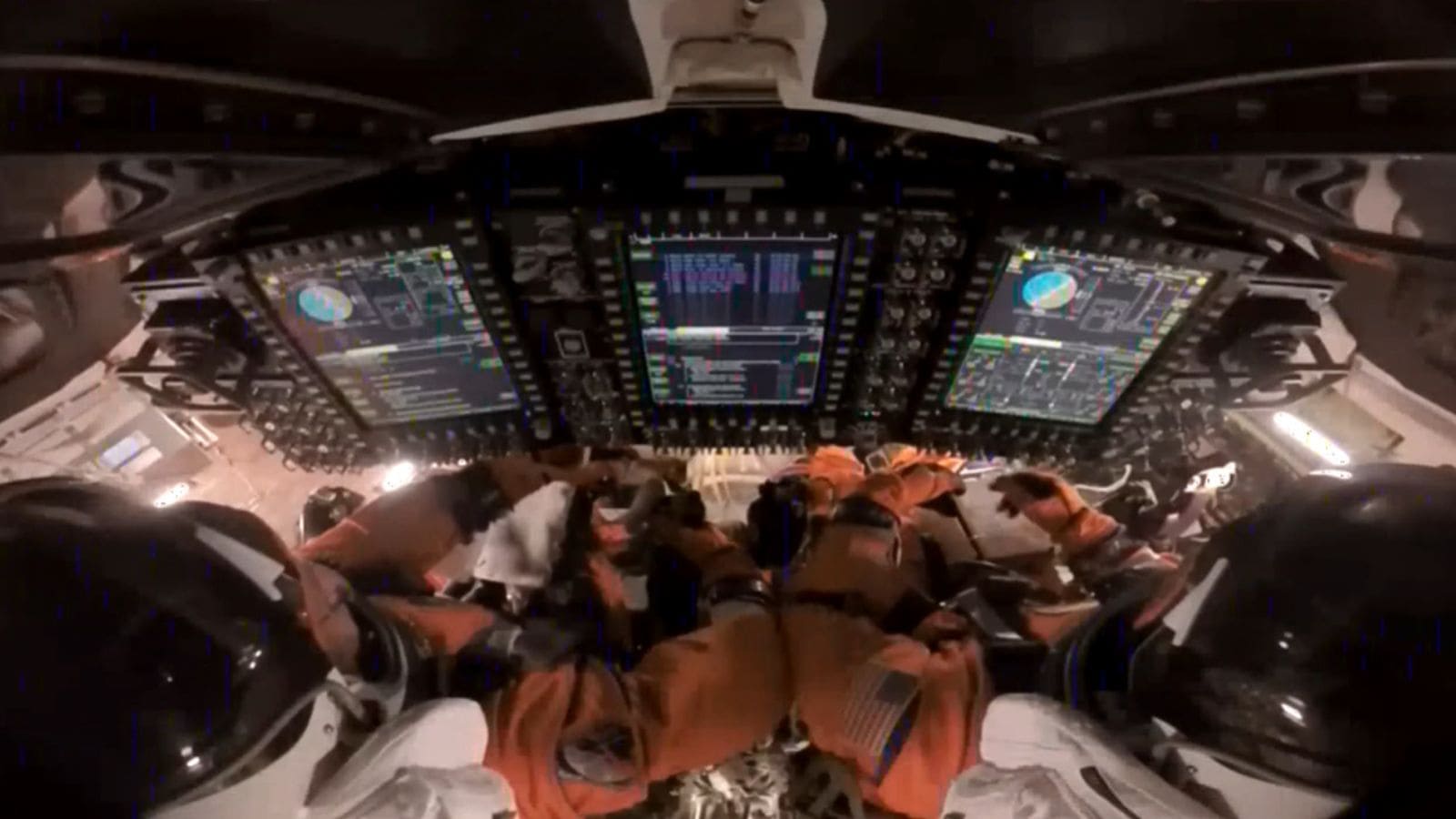

This morning, NASA’s Artemis II mission concluded its historic journey around the Moon as the four astronauts onboard returned safely to Earth, achieving a remarkable milestone by traveling farther from the Earth’s surface than anyone before them.
The Orion spacecraft, which carried American astronauts Reid Wiseman, Victor Glover, and Christina Koch, along with Canadian astronaut Jeremy Hansen, executed a splashdown in the Pacific Ocean near southern California shortly after 5 AM IST on Saturday.
The Artemis II crew marked the first human presence near the Moon in over fifty years. Although they did not land on its surface, their mission trajectory allowed them to reach a distance of 252,760 miles (406,778 kilometers) from Earth—surpassing the Apollo missions of the 1960s and 1970s. Notably, they traveled approximately 4,105 miles (6,606 kilometers) farther than Apollo 13 did in 1970.
Throughout their ten-day mission, the Artemis II astronauts covered a total distance of 694,481 miles (around 1.12 million kilometers). However, this does not exceed the longest distance traveled by a manned mission; for instance, Apollo 17, the final mission in the Apollo series, journeyed about 1.48 million miles (2.38 million kilometers). The average distance from Earth to the Moon is approximately 384,400 kilometers, indicating that a round trip would require at least 768,800 kilometers. Yet, the actual distance traveled by spacecraft can vary due to complex flight paths and the shifting positions of the Earth and Moon in their elliptical orbits. The total distance covered during such missions is influenced by the mission’s design, including the duration spent in lunar and Earth orbits and the specific geometry of the Earth-Moon system at the time of travel.
As the Orion spacecraft re-entered Earth’s atmosphere, it was traveling at a velocity of 11-12 kilometers per second (about 40,000-42,000 kilometers per hour). This speed is significantly greater than the 26,000-28,000 kilometers per hour typical for spacecraft returning from the International Space Station (ISS) or similar low-Earth orbits. The increased velocity results from lunar missions being farther away, which allows them to gain more speed under Earth’s gravity before re-entry. In contrast, the ISS operates at an altitude of approximately 400 kilometers, while the Moon is nearly 400,000 kilometers distant. Consequently, the higher speeds necessitate stronger spacecraft to endure the increased physical stresses associated with re-entering the atmosphere.
Upon re-entry, the Orion spacecraft, like others, was designed to decelerate rapidly. The initial parachutes deployed at an altitude of around 6 kilometers, followed by a second set at about 2 kilometers above the ground. By this point, the spacecraft had reduced its speed to roughly 200 kilometers per hour. At the moment of splashdown, it was traveling at only 30 kilometers per hour. NASA and U.S. military teams were strategically positioned in the vicinity of the landing site to assist in crew retrieval post-splashdown and transport them to a nearby ship.
The successful completion of the Artemis II mission paves the way for the first manned Moon landing in over fifty years, currently planned for 2028. Artemis II represents the inaugural crewed mission within NASA’s Artemis program, which aims to return humans to the Moon long after the Apollo program successfully landed 12 astronauts across six historic missions. The first Artemis mission in 2022 was an uncrewed flight that orbited the Moon and returned. With Artemis II successfully executing a trial run for the upcoming Moon landing, the program signifies the dawn of a new era in human space exploration, with aspirations for establishing a permanent lunar settlement and facilitating regular human visits to the Moon’s surface.