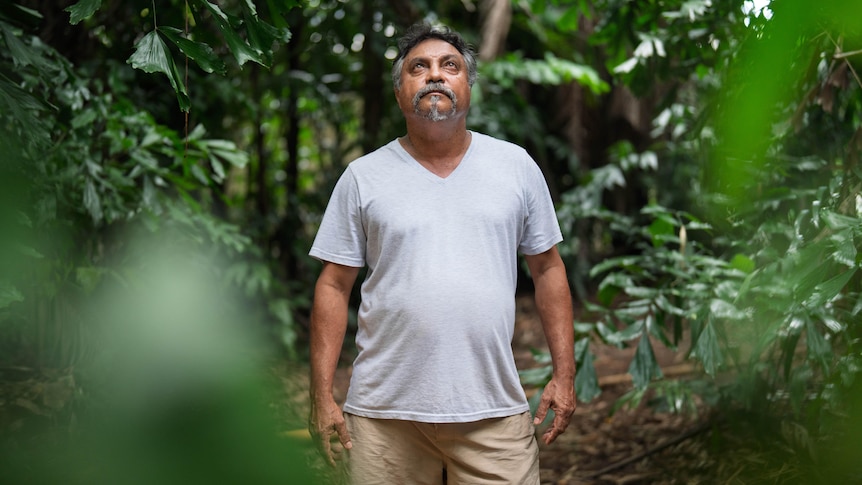

In 2019, during a dry season, Fred Hunter found himself lying on the ground in Kakadu National Park, injured and covered in blood and fuel, when he began to feel a sharp pain on his leg.
Mr. Hunter, a ranger, had been in a helicopter with a pilot and fellow ranger Ian Conroy, overseeing the control of feral animals near Gunlom Falls when the helicopter’s engine suddenly failed. This malfunction caused the aircraft to descend rapidly. He recounted, “We were pursuing horses when the helicopter transitioned from full power to idle, and in seconds, we were crashing to the ground.” He described the severity of the crash, noting that one of the rotors shattered, cutting through the engine and the cabin, even severing one of their rifles upon impact.
Approximately an hour after the distress call was made, CareFlight arrived on the scene, deploying medics to assist and evaluate the injured individuals. It was during this assessment that Mr. Hunter felt something biting into his leg. “I told them to grab scissors and cut my trousers; I could feel something crawling inside,” he recalled. Upon cutting away his clothing, they discovered that meat ants had infiltrated his leg, leaving his calf muscle exposed and skin torn back to his groin.
Despite their injuries, Mr. Hunter, along with the other men, was airlifted to Darwin, where they all survived the incident. Mr. Hunter was among numerous patients who expressed gratitude for CareFlight’s services as the organization marked its 20th anniversary in the Northern Territory this week.
Jodie Mills Mitchell, the general manager of CareFlight and a former flight nurse, highlighted that the service has conducted over 100,000 missions in the region and that the anniversary provided an opportunity to reflect on the stories of patients like Mr. Hunter. “This celebration truly filled my heart,” Ms. Mills Mitchell stated. “The fact that people commonly use ‘CareFlighted’ in conversations indicates how integral we are to the community.”
Ms. Mills Mitchell noted that medical personnel in isolated areas often feel relieved when they hear the sound of a CareFlight helicopter, though the situation becomes more complex when responding to patients involved in a helicopter crash. “Being winched up is already a daunting experience, compounded by the uncertainty of the situation,” she explained.
Having served as a Kakadu ranger for 38 years, Mr. Hunter was in the front passenger seat of the helicopter, fulfilling the role of spotter during a routine culling of feral horses. After the crash, he lost consciousness, and upon regaining awareness, he found himself surrounded by chaos, with the pilot’s head resting in his lap and the wreckage enveloping them.
Despite his injuries, Mr. Hunter managed to extricate himself from the wreck and activated an emergency beacon, sending a mayday signal to park headquarters. While he was unable to rescue Mr. Conroy, who remained trapped, he did manage to pull the injured pilot from the helicopter. However, he soon collapsed on the ground as his body seized up, rendering him immobile.
Reflecting on the traumatic experience, Mr. Hunter stated that while he had frequently flown in helicopters for work, the incident drastically altered his perspective. “I had just come down in one and was suddenly going back up in another,” he noted. “Being hoisted up was surreal; watching the helicopter and its blades, I felt a profound sense of fear.”
On this significant anniversary for the aeromedical service, Mr. Hunter emphasized the importance of CareFlight in remote areas of the Northern Territory, particularly in regions like Arnhem Land. “It’s vital to have a service that can reach those in need,” he affirmed. “In my case, their response was nothing short of remarkable.”