
In a groundbreaking mission that spanned nine days, one hour, 32 minutes, and 15 seconds, four astronauts embarked on an unprecedented journey deeper into space than ever recorded, captivating audiences back on Earth. This historic expedition was marked by a series of remarkable achievements.
The launch generated significant excitement among spectators, and the subsequent flyby set new records, offering breathtaking imagery that showcased the vastness of space. The mission successfully ventured 400,000 kilometers from our planet, a distance unmatched in human spaceflight history.
During the Artemis II mission, the crew covered a total distance of 1,117,515 kilometers, completing two orbits of Earth before executing a pivotal lunar flyby. This mission represents the first crewed test flight in the Artemis program, which aims to return astronauts to the lunar surface.
As they traversed the dark side of the Moon, the astronauts witnessed a total solar eclipse from the unique vantage point of deep space. Astronaut Jeremy Hansen communicated his awe back to mission control, saying, “It is blowing my mind what you can see with the naked eye from the Moon right now. It is just unbelievable.”
Upon reaching the milestone of venturing deeper into space than any human before, the crew proposed naming two lunar craters: one in honor of their spacecraft, Integrity, and another to commemorate the late wife of mission commander Reid Wiseman, named Carroll. Hansen remarked, “It’s a bright spot on the Moon. And we would like to call it Carroll.”
The final hours of the Artemis II mission proved to be the most challenging. While space travel is inherently risky, the return journey is particularly critical. The first key event was the separation of the crew module from the service module, occurring approximately 20 minutes prior to the Orion spacecraft’s reentry into the upper atmosphere.
Shortly thereafter, the crew module executed its raise burn to adjust its trajectory for a safe descent back to Earth. This was followed by a series of roll maneuvers to ensure the module distanced itself safely from the departing hardware. The entry interface stage marked the moment the module first interacted with Earth’s upper atmosphere.
At this juncture, all operations were proceeding as planned, leading to a six-minute communications blackout caused by the formation of plasma around the capsule, which obstructed radio signals. Around the globe, people anxiously awaited NASA’s reconnection with the crew.
After six tense minutes, communication was restored, and NASA confirmed that the spacecraft’s trajectory was “perfect.” Shortly after, Wiseman reestablished contact with mission control. Concerns had been raised prior to the landing regarding the spacecraft’s heat shield, which was engineered to withstand the intense temperatures—approximately 3,000 degrees Celsius—encountered during reentry.
The heat shield, composed of 186 blocks of a specialized material called Avcoat, was designed to burn in a controlled manner to prevent overheating of the area beneath it. Avcoat had been successfully utilized in previous missions, albeit in a single piece during the Apollo era, while Artemis missions applied it in multiple blocks. Following the Artemis I mission, engineers identified over a hundred cracks and craters on the heat shield, but NASA later assured that the heat shield for Artemis II was safe for crewed flight.
NASA stated, “Extensive data from the investigation has given engineers confidence the heat shield for Artemis II can be used to safely fly the mission’s crew around the Moon and back.” All four astronauts concurred with this assessment, and the heat shield performed as intended during reentry.
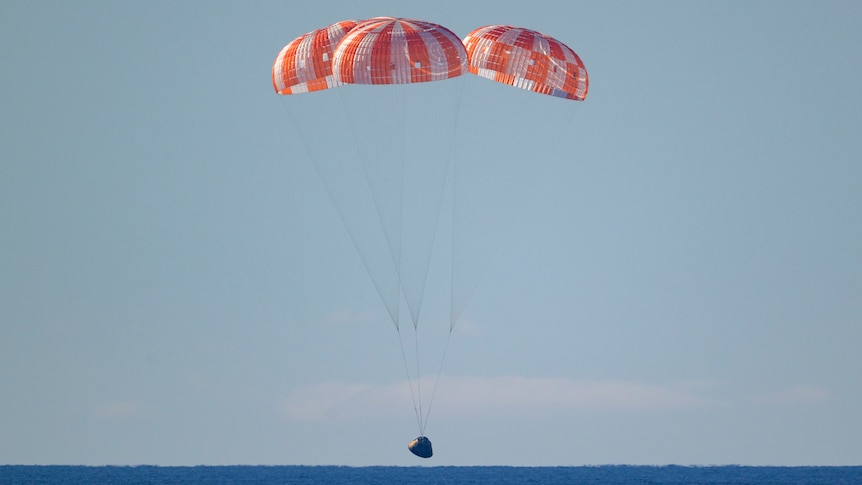
After the intense nine-day journey, the Artemis II capsule successfully splashed down in the Pacific Ocean, an event described as “a perfect bullseye” by NASA commentator Rob Navias. The Orion capsule, named Integrity, descended gently into calm waters off the Southern California coast shortly after 5:07 PM Pacific Time.
A navy medical officer who inspected the astronauts post-splashdown reported that all were in good health. Mission commander Wiseman relayed, “We are stable one—four green crew members,” indicating that the capsule was secure and all astronauts were well.
Elated, the crew celebrated as they floated in the ocean. Artemis II landing and recovery director Liliana Villarreal noted their excitement, stating, “They were already out of their seats, having a good time, waiting for us to open the hatch.” Recovery teams from NASA and the US Navy secured the capsule and retrieved the crew within two hours, which included US astronauts Wiseman, Victor Glover, Christina Koch, and Canadian astronaut Hansen.
After exiting the hatch, the astronauts spent a brief period on an inflatable life raft before being hoisted into helicopters and transported to the USS John P Murtha. Villarreal commented on the crew’s evident joy upon returning home, noting their stability as they walked from the helicopters to the medical bay for evaluations.
While the astronauts ventured further into space than any humans before, those of us on Earth were captivated by their journey, which provided a welcome distraction in a time of challenging news cycles. This closely-knit team garnered admiration as they shared their experiences from space.
The mission of nine days, one hour, 32 minutes, and 15 seconds in space has concluded, but it marks just the beginning. Artemis II serves as the inaugural crewed test flight in a series of missions designed to advance human exploration beyond Earth.