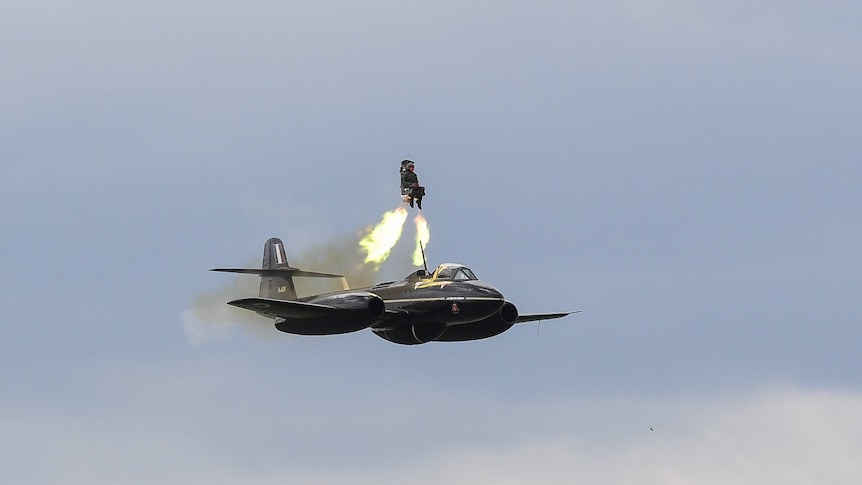

The decision to eject from a fighter jet is a critical one that pilots hope never to face, yet it must be made in a fraction of a second. Activating the emergency ejection lever initiates an irreversible sequence of events.
In mere moments, rocket motors beneath the seat ignite, propelling the pilot into the air with forces that can reach up to 20 Gs. This was the situation for Brian Udell, a retired U.S. Air Force captain, as he faced the imminent crash of his F-15 fighter jet into the Atlantic Ocean.
“I ejected with only a third of a second left,” Udell recounted to ABC. “Had I delayed pulling the handle by just that fraction of a second, I would have hit the water while still seated.”
The act of ejecting is something that Air Force personnel rigorously train for throughout their careers. They prepare their bodies and minds to endure and react to severe, sudden trauma, recognizing that ejection is only the first step in a potentially perilous situation.
During the early stages of the U.S. military involvement in Iran, six American crew members successfully ejected from three F-15E Strike Eagles that were accidentally engaged by Kuwaiti air defenses. Additionally, an F-15E was shot down by Iran, resulting in two crew members being ejected into hostile territory, as noted by President Donald Trump.
One of the crew members, identified as Dude 44 Bravo, was missing for nearly two days while evading capture despite being severely injured.
Following one of the fastest ejections on record, Captain Udell shared insights into the challenges faced by aircrew members in similar situations. He described the mindset required for survival as one of primal instinct.
On the day of his ejection, Captain Udell was 31 years old and undergoing a training exercise off the coast of North Carolina in 1995. At an altitude of around 3,000 meters and speeds exceeding 1,000 km/h, he issued the command to “bailout! bailout! bailout!”
“I vividly remember pulling the ejection handles,” he said. “A flash of light erupted behind me, illuminating the cockpit.”
Within 0.15 to 0.2 seconds, the ejection handle activates the jet’s canopy, causing it to explode off. Following this, a series of explosions propel the seats along a rail, culminating in the ignition of a solid-fuel rocket engine that launches the crew upward.
“A sequence of pyrotechnic charges fires in rapid succession, each more powerful than the last,” explained Captain Udell. “This design prevents immediate firing of the main catapult, which could cause serious injury to the spine.”
As crew members are ejected one after another, they are launched upwards to allow enough altitude for parachute deployment. Depending on the aircraft and circumstances, pilots may experience G-forces equivalent to 20 times gravity. Captain Udell’s ejection occurred at a speed of approximately 1,260 km/h, resulting in forces so intense that medical professionals were astonished he survived.
Unfortunately, Dennis White, Udell’s weapons systems officer, did not survive the ejection.
An ejection test conducted at Holloman Air Force Base in New Mexico illustrates the process of crew members being launched from a two-seat jet.
Aaron Love, a retired U.S. Air Force pararescueman trained in personnel recovery, explained that the rapid acceleration creates immense pressure on the spinal cord. “In the fighter community, we joke that ejection can make you about three inches shorter,” he remarked. “The spinal compression is significant; some pilots have reported actually becoming shorter because of it.”
Captain Udell further noted that his situation was far more severe than that of the crew who ejected in Iran. “When I ejected, I was travelling at supersonic speeds; they were not near that velocity,” he stated. His mask was torn away, leading to facial injuries, and his head swelled dramatically.
He also suffered substantial “flailing injuries,” though advancements in ejection seat technology have reduced the occurrence of such injuries in recent years. “That’s when your limbs are thrown outward and exposed to the wind,” explained Udell. “I ended up with two broken legs, a dislocated elbow, and a separated shoulder.”
In response to incidents like Udell’s, modern ejection seats are equipped with straps and webbing that secure the pilot’s body in a safe position as the ejection lever is activated, forming a protective “cocoon” until the seat slows. Current ejection systems boast a success rate of approximately 90 percent.
The exact speed and altitude of the F-15 shot down in Iran remain uncertain, but crew members faced dangers, with one reported to have spent 36 hours awaiting rescue while sustaining severe injuries. He had to scale a 2,100-meter ridge and hide in the mountainous terrain to evade Iranian forces.
In an ideal ejection, sensors in the seat would detect when the pilot’s freefall stabilized and, upon reaching an altitude with breathable air, the primary parachute would automatically deploy before separating from the seat.
John Conway, a defense analyst and managing director at Felix Defence, highlighted that each stage of the ejection process still requires the pilot to manage their instinctive responses. “The optimal human reaction is the result of years, if not decades, of training and preparation,” he noted. “The ability to maintain composure under extreme pressure is a crucial aspect of aircrew training, which continues to evolve as we gain a deeper understanding of human psychology.”