
Despite a ceasefire declared by the Kremlin for the Easter holiday, Russian forces continued their drone attacks on Ukrainian positions, according to a Ukrainian military spokesperson. Serhii Kolesnychenko, a communications officer from the 148th Separate Artillery Brigade, reported that while artillery fire had ceased in their operational area at the border of Donetsk, Dnipropetrovsk, and Zaporizhzhia regions, drone strikes persisted.
Kolesnychenko indicated that Ukrainian forces adopted a policy of responding with “silence to silence and fire to fire.” He noted that Ukraine’s military command recorded 469 instances of ceasefire violations by Russian troops by Saturday night.
In a counterclaim, Russian officials accused Ukraine of breaching the ceasefire. Alexander Khinshtein, governor of Russia’s Kursk region, stated that a Ukrainian drone attack on a gas station in Lgov resulted in injuries to three individuals, including a child. Additionally, in the Belgorod region, Governor Vyacheslav Gladkov reported injuries to two people from drone strikes in the towns of Shebekino and Grayvoron, along with damage to residential structures.
On Thursday, President Vladimir Putin announced a 32-hour ceasefire intended to coincide with Orthodox Easter, instructing military forces to halt operations from 4 PM Saturday until the end of Sunday. Ukrainian President Volodymyr Zelenskyy expressed his commitment to uphold the ceasefire, viewing it as a potential step toward peace, while cautioning that any violations would be met with a decisive military response.
Zelenskyy remarked that Easter should embody “silence and safety,” and hoped that the ceasefire could serve as a foundation for genuine peace efforts. However, he acknowledged the complexities involved, emphasizing Ukraine’s readiness to respond proportionately to any aggression.
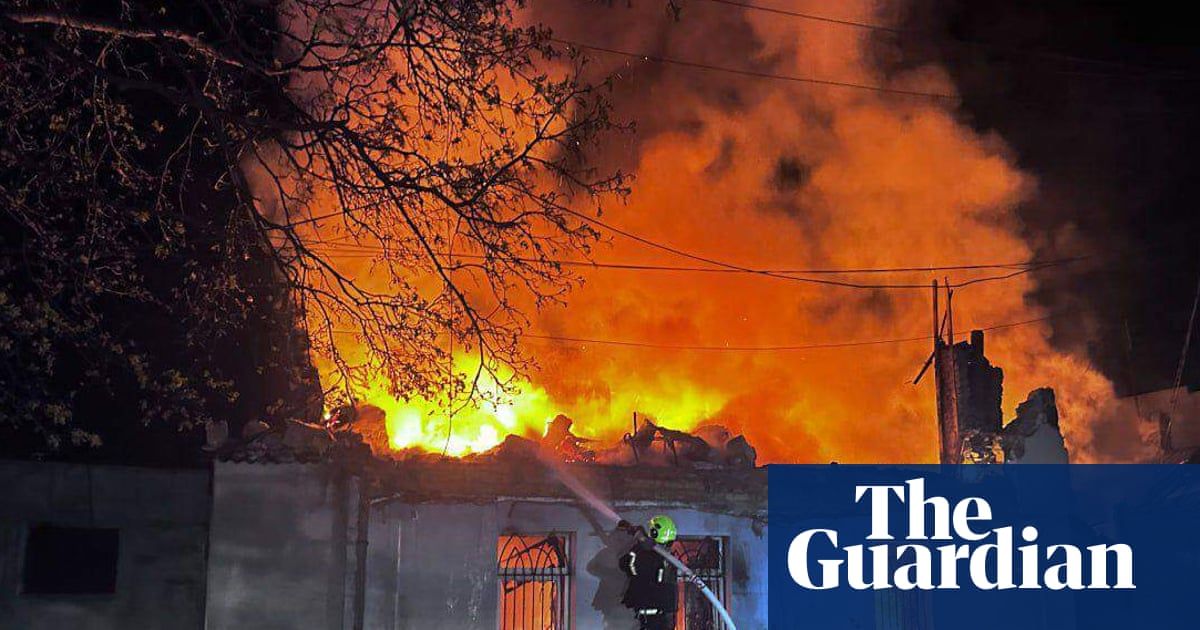
Prior to the ceasefire’s commencement, Russian drone assaults in Odesa resulted in at least two fatalities, with additional injuries reported when residential areas were struck, including damage to homes and a kindergarten. In Kherson, a drone hit a public trolley bus, leading to the death of the driver just before the ceasefire was set to take effect. Ukrainian air force officials reported that Russia launched 160 drones overnight, of which 133 were intercepted.
Meanwhile, Russia’s defense ministry claimed to have shot down 99 Ukrainian drones across its territory and occupied Crimea. In a separate development, a prisoner swap on Saturday resulted in the return of 175 Russian soldiers, a move confirmed by Zelenskyy, who noted that the majority had been held since 2022.
As families of returned prisoners of war gathered in northern Ukraine, many expressed their hopes for the safe return of their loved ones still unaccounted for. The emotional scene included relatives holding pictures of missing soldiers and chanting greetings to those who had just returned. One mother, Svitlana Pohosyan, expressed her longing for her son, expressing hope that the ceasefire could lead to lasting peace.
Pohosyan stated, “My celebration will come when my son returns. I will hold him in my arms – and that will be the greatest celebration for me and for every mother, every family.”
Periodic exchanges of prisoners have emerged as a rare positive outcome amidst prolonged negotiations between Moscow and Kyiv, which have yet to yield significant progress toward resolving the ongoing conflict that has persisted for five years.
In a distinct event, seven individuals from Russia’s Kursk region who had been captured by Ukrainian forces were reported to have returned home, welcomed by Russia’s human rights ombudswoman at the Belarusian-Ukrainian border. Tatyana Moskalkova noted that these returnees were the last individuals taken from the Kursk region following its temporary occupation by Ukrainian forces in 2024, marking a significant moment in the ongoing conflict.