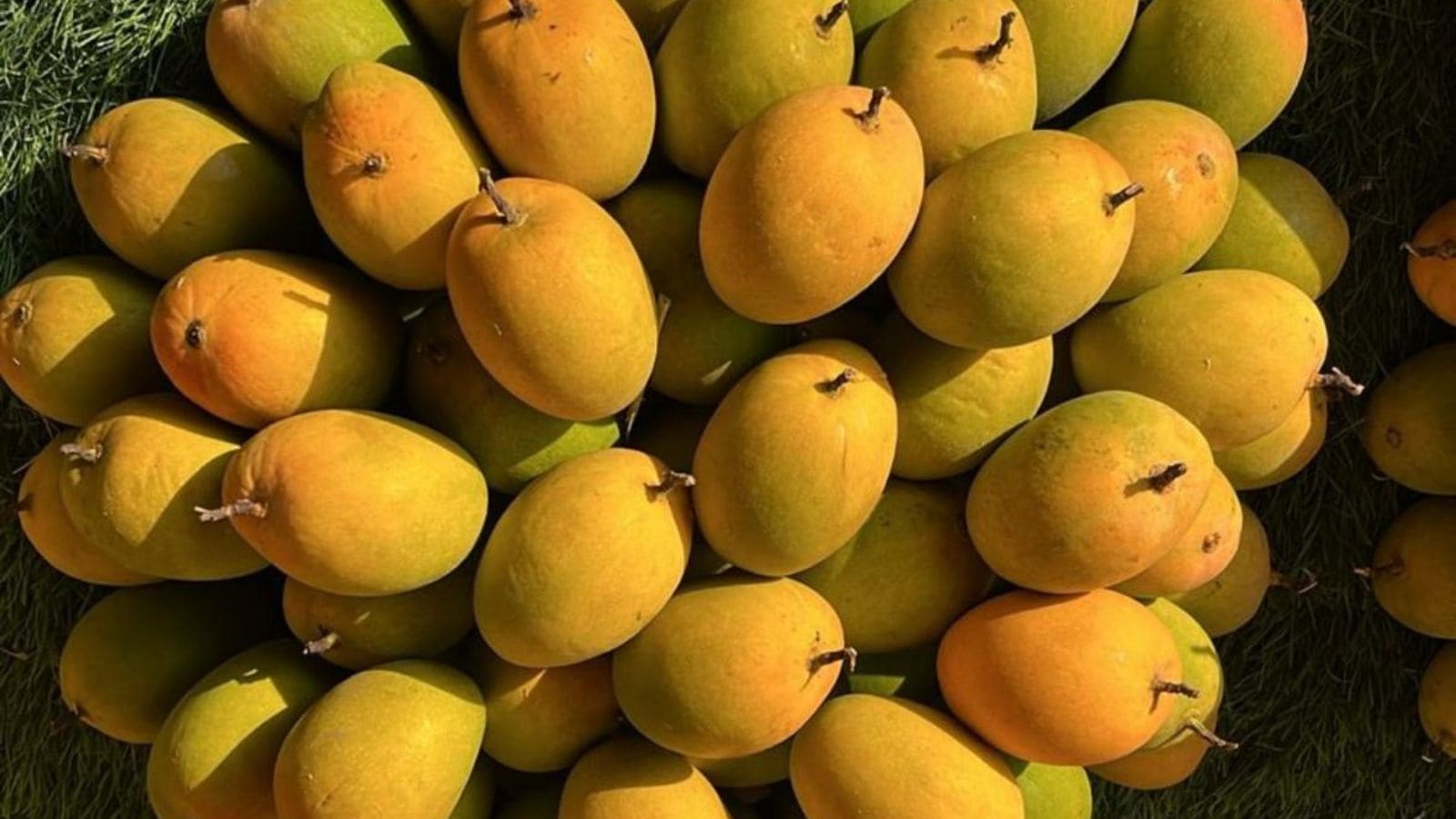

The familiar scent of Hapus, or Alphonso mangoes, which typically envelops Pune’s Gultekdi market during the festival of Akshaya Tritiya, is notably absent this year. With fewer boxes available and soaring prices, farmers cultivating Maharashtra’s esteemed mango variety are facing unprecedented losses that they describe as unparalleled in recent times.
Anand Marathe, a mango grower from Rajapur taluka in Ratnagiri district, has been involved in this industry for over 25 years and states that this season has been particularly challenging. “This year, we have only about 20 percent of last year’s yield. Previously, I would send around 100 boxes daily to Mumbai and Pune, but now I can barely manage 20,” he remarked.
Marathe attributes the significant decline in production to a series of adverse weather conditions, including unexpected rainfall and drastic temperature fluctuations that disrupted the crucial flowering phase. The flowering in January suffered considerably, while the February flowering, which typically produces fruit by mid-May, is also anticipated to be disappointing.
The reduced yield has compelled farmers to reconsider basic logistics. “The limited produce makes individual transportation economically unfeasible. Now, several of us combine our harvests and share transportation costs,” he added.
Furthermore, the investments made in field preparation have not yielded returns. For Marathe, who usually employs 30 migrant workers from Nepal for his 1,000-tree orchard, the diminished harvest has also had human repercussions. “I had to send 20 of them back due to the lack of work,” he stated.
Marathe urges the government to expedite the processing of crop insurance claims. “Typically, relief arrives around Diwali, but by then it’s too late for us to prepare for the next planting cycle. If claims are settled by June, we can at least start getting the farm ready for the Kharif season,” he said.
A similar narrative unfolds across the Konkan region. Narendra Desai, who oversees a 5,000-tree plantation with his family in Pavas village, shared that initial expectations for this season have been dashed. “Last year’s rainfall was satisfactory, leading us to anticipate a bumper crop. However, the subsequent weather was quite unfavorable. The cold nights and scorching afternoons, reaching up to 35 degrees Celsius, created significant stress on the trees exactly when they required stable conditions for flowering,” he explained.
The Desai family has experienced a nearly 50 percent reduction in their overall harvest this year. “We remain cautiously optimistic that supplies in April may stabilize, but May is uncertain given the current weather patterns,” Desai added.
Dr. Vivek Bhide, chairman of the Hapus Amba Utpadak Vikreta Sahakari Sangh, has been involved in the Alphonso trade for over four decades and expresses deep concern about the current situation. “The only thing predictable about the weather now is its unpredictability. This year has been one of the worst we have encountered. Everything seemed fine until December, but the sudden cold wave in January and February undermined all our expectations,” he said.
The initial flowering of the Alphonso, known locally as mohar, requires temperatures between 19 and 24 degrees Celsius for successful fruit development. Unfortunately, this year, temperatures dipped below 10 degrees Celsius in certain areas of the Konkan region, causing flowers to drop before fruit could form. Additionally, early morning dew exacerbated the situation, leading to fungal infections on the blossoms.
Dr. Bhide noted that similar conditions have been observed across Raigad, Ratnagiri, Sindhudurg, Palghar, and Thane, effectively affecting every district in Maharashtra that cultivates Alphonso mangoes. “The erratic rainfall followed by sharp temperature changes severely disrupted the trees’ reproductive cycles,” he stated, pointing to climate change as a significant underlying factor contributing to this increasingly common distress pattern.
The repercussions have extended to Pune’s Gultekdi market, where traders are closely monitoring supply levels. Aniruddha Mansukh, a fruit trader at Gultekdi, highlighted the stark contrast to a typical Akshaya Tritiya season. “At this time, we usually see 13,000 to 14,000 boxes arriving daily. Currently, the best we can manage is between 5,000 and 7,000 boxes,” he noted.
Price increases reflect the scarcity of the fruit. A dozen Alphonso mangoes are currently priced between Rs 800 and Rs 1,500, while a box containing five to six dozen ranges from Rs 3,000 to Rs 6,000. Premium varieties are commanding prices as high as Rs 8,000 per box. Mansukh anticipates that prices may stabilize after Akshaya Tritiya, with supply gradually increasing.
Another trader, Mauli Ambekar, commented on the broader implications for the food processing industry. “Last year was a record season, but this year, our supply is barely at 20 percent of that level. This situation has affected not only the fresh fruit market but also the entire processing chain, including mango pulp manufacturers, who are all struggling to secure sufficient fruit,” he explained.
Shubham Kurale is a journalist based in Pune with a background in journalism from the Ranade Institute. He primarily reports on transportation and is keen on covering civic matters, sports, issues related to gig workers, environmental topics, and LGBTQ+ issues. You can find him on X:@ShubhamKurale1.