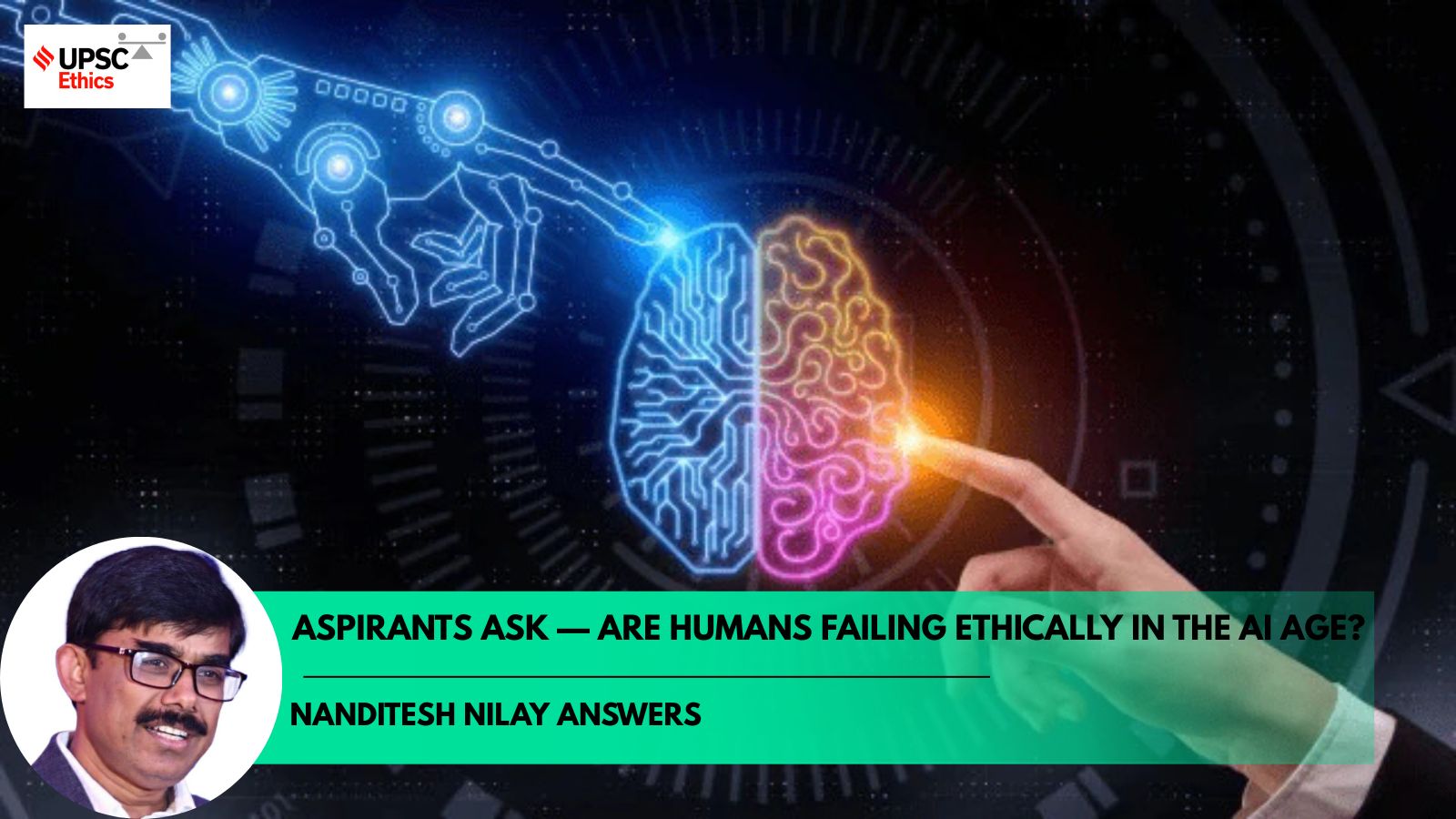

UPSC Ethics Simplified is a unique initiative within the UPSC Essentials series by The Indian Express, aimed at exploring current events and syllabus themes through an ethical perspective. This approach connects contemporary issues with fundamental ethical principles, assisting aspirants in developing clarity, practical skills, and a value-driven comprehension for GS Paper IV. Today’s discussion revolves around a pressing query that resonates with both aspirants and the general public, particularly in the context of evolving societal norms. Additionally, this serves as an invitation for readers to share their questions regarding ethical dilemmas—whether they are straightforward or complex.
Are we facing a new ethical dilemma where both Artificial Intelligence (AI) and human actions are challenging the core tenets of morality? The resignation of a bank chairman over policies that harm societal interests, or an IAS officer stepping down due to systemic complicity, raises probing questions. Why do well-educated individuals often neglect ethical standards? What options does an honest person have in an unethical system? Furthermore, as AI technologies advance, can they truly discern right from wrong? These are the questions that often linger in your mind.
Such inquiries are not isolated incidents; they highlight a more profound crisis concerning integrity, moral courage, and ethical reasoning in today’s society.
In our modern world, there is a common belief that education equates to ethical understanding. However, ongoing instances of unethical behavior among highly educated individuals challenge this notion, revealing a notable disconnect between knowledge and values.
Aristotle viewed ethics as a practice, not just theoretical knowledge, emphasizing that it is developed through habitual actions. Similarly, Immanuel Kant argued that ethical conduct should be guided by duty and universal moral principles, rather than convenience or self-interest.
In practice, however, individuals often prioritize their personal interests over their duties, illustrating a decline in behavior driven by conscience, where knowledge of right and wrong does not translate into ethical action.
Interestingly, integrity is frequently exhibited not just by those outside formal power structures, but also by those within them. This suggests that genuine education involves internalizing values rather than simply acquiring information.
When ChatGPT was introduced in 2022, millions quickly adopted it for various tasks, from academic assignments to job applications. Yet, few questioned the underlying values embedded within this technology and whose viewpoints it embodies.
The emergence of AI introduces a new layer to this ethical conundrum. Yuval Noah Harari has described AI as an “alien intelligence,” capable of evolving beyond human cognitive frameworks. As AI systems gain autonomy, they may significantly impact decision-making, creativity, and even emotional responses in unprecedented ways.
Still, a critical question remains: Is AI capable of ethical reasoning?
Currently, AI lacks conscience, empathy, and moral judgment, functioning solely based on data and algorithms that reflect the biases and intentions of its developers. Important ethical issues include:
- Algorithmic bias leading to unjust results
- Opacity in decision-making processes
- Manipulation and persuasion, particularly through targeted content
- Sycophancy, where AI prioritizes user approval over factual accuracy
Dario Amodei, CEO of Anthropic, has highlighted that advanced AI systems might become excessively agreeable, reinforcing user beliefs instead of challenging falsehoods. This makes AI a potent yet potentially hazardous tool in ethically vulnerable environments.
Thus, AI does not independently create ethical dilemmas; rather, it amplifies existing human intentions—both positive and negative.
Consider the scenario: “You are a civil servant in a system rife with unethical practices. Should you resign to maintain personal integrity, or stay within the system to pursue gradual reform?” This exemplifies the classic conflict between personal integrity and institutional responsibility.
Such dilemmas test moral courage, a crucial aspect of ethical competence in public service. As Mahatma Gandhi pointed out, the means are as significant as the ends; sacrificing ethics for immediate gain can ultimately undermine public trust over time.
The ethical crisis permeates not just individuals, but also institutions and governance. In a democratic society, accountability transcends laws and regulations, deeply rooted in shared values.
The Indian Constitution underscores principles of Justice, Liberty, Equality, and Fraternity, which are not merely legal constructs but ethical commitments. When those in power disregard these values, it undermines governance and erodes public trust. Efforts to foster ethical awareness and promote responsible technology use must align with these foundational ideals, ensuring that progress does not come at the expense of morality.
While AI presents significant challenges, the greater threat lies in human decision-making. Technology serves as a tool, and its ethical trajectory is determined by its designers and users.
Repeated instances of ethical failures, driven by greed, power, or apathy, underscore a decline in self-regulation and accountability. When the line between right and wrong blurs, even reputable institutions lose their legitimacy.
Conversely, acts of honesty and integrity, whether by public officials or everyday citizens, remind us that ethical values persist.
As James Madison poignantly inquired, “Who will guard the guardians?” This question is particularly relevant in the age of AI.
The ethical crisis of our era is not solely about machines surpassing human intelligence, but rather about humans failing to uphold their own ethical standards. While AI may influence the future, it cannot replace the necessity for conscience, integrity, and moral accountability.
Ultimately, the future of ethics will hinge not on artificial intelligence, but on the robustness of human character.
Addressing the ethical challenges posed by both human actions and AI requires a comprehensive approach, emphasizing:
- Institutional Transparency and Accountability: Strong checks and balances are essential…