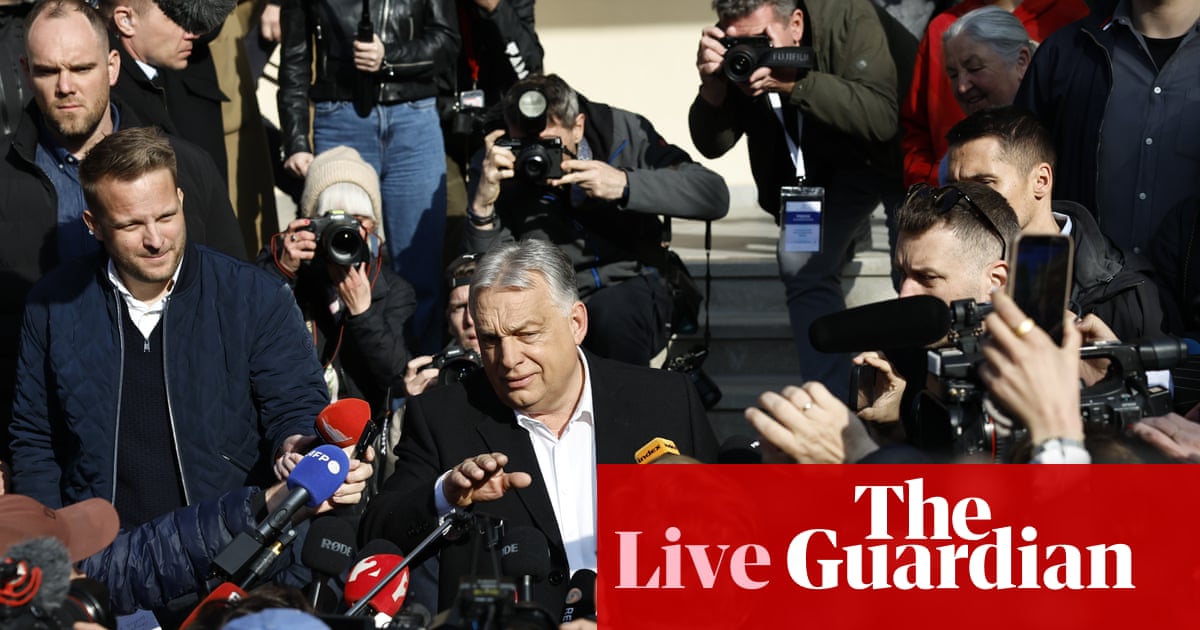

Viktor Orbán, the Prime Minister of Hungary, cast his ballot early this morning in Budapest, accompanied by his spouse, Anikó Lévai.
Following his vote, the leader of the Fidesz party, who faces the possibility of losing his position after 16 years in office, expressed confidence, stating, “I am here to win,” and emphasized his enjoyment of victory.
He dismissed any concerns regarding potential disputes over the election results by the European Union, asserting that they must respect the will and opinions of the Hungarian populace. “They cannot disregard the Hungarian people,” he remarked.
When asked to compare this election to the pivotal one in 1990, Orbán noted the differences in context, declaring, “The issue is not whether to establish democracy, but rather how to effectively govern a democratically elected administration.” He highlighted the pressing need for national unity to face multiple impending crises, including energy, financial, and economic challenges.
In response to suggestions that this might be his final election, Orbán confidently declared, “I am a young man!” He added that it would take a significant defeat for him to consider stepping down from his role within Fidesz.
Unlike many other nations, Hungary does not enforce an official election silence period, allowing some campaigning activities to continue on the election day. However, there are specific restrictions that prevent major events from occurring today, leading candidates to hold their final rallies the night before. Campaigning is prohibited within a 150-meter radius of polling stations, although pre-existing posters can remain displayed.
Despite these restrictions, some voters found innovative ways to express their support; for instance, a van driving through central Budapest played Fidesz’s campaign anthem loudly earlier today.
The polls opened at 6 AM and will close at 7 PM local time (6 PM UK time). Initial polling data is expected to be released shortly thereafter, but caution is advised in interpreting these figures due to the unpredictable nature of the situation. The first partial results are anticipated within the first hour after polls close, with approximately half of the votes counted by 10 PM and over 90% by midnight. Voters should be prepared for a lengthy wait as the final outcome unfolds.
If the election results are particularly close, complications may arise as overseas ballots will not be counted until Saturday. Although several polls were conducted in the lead-up to election day, their reliability varied significantly based on their affiliations. More independent sources indicated that Péter Magyar’s Tisza party might be leading, but the exact margin of victory remains unclear, with differing estimates circulating.
Before the final weekend, the general consensus suggested that Tisza had approximately a 10-point lead. However, the intricacies of the Hungarian electoral system warrant caution in interpreting these projections. The election involves a mixed system that has undergone numerous reforms under Orbán, which critics argue favors his party. A total of 106 members of parliament will be elected from single-member constituencies, alongside 93 from national party lists, with a 5% threshold required for parties to gain representation.
In the meantime, Péter Magyar, leader of the Tisza party, concluded his campaign in Debrecen, Hungary’s second-largest city, drawing an unexpectedly large crowd despite the city’s historical affiliation with Fidesz. This rally was seen as a strategic move, indicating Magyar’s confidence in gaining support in traditionally Fidesz territory.
András Bíró-Nagy from Policy Solutions noted that Magyar’s choice to campaign in areas dominated by Fidesz in the final days suggested he believed he could achieve significant gains there. Fidesz has maintained control in Debrecen for 28 years, making it a pivotal location for Orbán, who recently campaigned there due to indications that the city might be contested.
Orbán concluded his electoral activities with a rally near the Matthias Church in the Buda Castle District. Although attendance was lower than expected for a final campaign event, several thousand supporters gathered to express their hopes for his re-election. His remarks, particularly his criticisms of European support for Ukraine and warnings about the risks of a government change during uncertain global times, resonated well with his audience.
Notably, Hungary’s foreign minister, Péter Szijjártó, who has faced scrutiny over his engagement with Russian officials, also spoke at the rally. Meanwhile, a group of counter-protesters briefly displayed a banner mocking the Prime Minister before it was removed by his supporters.