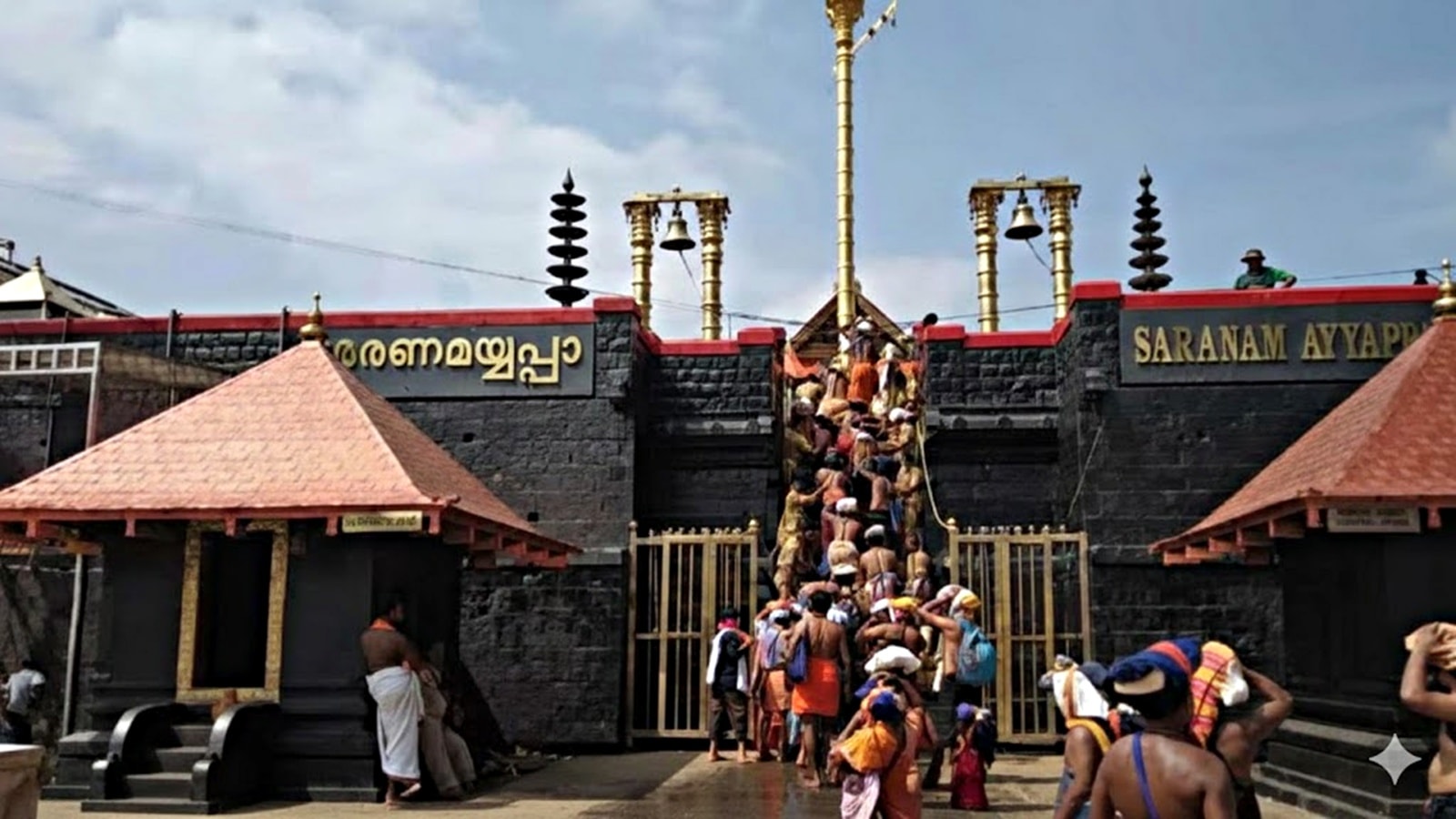

The ongoing hearings at the Supreme Court regarding the Sabarimala temple have revealed significant divisions within the saffron faction concerning a deeply cherished issue among its supporters: the autonomy of temples from government oversight.
Recent arguments presented by the BJP-led Central Government to a nine-judge panel, under the leadership of Chief Justice Surya Kant, showcase the administration’s hesitance to relinquish full authority over temples to worshippers. This has been a point of contention, with the ruling party frequently accusing state governments led by the Opposition of similar overreach. A variety of Hindu organizations, including the Kerala Kshetra Samrakshana Samithi, which is aligned with the RSS, have voiced their objections to the Central Government’s position.
The bench is composed of Justices B V Nagarathna, M M Sundresh, Ahsanuddin Amanullah, Aravind Kumar, Augustine George Masih, Prasanna B Varale, R Mahadevan, and Joymalya Bagchi. They are considering seven constitutional questions stemming from appeals to review the Supreme Court’s 2018 ruling that eliminated restrictions on women’s entry into the revered hill temple in Kerala.
Among the pivotal inquiries is the relationship between individual rights under Article 25 of the Constitution and the rights of religious groups as outlined in Article 26. This examination seeks to clarify the boundaries of the constitutional framework regarding the interaction between religion, religious groups, and governmental authority.
Article 26(b) grants religious groups, and any subdivisions within them, the authority to manage their religious affairs. Conversely, Article 25(2)(a) allows the state to legislate on matters governing or limiting any secular activities that may be connected to religious practices. Furthermore, sub-clause (b) enables the state to enact laws aimed at social welfare and reform, or to ensure that public Hindu religious institutions are accessible to all members of the faith.
Hindu organizations contend that various state governments have exploited Article 25 to impose enduring control over temples, seize their assets, appoint priests, and even dictate practices, as exemplified by the situation in Tamil Nadu, where the government has influenced the prayers offered in temples, and in Kerala, where the display of saffron flags during temple festivals has been restricted.
Regarding the appointment of temple priests, Solicitor General Tushar Mehta, representing the Central Government, unequivocally stated that this is not a function of the state. He asserted, “The selection of a pujari, who must possess specific expertise and knowledge of Agamas (sacred texts detailing temple worship and construction), should never be under governmental control. This should come from within the religion and its community, not from the state.” He emphasized that true secularism involves mutual non-interference between religion and government.
However, Mehta expressed caution regarding the balance between the rights enshrined in Articles 25 and 26. He clarified that both are fundamental rights, with Article 26(b) being a collective right that should take precedence unless limited by law under Article 25(2). He raised concerns that an unrestricted interpretation of Article 26(b) could lead to restrictions against certain groups, such as Scheduled Castes, from participating in religious practices.
Ananthakrishnan G., a Senior Assistant Editor with The Indian Express, brings over 23 years of journalism experience, having begun his career in the late 1990s as a freelancer. A law graduate, he spent two years practicing law in Kerala before transitioning to journalism. He has reported extensively from the Delhi High Court and the Supreme Court of India, and his current work focuses on legal reporting, including the administration of justice. His background includes a decade of political and community reporting, and he is known for his thorough fact-checking and impactful storytelling.