
Every Monday, we present the UPSC Current Affairs Highlights—a succinct, examination-oriented resource designed to keep you informed and prepared for both the Prelims and Mains stages of your studies.
If you missed last week’s UPSC Current Affairs Highlights from March 30 to April 5, 2026, you can find it here.
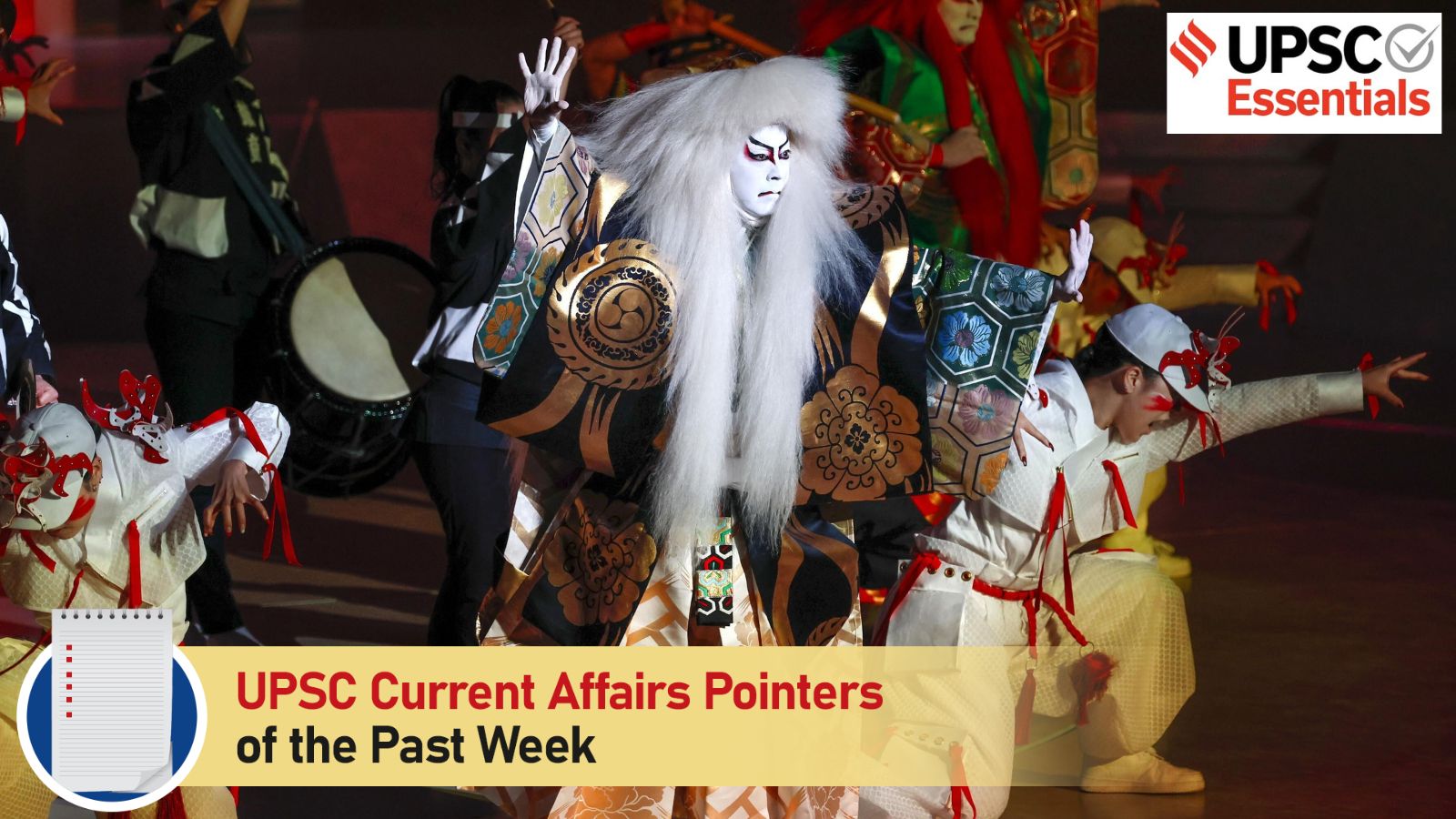
The tradition of passing down names across generations is a significant aspect of the Japanese theatrical art known as Kabuki, a practice celebrated at theatres and special occasions every few years. Originating in the 1600s, Kabuki continues to thrive in contemporary Japan.
Currently, the eighth Kikugoro is receiving this esteemed name from his 83-year-old father, the seventh Kikugoro, who inherited it from his own father.
Within the realm of Kabuki, stage names are traditionally transmitted through male lineage, creating a hereditary system that carries immense responsibility and honor. A new heir is expected to uphold the standards of artistry, ethos, and technique associated with the name.
As they progress in their careers, actors typically adopt three different stage names. This lineage generally follows a father-to-son pattern, with the art form predominantly practiced by Japanese men.
Kabuki performances are characterized by stylized dance, elaborate makeup, dynamic live music, and intricate costumes and sets. Common narratives often revolve around themes such as ill-fated love, tragic suicides, and quests for vengeance.
Actors portraying female characters are designated as “onnagata,” while performers like Kikugoro are capable of embodying both male and female roles.
The second edition of the International Conference on Spacecraft Mission Operations (SMOPS) took place from April 8 to 10, 2026, in Bangalore, India.
The theme for this year’s SMOPS Conference is “Innovative Operations for Smart and Sustainable Space Mission Management – Next Generation.”
The event was organized by ISRO, the Astronautical Society of India (ASI), and the International Academy of Astronautics (IAA).
On April 7, clashes between tribal villagers and police in Kashipur, located in Odisha’s Rayagada district, resulted in injuries to at least 40 police officers and 25 villagers. The conflict stemmed from local opposition to the construction of a 3 km road leading to the Sijimali bauxite mine, highlighting long-standing grievances regarding the bauxite project.
Sijimali is situated in the Eastern Ghats and is characterized by its valleys. The bauxite reserve spans approximately 1,500 hectares across the Rayagada and Kalahandi districts.
With an estimated 311 million tonnes of high-quality bauxite, Sijimali is located near Vedanta’s alumina refinery in Lanjigarh, Kalahandi, which has the capacity to produce 5 million tonnes annually. The mining rights were awarded to Vedanta Limited in 2023 through an auction process.
Bauxite ore is refined into alumina, which is then used to manufacture aluminum, a versatile material utilized in products ranging from soda cans to aircraft. Aluminum is valued for its strength, light weight, and conductivity, making it widely applicable.
It is the most plentiful metal in the Earth’s crust and ranks as the third most prevalent element overall, following oxygen and silicon.
According to the 2022 Yearbook from the Indian Bureau of Mines, Odisha represents 41% of India’s bauxite reserves and was the leading producer in the 2021-22 period, contributing approximately 73% of the nation’s total output.
Road construction projects led by the Public Works Department (PWD), including significant initiatives like the Barapullah Phase III elevated corridor, have experienced delays due to rising costs of petroleum-based materials, such as bitumen, driven by geopolitical tensions in West Asia, as reported by The Indian Express.
Bitumen, a byproduct of crude oil, serves as a binder in road construction, combining materials like sand, gravel, and crushed stone to create asphalt. Its waterproof, adhesive, and flexible qualities enable roads to endure various traffic loads and weather conditions.
India is expected to import approximately 10-12 million barrels of Venezuelan crude oil this month, marking the highest volume in over six years, according to data from Kpler, a commodity market analytics firm.
The majority of Venezuelan crude is classified as heavy sour crude, which is denser and thicker than lighter grades, as well as having a higher sulfur content.
The sulfur content determines whether crude is classified as sweet or sour. Sweet crude contains very low levels of sulfur, typically below 1%, while sour crude may have 1-2% sulfur content.
Heavy sour crudes tend to be more economical than light sweet crudes, resulting in lower feedstock costs for complex refineries that can process them, compared to simpler refineries that are unable to handle heavier grades.
This economic dynamic explains why the U.S. continues to import substantial amounts of cheaper heavy crudes while exporting its lighter domestic crude at a premium on the global market.
Prior to the implementation of U.S. sanctions on Venezuela in 2019, Indian private sector refining giant Reliance Industries Ltd (RIL) regularly sourced Venezuelan crude. After the sanctions were enforced, imports from Venezuela ceased within a few months.
According to India’s official trade statistics, Venezuela was India’s fifth-largest oil supplier in 2019, providing nearly 16 million tonnes, equivalent to around 117 million barrels, to Indian refineries. The two nations had a bilateral trade agreement worth $6.40 billion in 2019-20, with Indian imports, primarily crude oil, valued at $6.06 billion.
The Reserve Bank of India (RBI) maintained the policy repo rate at 5.25 percent in its first bi-monthly Monetary Policy Statement for the financial year 2026-27, keeping its policy stance neutral.
Under Section 45ZB of the amended RBI Act of 1934, the central government possesses the authority to establish a six-member Monetary Policy Committee (MPC) tasked with determining the interest rate needed to meet the inflation target. The inaugural MPC was formed on September 29, 2016.