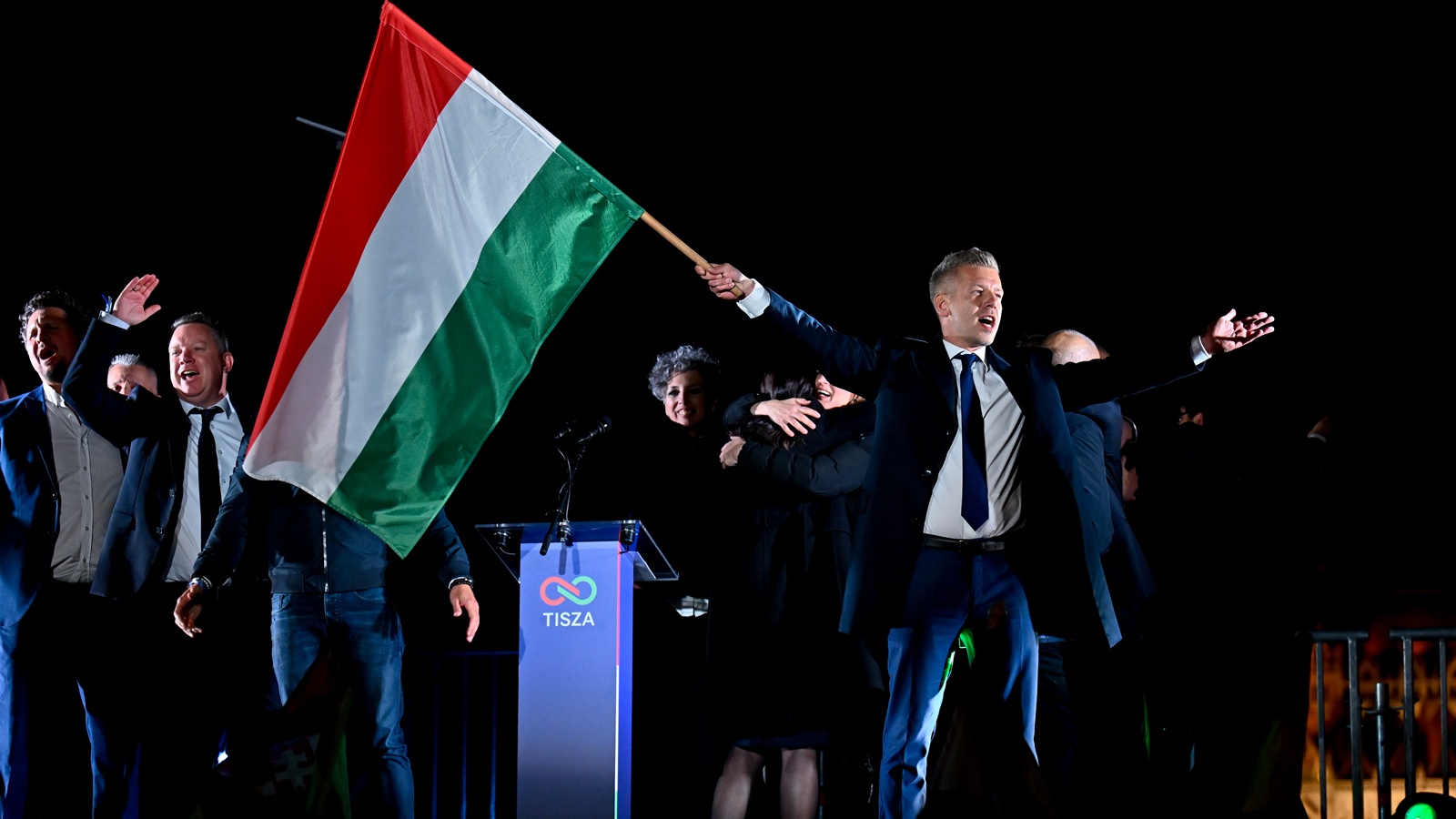

Following his electoral victory, Péter Magyar, the leader of the Tisza party, urged Hungary’s president on Monday to summon parliament promptly to establish a new government, hoping to assume the role of prime minister by May 5, succeeding Viktor Orbán.
At a press conference after Tisza’s success in the elections on Sunday, Magyar proclaimed that they had obtained “an unprecedented mandate.” This supermajority would empower Tisza to initiate significant reforms and a bold agenda.
Magyar emphasized that the Hungarian electorate had not merely voted for a governmental shift but for a comprehensive regime change. He expressed gratitude towards Moscow and Beijing for their congratulations and willingness to collaborate with Hungary’s forthcoming administration.
“The Hungarian people declared yesterday that they will narrate their own story, independent of Moscow, Beijing, or Washington,” he remarked.
During his campaign, Magyar promised to halt Hungary’s growing alignment with Russia and to restore connections with European partners. He assured citizens that, following 16 years of autocratic rule and the degradation of the rule of law under Orbán, he would eradicate corruption and foster a “peaceful, functioning, and humane” Hungary.
However, the specifics of these changes remain uncertain. Orbán had long governed with a two-thirds parliamentary majority, enabling him to enact a new constitution, modify the electoral framework, and influence the judiciary.
Magyar’s Tisza party secured precisely this kind of mandate, winning 138 out of the 199 parliamentary seats, thus granting them substantial power to reverse many of Orbán’s policies, which included judicial manipulation, suppression of press freedom, and discrimination against the LGBTQ+ community.
Nonetheless, potential challenges could hinder the sweeping changes that many Hungarians aspire to see. Following the victory, celebrations erupted in Budapest on Sunday night, with tens of thousands, particularly young citizens, expressing their hope that Orbán’s defeat would usher in a freer and happier Hungary, firmly re-integrated into the European democratic fold.
In the capital’s streets, revelers honked car horns and played anti-government anthems, while participants in the march chanted enthusiastically. Adrien Rixer, who returned from London to vote, expressed his elation, stating, “I am over the moon. Finally, I can say I’m a proud Hungarian, after 16 years.”
Many Hungarians, alongside observers from across Europe, were concerned that a simple majority would not suffice to genuinely reform Orbán’s system. Others, however, voiced hesitation about the implications of a two-thirds majority, questioning the fairness of a government formed from Orbán’s former mandate. “It’s hard to see that with two-thirds, it’s going to be a fair government, but we will see,” said celebrant Dániel Kovács. “Let’s hope that it’s going to be a promising four years.”
Magyar and Tisza’s electoral achievement is historic in Hungary’s post-Communist era, garnering more votes and parliamentary seats than any party ever before. Bulcsú Hunyadi, an analyst from the Budapest-based think tank Political Capital, noted that while Tisza’s constitutional majority grants the power to reverse many of Orbán’s policies, key state institutions remain under the control of individuals entrenched in their positions for years.
To consolidate his grip on Hungary’s democratic framework, Orbán appointed loyalists to lead essential institutions, including the media authority, the public prosecutor’s office, and the Constitutional Court. In several instances, mandates were prolonged or new appointments made before existing terms expired, effectively ensuring that loyal leadership stayed in place long after any governmental transition.
In his victory address on Sunday, Magyar urged such officials, including the president, to resign voluntarily. Hunyadi commented that beyond this, “they don’t have many tools to remove these individuals.”
Magyar accused Orbán and his administration of economic mismanagement and neglect of social services, claiming that unchecked corruption has led to the concentration of extreme wealth among a small network of well-connected individuals, leaving ordinary citizens underserved. He pledged to hold these abuses accountable and proposed the establishment of an Office for the Recovery and Protection of National Assets to reclaim what he alleges are the ill-gotten gains of Orbán’s associates.
He heavily campaigned on the promise to secure the release of billions of euros in EU funding that has been withheld due to concerns over corruption and the rule of law during Orbán’s tenure. Additionally, he expressed his intention to introduce the euro in Hungary by 2030, a move that Orbán’s government had long resisted.
According to Hunyadi, Magyar’s administration will face “tight pressure” from the EU to swiftly implement reforms necessary to access the frozen funds critical for Hungary’s struggling economy. “There are deadlines for unfreezing the funds. They will need to pass specific laws and reforms by August this year, which is only a few months away,” he noted.
Tisza’s victory has sparked optimism throughout the EU that a fresh government in Budapest would reverse Orbán’s adversarial stance towards Ukraine and facilitate assistance to the war-torn nation as it defends itself against Russia’s invasion. Orbán had previously leveraged his veto power in the EU to block sanctions against Russia and hinder essential financial support for Ukraine, asserting his opposition to any discussions regarding Ukraine’s EU membership.
On Monday, Ukrainian Foreign Minister Andrii Sybiha remarked that the campaign period marked by Orbán’s manipulative rhetoric towards Ukraine was now behind them, signaling a potential shift in diplomatic relations following Magyar’s win.