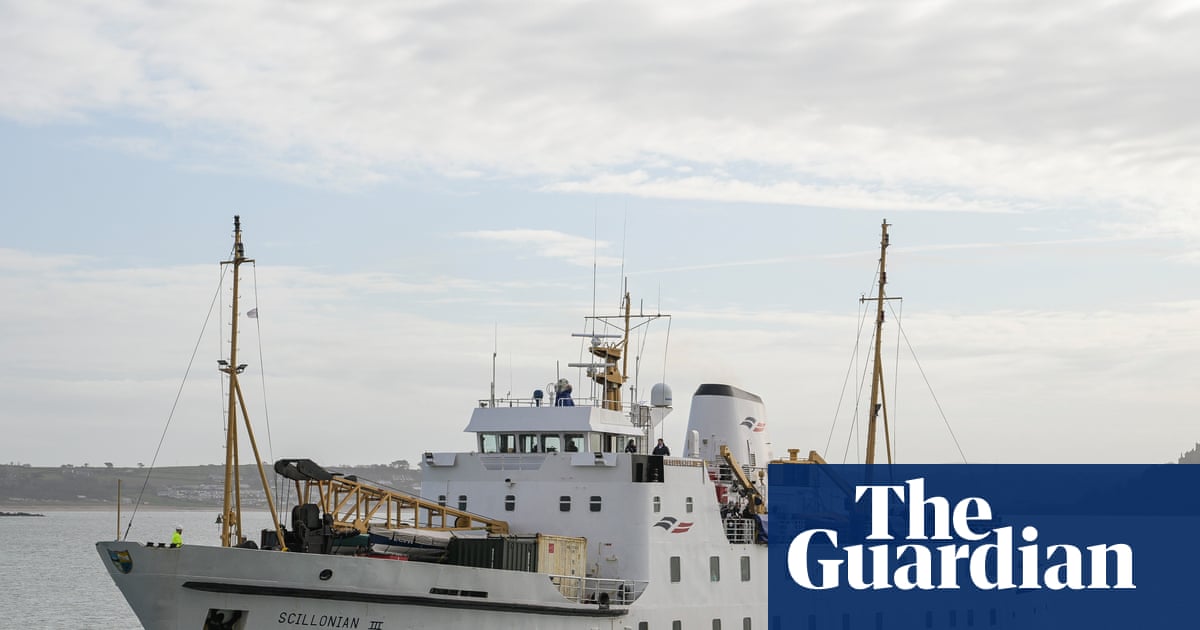

Passengers in Penzance experienced a blend of excitement and anxiety as they awaited their turn to board the Scillonian III ferry. While some were eager for the adventure that awaited them on the journey to the Isles of Scilly, located 30 miles off the coast of Cornwall, others were less enthusiastic. They were aware that the ferry could be quite rocky during times of Atlantic swells, earning it the less-than-flattering nickname of the “vomit comet.”
This marks the final operating season for Scillonian III, which has spent nearly five decades providing a vital connection between the UK mainland and the stunning archipelago.
Sholto Blackwell, a devoted fan of the Scillonian III, expressed his affection for the vessel. The 43-year-old has been sailing on it since childhood, when he first visited the islands for family holidays. “She has been a remarkable ship,” he shared. “She feels like a member of my family.”
When asked if he ever experiences seasickness, Blackwell admitted that he does struggle during rough weather, despite having seafaring roots through his father, a merchant navy sailor. “The Scillonian does have its moments of pitching and rolling,” he acknowledged.
Nonetheless, he finds the thrill of the journey part of its charm. “I’d prefer to be seasick on that ship than miss out on the experience altogether. Some might think I’m odd for saying that, but it truly is my happy place. For me, feeling unwell is just part of the adventure.”
Blackwell, who works as a crane operator and lifting supervisor near Bristol, is so enamored with the vessel that he established the Scilly III Appreciation Group, which has garnered over 4,000 members. “It’s evident that many others share my romantic feelings for Scillonian III,” he noted.
Among the travelers embarking this week were the Lassington Oak Morris Men from Gloucestershire, who were heading to the islands for performances in celebration of their 50th anniversary. Before boarding, they entertained on the quayside, although one member, Vernon Webb, confessed to feeling nervous about the journey. “I’m not the best sailor,” he admitted.
While the ferry is cherished by visitors, it also enjoys a loyal following among local residents, many of whom have their favorite spots on board. They know that during turbulent weather, the lower saloon, which lacks windows, is a great refuge where one can doze off to the soothing sounds of the engines.
Launched in May 1977 and constructed in Appledore, North Devon, the Scillonian III has transported over five million passengers, playing a crucial role in supporting tourism and the local economy while fostering community ties within the islands.
The current season will continue until November 2026, after which the Scillonian IV will take its place starting next March. This new vessel, currently being outfitted in a Vietnamese shipyard, is designed to accommodate more passengers, operate faster, and include “roll and pitch reduction systems” to mitigate the effects of rough seas.
The final journeys of Scillonian III evoke a mix of nostalgia and sadness for both current and former crew members. Pete Crawford, a former shipmaster who retired after nearly four decades, reflected on some of his fondest memories, including encounters with wildlife. “We would see something new every day. I’ve witnessed humpback whales breaching off Land’s End and spotted orcas. Once, a fishing boat alerted us to a massive pod of dolphins, and we diverted three miles off course to let our passengers experience it,” he recalled.
Current master Dave Redgrave, who has served with the Isles of Scilly Steamship Group for 17 seasons, remarked on the unique design of the Scillonian III. “They don’t make ships like this anymore. It has a lot of curves, while modern vessels are typically more angular. It’s a one-of-a-kind ship for a one-of-a-kind journey. The passengers adore it.”
Redgrave acknowledged the vessel’s reputation for rolling. “It can be a bit bumpy at times,” he noted, explaining that the shallow draft contributes to its tendency to bob around. “However, we certainly have many calm summer days when the sea is smooth.”
Second engineer Steve George, who has spent 39 years working on the ship, mentioned that visitors often stop to chat about their experiences aboard. Yet, he too has faced seasickness in the past. “When I first started, I struggled with it daily and questioned if this was the right job for me. Over time, you adapt, but I still occasionally find myself thinking, ‘I’ll be glad to reach our destination today.’ On a beautiful day, there’s no place quite like the islands; they’re like a miniature Caribbean—except for the colder water,” he said.