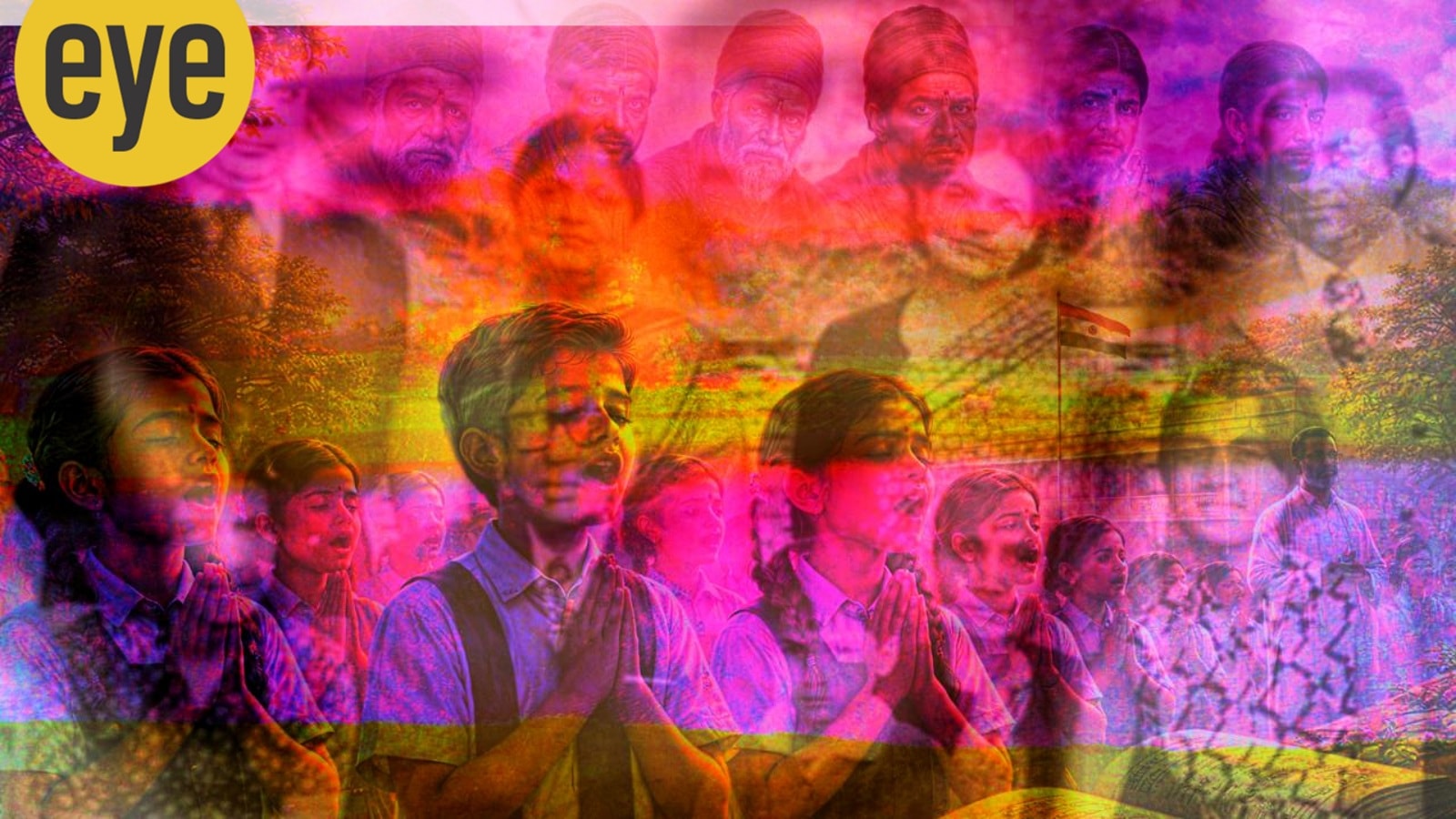

I was raised in a nation still discovering its own voice.
This voice was not loud or assertive, but rather tentative, like a child grappling with the significance of its own sound. The India of the 1970s and 1980s was flawed, inconsistent, and often tumultuous, yet there was a subtle connection that united it—a delicate but enduring belief that we were crafting not merely a country, but a shared ethical vision.
We were subtly and consistently taught that to be a part of India meant embracing diversity. Difference was not a threat. Contradiction did not equate to disintegration. Amid the multitude of languages we spoke and the various deities we worshipped—or chose to ignore—we could still discover a common essence of existence.
The concept of Vasudhaiva kutumbakam was not a subject for debate; it was an instinctive inheritance, much like a natural rhythm.
Occasionally, this rhythm manifested as song.
“Hum ko man ki shakti dena, man vijay kare…”
Grant us the strength of mind, so that the mind may prevail…
I recall standing in assembly, the gentle sun warming our faces, uniforms slightly askew, our voices occasionally out of sync yet somehow harmonious. We sang without the need for performance, irony, or the weight of interpretation.
“Doosron ki jai se pehle, khud ko jai kare…”
Before seeking victory over others, may we first achieve victory over ourselves…
At that time, I was unaware that these lines were penned by the renowned Gulzar. I had no knowledge of cinema, context, or authorship; I simply felt that something about those words resonated deeply.
They did not incite passion. They did not provoke anger. Instead, they guided us—gently and almost affectionately.
Years later, I would come to realize that what we were being offered was not merely a nationalistic anthem but an ethical framework. It was a way of life that resisted the allure of superiority, asking us to reflect inwardly before looking outward.
Long before I grasped the philosophical implications, I encountered the language.
This revelation came through a teacher—Toquir Ahmad—who viewed Urdu not just as a subject to memorize but as a sensibility to embrace. While others focused on letters, he provided access. Where others emphasized correctness, he instilled courage.
Through his guidance, the world unfolded—not in straight lines, but in spirals.
Mirza Ghalib was my first companion, irreverent yet intimate, teaching me that doubt could be an act of devotion.
Allama Iqbal followed, inspiring me to envision a self unconfined by fear.
Mir Taqi Mir infused sorrow with profundity, and Faiz Ahmed Faiz transformed resistance into a love letter whispered from exile.
Then there were those whose mere existence complicated the narratives we were being subtly taught about language and identity:
Firaq Gorakhpuri, whose name echoed Sanskrit’s rhythm while embodying Urdu’s essence.
Chakbast, who wrote in a language some would later claim did not belong to him.
They stood firm, unapologetic and whole—evidence that Urdu was not a possession but a shared treasure. It was not a tool of division but a space for connection. Language, much like love, refuses to be confined within arbitrary boundaries.
“Bhed-bhav apne dil se saaf kar sake…”
May we cleanse our hearts of all prejudice…
“Doston se bhool ho to maaf kar sake…”
If friends err, may we find the grace to forgive…
These lines, which we sang effortlessly, contained a radical insistence. It was not about achieving consensus but fostering introspection. It was not about uniformity but about self-examination.
To rid the heart of prejudice is a challenging endeavor. It demands unlearning, deconstructing, and unsettling our ingrained beliefs. It compels us to scrutinize the narratives we have absorbed about ourselves and others.
Forgiveness is an even greater challenge.
It requires us to relinquish the tempting power of resentment. It calls for choosing healing over righteousness, acknowledging our fallibility, and accepting that we will inevitably make mistakes.
“Jhooth se bache rahe, sach ka dam bhare…”
May we remain shielded from falsehood, may we have the courage to uphold truth…
Truth, during those formative years, was not presented as a weapon.
It was framed as a duty.
Something to be handled with care, rather than thrown carelessly. It required courage—not because it made us dominant, but because it made us responsible.
In today’s world, we often mistake noise for truth and certainty for strength. We are encouraged to declare before we fully comprehend, react before we reflect, and align ourselves before we inquire.
Populism thrives on this urgency, feeding on the allure of sameness—the false belief that if we all sound alike, we must all be correct. It simplifies complexity into catchy slogans and turns nuance into distrust.
However, the songs of our childhood demanded something entirely different from us.
They called for reflection.
For patience.
For a kind of inner strength that is neither glamorous nor readily apparent.
“Mushkilein padein to hum pe, itna karam kar…”
When challenges arise, grant us this grace…
“Saath dein to dharm ka, chalein to dharm par…”
May we stand by what is just, may we walk the path of righteousness…
In this context, dharm was not about doctrine.
It was not about identity.
It was not about exclusion.
It represented principles.
An ethical commitment that transcended labels. A dedication to doing what is right, even in the face of adversity, isolation, or personal cost.
Perhaps this is where the concept of neutrality must be redefined.
Not as indifference.
Not as disengagement.
But as strength.
To be genuinely neutral does not mean lacking a stance. It means resisting the easy allure of blind loyalty. It requires remaining anchored in one’s conscience rather than being swept away by consensus.
A person guided by their conscience does not dissolve into the crowd.
They exist within it, yet remain distinct.
They listen, but do not mindlessly echo.
They feel, yet retain their discernment.
They belong, but do not lose their individuality.
“Khud pe hausla rahe, badi se na dare…”
May we remain brave within ourselves, may we not fear adversity…
There is a quiet defiance in this sentiment…