
When Corentin Roudaut relocated to Paris a decade ago, he felt hesitant about cycling. Having previously enjoyed biking throughout his university years in Rennes, the chaos of the French capital’s traffic left him intimidated. The streets were filled with cars, and cyclists lacked adequate protection.
However, his perspective changed when the city created a dedicated bike lane on Boulevard Voltaire, located near his residence in the 11th arrondissement. Roudaut resumed cycling to work and has since embraced this mode of transportation wholeheartedly. He now volunteers with Paris en Selle, a cycling advocacy group, and has been amazed to see the city evolve away from its car-dominated image.
“The transformation began slowly but has gained momentum over the past decade,” Roudaut commented. “In certain areas, we now have a cycling network that is becoming safer and nearly comprehensive.”
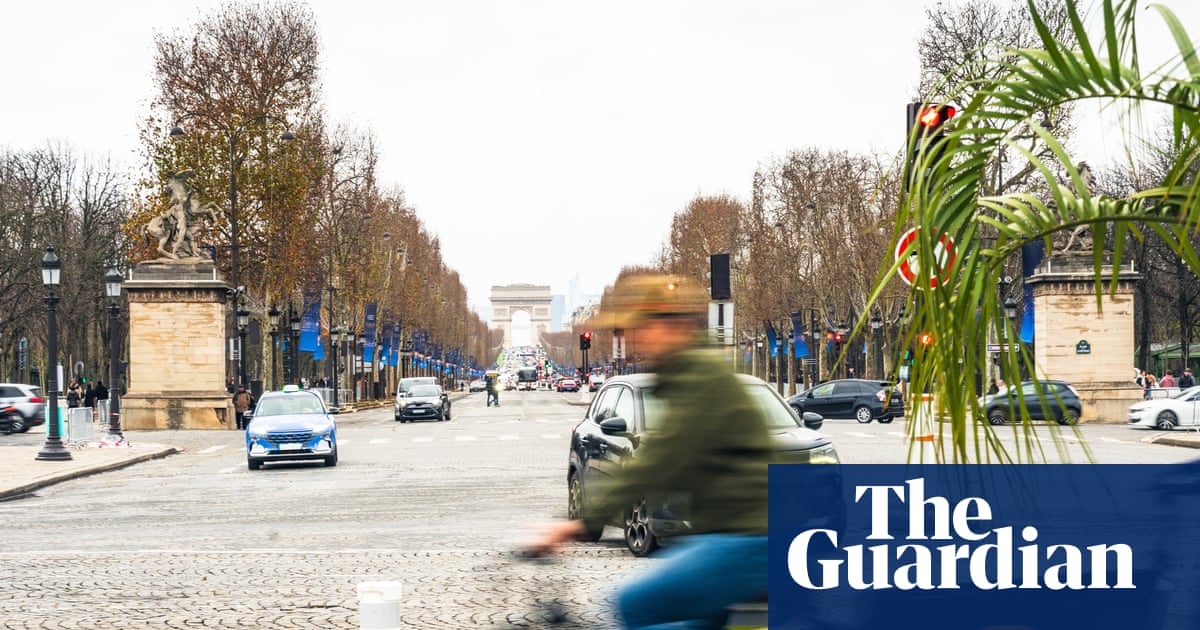
Since Anne Hidalgo assumed the mayoral office in 2014, Paris has undergone significant changes, including planting 155,000 trees, constructing hundreds of kilometers of bike lanes, and converting 300 school streets into pedestrian-friendly zones. Additionally, the city has prohibited car access along the Seine’s banks, repurposed parking spaces into green areas, and created outdoor terraces for cafes and bars. These initiatives have made walking to school safer for children.
As Hidalgo prepares to leave her post after 12 years, her efforts to enhance the city’s livability have been recognized as a model for progressive urban centers in Europe, especially as national governments retract environmental initiatives.
“When people seek my advice, I encourage them to be ambitious,” Roudaut shared, recalling his experience hosting a delegation of Green Party officials from Germany who were keen to understand Paris’s successes compared to Berlin’s struggles. He noted that although Hidalgo’s plans were only partially realized, the general sentiment is one of admiration for Paris’s achievements.
Not all residents share this enthusiasm. The measures aimed at improving street safety have often resulted in reduced space for vehicles, leading to backlash from some drivers. Recent referendums that sought to impose higher parking fees on SUV owners and expand pedestrian zones garnered disappointingly low voter turnout. Ahead of the recent municipal elections, Rachida Dati, the candidate from the right-leaning Les Républicains party, criticized the current state of public spaces, describing it as “anxiety-inducing,” though she refrained from suggesting a reversal of existing policies.
In a recent interview with the Guardian, Hidalgo remarked that transforming the riverbanks into pedestrian areas was a challenging endeavor, yet now that it has been accomplished, the public is unlikely to revert to the previous situation. “Today, there are generations of children who have never experienced cars there. People are often astonished when they hear that,” she stated.
Experts attribute the city’s successful transition to its compact administrative boundaries, which limit the influence of surrounding suburbs on its transportation policies, as well as the groundwork laid by earlier administrations. Nevertheless, it still required bravery to implement changes that disrupted car use while delivering shared social and environmental advantages.
While more improvements are still possible, the progress thus far is considered “fabulous” by Audrey de Nazelle, an environmental epidemiologist at Imperial College London, who frequently visits Paris. She recalls a time when cycling was so uncommon that running into another cyclist was a rare occasion.
“What is lacking in many places is the courage to initiate change,” she noted. “Mayors should see this as an opportunity to create a lasting legacy, yet most hesitate.”
According to a recent report, Paris is one of 19 cities globally that achieved significant reductions in two harmful air pollutants from 2010 to 2024. However, the list also includes several neighboring capitals with less progressive urban policies. For instance, fine-particulate pollution decreased more sharply in Brussels and Warsaw, while nitrogen dioxide levels fell more quickly in London.
Despite having a higher proportion of cyclists than Paris, Berlin recently opened a new highway segment within the city and voted to eliminate 30 km/h speed limits on 23 major streets.
Giulio Mattioli, a transport researcher at the Technical University of Dortmund, who previously lived in Paris, remarked that rather than being an outlier, the city has merely caught up to others from a lower starting point. “The infrastructure was already conducive; it just required the implementation of bike lanes for people to utilize them,” he explained.
During the Covid-19 pandemic, cities across Europe experienced a surge in cycling and bike-friendly infrastructure, but this progress has faced setbacks due to a rightward political shift and the rise of conspiracy theories targeting concepts like accessibility to local amenities.
While central Paris has made significant strides toward becoming a “15-minute city,” its extensive suburbs remain heavily reliant on cars and are separated by a busy ring road. Analysis conducted for the think tank Terra Nova by Jean-Louis Missika, a former deputy mayor under Hidalgo and her predecessor, emphasizes that transforming the Boulevard Périphérique, which encircles the city, is crucial for realizing the vision of a post-car metropolis in Paris.
“As long as this 35 km highway continues to encircle Paris, the Greater Paris metropolis will remain an illusion, a mere administrative concept disconnected from urban reality,” he wrote. “A true metropolis cannot be established by building barriers between its residents.”