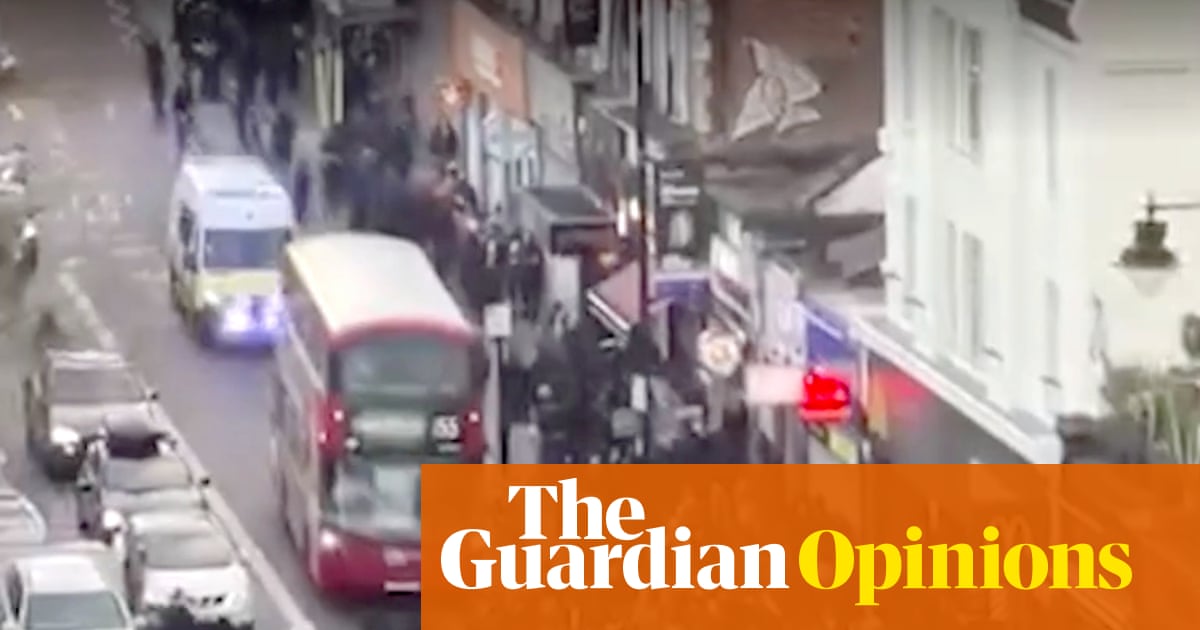

Recently, a group of teenagers in the Clapham region of south-west London sparked concern by running up and down the high street. The descriptions of their behavior varied widely, with some labeling them as a “feral gang” or a “chaotic swarm,” highlighting the subjective nature of public perception. It was confirmed that some individuals engaged in shoplifting during this incident.
Fireworks were set off, reminiscent of the antics seen in children’s comics, yet the situation felt quite alarming in reality. The distinction between playful mischief and genuine threat proved to be thinner than expected. Local store Marks & Spencer required police protection and closed earlier than usual, while Oliver Bonas briefly employed a security guard, which seemed either an excessive response or a sign of deeper societal issues.
Events escalated further in a manner typical of our current media environment. On Friday, a police detail assigned to London Mayor Sadiq Khan inadvertently left a bag of firearms outside his residence, located just a few tube stops from Clapham. This incident contributed to ongoing discussions about the mayor’s governance, particularly on radio talk shows.
Local MP Bell Ribeiro-Addy expressed her disapproval of the intimidating behavior displayed by the teenagers on social media. The reactions to her post were polarized, revealing a split in public opinion. One commenter suggested the need to focus on supporting future generations, while another harshly criticized London, calling it a “vile city full of immigrant scum” and demanding a referendum on relocating the capital. Such stark contrasts in views hinted at deep societal divides, and if the two commenters were ever to meet, the clash could escalate beyond mere words.
Coinciding with these events, the Telegraph reported on the Sentencing Act, which came into effect in March, indicating that around 12,000 shoplifters would soon be released from prison. Observers noted that habitual shoplifters are typically quite different from the teenage boys seen in Clapham, as they tend to be more calculated in their actions. Lord Walker of Broxton, head of Iceland, even proposed that security personnel should be equipped with truncheons and pepper spray, prompting the suggestion that those advocating for such measures should be the first to utilize them.
By Saturday, the atmosphere appeared to have calmed down when I attended a pilates class in the vicinity. Perhaps the local troublemakers were simply keeping a low profile out of respect for our fitness levels. I will refrain from opining on the decline of youth services, the impact of social media, or the possible influence of substances like ketamine and instead make a broader observation about teenage boys: they seem to be constantly scrutinized. I first noticed this while walking with my son, who is now 18, and realized that wherever teenage boys gather, they often face disapproving glances as if their presence is unwelcome.
When in school uniforms and moving in groups after being released simultaneously, they receive the kind of cold stares typically reserved for the worst-behaved cadets. If they carry a football, onlookers tense up, bracing for potential trouble. Wearing hoods transforms them into “hoodies,” laden with negative connotations. If they speak too loudly, they are deemed bothersome, but in silence, they are perceived as suspicious. Riding bikes might indicate intent to steal, walking could block pathways, and running signals another swarm. Local neighborhood forums often buzz with alerts about teenagers spotted on the streets, raising safety concerns.
It’s challenging to determine what constitutes “good” behavior under such scrutiny. A teenage boy might be seen reading a book or singing in a barbershop quartet, but otherwise, he risks being labeled as a potential shoplifter. I make no claims to understand the thoughts of teenage boys, as they remain enigmatic. However, if I were in their shoes, I might think, “I might as well be punished for a significant crime as for a minor one, like swiping a Southern Fried Chicken wrap, rather than simply doing nothing.”
Zoe Williams is a columnist for The Guardian.
Do you have thoughts on the issues presented in this article? If you wish to contribute a response of up to 300 words for possible inclusion in our letters section, please reach out via email.