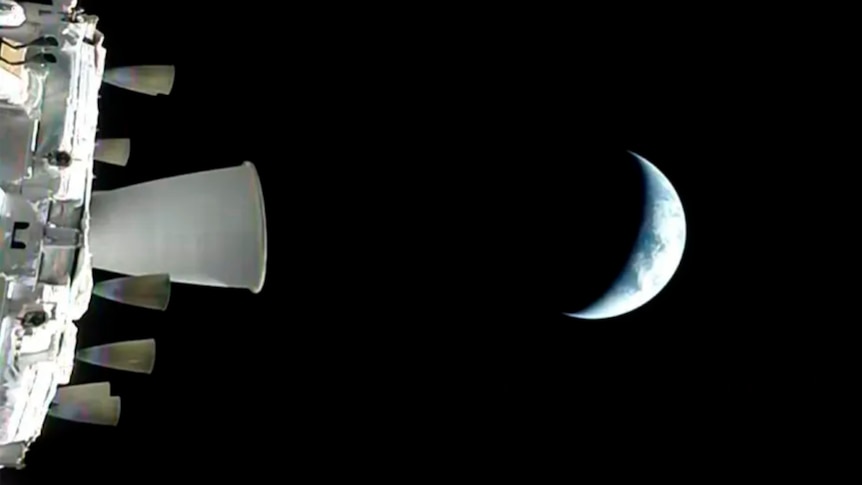

The Artemis II crew, already pioneers in the new age of lunar exploration, is set to undertake an unprecedented mission tomorrow. This team, comprising three Americans and one Canadian, aims to establish a new record for the greatest distance from Earth, a milestone previously held by Apollo 13 in 1970.
As they orbit the Moon without landing, they will become the furthest humans from Earth. Since their launch on Thursday, the crew has captivated audiences worldwide, with space enthusiasts eagerly sharing exceptionally clear images of Earth and updates from their journey.
The flyby, which will last approximately six hours, promises to showcase the Moon’s far side, previously unseen by astronauts on prior missions due to its shadowed nature.
Key details about the Moon’s orbit include that on the sixth day of their mission, during early Tuesday in Australia, the astronauts will enter the “lunar sphere of influence,” where the Moon’s gravitational pull will surpass that of the Earth on their spacecraft.
Nasa’s calculated trajectory allows the Orion spacecraft to navigate a free-turn path, shaped naturally by the gravitational forces of both the Earth and the Moon, enabling it to loop around the Moon and return to Earth without significant engine burns, according to the European Space Agency. If all goes as planned, the astronauts will set a new record for the farthest distance traveled from Earth by humans.
Following the flyby, the Orion will execute a U-turn and make its way back to Earth without any stops.
The Artemis II crew will experience the Moon from a perspective distinct from that of the Apollo missions of the 1960s and 70s. In addition to capturing images of Earth, communicating with mission control, and addressing practical tasks aboard the spacecraft, the astronauts are also engaged in various scientific experiments.
Listeners can keep up with mission developments through the daily podcast “Artemis Explained” from ABC Radio National. The podcast provides updates from launch to splashdown and addresses questions about life as an astronaut, space science, and future plans beyond the Moon. For inquiries to be answered in upcoming episodes, listeners can email sciencefriction@abc.net.au.
The Artemis II crew will approach within approximately 4,000 miles (6,437 kilometers) of the Moon’s surface, allowing them to view its entire circular expanse. From this vantage point, Earth will appear no larger than a basketball beyond the Moon’s dark side. Additionally, the astronauts will witness a total solar eclipse not visible from Earth, offering them several minutes of views of the Sun’s corona, its outermost layer.
During their time behind the Moon, the crew will temporarily lose contact with mission control for nearly an hour, as NASA relies on its Deep Space Network for communication, which will lack a direct line of sight while the Orion is obscured.
The astronauts will take turns capturing images of the lunar landscape through the spacecraft’s windows, relaying their observations while using a range of professional cameras onboard. Each astronaut also possesses an iPhone for more spontaneous photography. To prepare for this task, they completed geology training with lunar flashcards created by NASA geologist Kelsey Young’s team.
“They’ve trained extensively on visualizing the Moon,” Young stated. “I am eagerly anticipating their ability to bring the Moon closer to home with their observations.”
The Artemis II mission will surpass Apollo 13’s maximum distance from Earth, which was 248,655 miles (400,171 kilometers). Artemis II is expected to reach a maximum distance of 252,757 miles (406,772 kilometers), exceeding the previous record by approximately 4,102 miles (6,601 kilometers). While Apollo 13 was intended to land on the Moon, an onboard explosion forced the crew to abandon that plan and instead orbit the Moon.
Christina Koch, one of the Artemis II astronauts, emphasized that while they do not focus on accolades, this achievement is significant for people to comprehend as it connects historical accomplishments with present and future milestones.
In contrast, unmanned spacecraft have traveled much further. The Voyager 1 probe, launched in 1977, is currently the furthest human-made object from Earth, positioned over 24 billion kilometers away in interstellar space. Voyager 1 is projected to reach a distance of one light-day from Earth in November. NASA has also successfully deployed several remote-controlled rovers on Mars for exploration, with six operational missions conducted thus far.