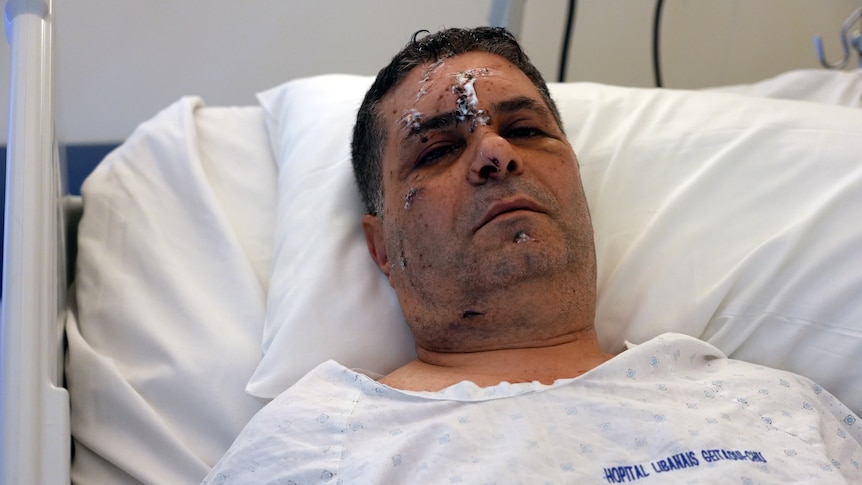

Bashir Nadaff is currently hospitalized, far from his home, suffering from multiple shrapnel wounds sustained during an Israeli attack on his village in southern Lebanon. The incident occurred in late March while he was with his wife and 14-year-old daughter in their Christian community of Débel, as Israeli tanks entered the area and began firing.
“We were caught in a hail of bullets,” Nadaff recounted. “We sought refuge in a small room downstairs while the gunfire persisted for nearly 45 minutes.” He described using his body as a shield to protect his family from the relentless shelling that struck their home. “When one of the shells hit, it impacted the wall I was leaning against. Although I remained conscious, I was unable to see or hear anything, and I was losing a lot of blood,” he reflected. “In that moment, I told my wife and daughter that I might not survive.”
His home lies within an area in southern Lebanon that has been subjected to a ground invasion and extensive aerial bombardments by Israel since early March, following attacks by the Iranian-aligned militant group Hezbollah. In response, Israeli authorities have mandated that many residents evacuate to avoid potential harm, but numerous individuals are choosing to stay, including those from Christian villages that do not have ties to Hezbollah. The fear of permanent displacement hangs over them, reminiscent of past conflicts where fleeing meant never returning.
Residents of Débel, located approximately six kilometers from the Israel-Lebanon border, report that the Israeli military has effectively blocked their sole remaining route for escape, resulting in increasingly dire living conditions. “We are unable to leave; we feel trapped,” stated Akl Naddaf, the municipality president. “We have lost access to drinking water. Our artesian well is now in an area occupied by Israel, making it unreachable. The situation is desperate.”
Inquiries to the Israel Defense Forces (IDF) regarding the assault on Débel went unanswered by the deadline. Historically, the IDF claims its operations do not target civilians but focus on Hezbollah militants and their facilities. However, in late March, Israel announced its intentions to fully occupy southern Lebanon up to the Litani River — approximately 30 kilometers north of the border — to establish a “buffer zone” against Hezbollah, which would encompass about 10% of Lebanon’s territory. Furthermore, Israel’s defense minister indicated plans for the demolition of homes in border villages, reminiscent of strategies employed in Gaza.
Just two kilometers from the Israel-Lebanon border lies the Christian village of Rmeich, where 24-year-old speech therapist Teresa Touma is resolute in her decision to remain. “Leaving feels like relinquishing everything that shapes my identity,” she expressed. “While fear lingers, staying is also about preserving who we are and where we belong. We are not merely transient; we are deeply rooted in this land, and abandoning it would mean losing our identity.”
Many southern Lebanese villages have experienced extensive destruction due to previous conflicts, particularly during the war between Israel and Hezbollah that erupted in late 2023, shortly after hostilities in Gaza. By late 2024, over one million Lebanese individuals had been displaced, with many still unable to return home. A ceasefire brokered by the United States in November of that year did not lead to an end of Israeli military presence, as reports of continued air strikes persisted, with the UN documenting over 100 civilian fatalities during the ceasefire, including 16 children.
The Israeli military has not clarified whether Christian villages will be excluded from demolition or forced displacement in the current conflict. Recently, the Lebanese army, which had been facilitating safe passage for residents to obtain food and medical supplies, withdrew from the area. Within Rmeich, parish priest Father Najib al-Amil made an urgent appeal to the government for protection of the village and its inhabitants. “Do not abandon us,” he implored. “We either perish together, or we live and preserve our villages.” He noted that the community is under constant threat of bombardment, which has made even simple tasks, like retrieving livestock from fields, perilous.
The current conflict has reignited fears of a lengthy Israeli occupation in southern Lebanon, particularly among older residents who remember the Israeli presence from 1982, which lasted until 2000 in some regions. As Ms. Touma listens to the sounds of nearby explosions, she expresses her anxiety that her village could soon be struck. She finds solace in her faith amidst the uncertainty. “What frightens us most is how rapidly everything can change,” she remarked. “In an instant, everything could vanish. The future feels uncertain and vague, yet a small part of us clings to hope, for without it, remaining would be impossible.”
Since the onset of this conflict, Israeli air strikes have resulted in nearly 1,300 fatalities in Lebanon, with more than a million individuals displaced.