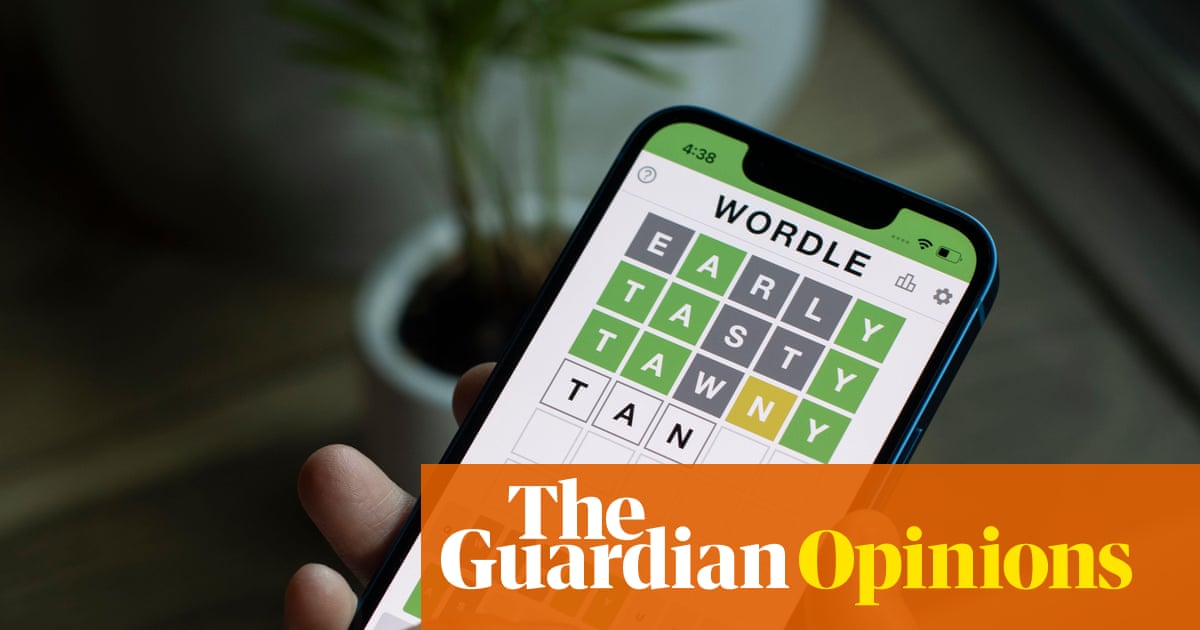

It seems that puzzle games have captivated a wide audience recently. Many people are engaging with them daily; for instance, I enjoy playing Word Wheel on the Guardian app with my morning coffee, while colleagues often share their experiences with Tradle, a game where players guess countries based on their exports. Did you know that Greenland exports around 45% fish and 50% crustaceans? Additionally, a friend of mine has a nightly routine that involves solving Sudoku puzzles before going to bed.
The surge in popularity of online puzzles can be traced back to the Covid pandemic, and this trend shows no signs of abating. Current data indicates that subscribers to the New York Times are now dedicating more time to puzzle-solving within the app than to reading news articles. Furthermore, sales of trivia books reached an all-time high last year, increasing by 24% compared to 2024.
Although puzzle games have been around for quite some time, their popularity has seen various peaks. The advent of the steam-powered printing press in 1814 transformed newspapers into widely accessible media, prompting editors to realize that puzzles were an effective way to engage readers. By 1925, the Chicago Department of Health reported that Americans were experiencing a phenomenon dubbed “crossworditis,” attributing it to the addictive nature of puzzles.
Modern neuroscience supports this notion, revealing that solving puzzles triggers the release of beneficial neurotransmitters in the brain, particularly dopamine.
Yet, the current puzzle phenomenon might be attributed to more than just the enjoyment derived from frequent moments of discovery. They could be addressing deeper psychological needs, especially as the complexities of the world around us increase our desire to solve problems.
In an era where our attention is frequently challenged, these puzzles act as a mental respite. Research consistently shows that social media can elevate anxiety and fragment our focus. Puzzles provide a welcome distraction, allowing us to concentrate on a singular task rather than becoming overwhelmed by the fast-paced nature of social media or the incessant scrolling through news feeds. Plus, we can still engage with our devices while enjoying this mental exercise.
Additionally, these games encourage a productive form of contemplation. For example, an Italian friend of mine plays Wordle primarily to enhance his English vocabulary, while another sees puzzle-solving as a means of resisting the cognitive overload imposed by the digital age. During a dinner conversation with friends nearing their 40s, several admitted to feeling a decline in their mental acuity, attributing it to the effects of social media and artificial intelligence.
This puzzle trend may echo the emergence of recreational sports in the 19th and 20th centuries. As manual labor became less prevalent, individuals began to engage in physical exercise with greater intention. In a world where artificial intelligence increasingly manages our cognitive tasks and social media bombards our attention, puzzles might serve as a mental gym to keep our minds sharp.
Research indicates that engaging with puzzles can enhance neuroplasticity, allowing the brain to forge new connections and improve memory, concentration, and creative thought. Furthermore, much like physical sports, puzzles can also be a social activity, with players frequently sharing their achievements and discussing strategies.
Puzzles also serve as cultural artifacts that reflect the times in which they were created. Notably, the renowned illustrator Tomi Ungerer from Alsace preferred English and French crosswords, finding German ones lacking in enjoyment. The first English crossword, published in 1913, started with the word “fun,” while the inaugural German Kreuzworträtsel, released in 1925, posed a question about “Germany’s pressing obligation,” with the answer being “Reparations.”
However, the current fascination with puzzles might extend beyond their escapist nature and the cerebral challenges they present; they may also embody an idealistic quality. Puzzles create a small, contained universe that stands in stark contrast to the chaos and uncertainty of real life.
I recall fondly my grandmother engrossed in the crossword of her local Swiss newspaper, La Liberté, pencil in hand, humming as she filled in the answers. In those moments, we understood that she was momentarily lost in a different realm. This pastime seemed to provide her with solace, a retreat from the demands of family life. In today’s world, such solace is arguably more vital than ever.
While the U.S. president navigates his office for personal business gain and asserts that his moral compass is his only constraint in foreign policy, the realm of puzzles operates under a semblance of order and meritocracy. Success in puzzles cannot be achieved through deception or aggression; incorrect answers are simply wrong, and correct solutions stand unequivocally right.
Moreover, unlike those who may stumble into success through luck, puzzle-solving rewards diligence, thought, and accumulated knowledge, providing instant feedback. In adulthood, we often find ourselves in uncertain territory, unsure if we are on the right track until it is too late. Puzzles, in contrast, offer immediate clarity regarding our progress.
In addition to the comforting clarity of right and wrong reminiscent of our school days, puzzle games provide an increasingly rare sense of closure. Much of life can feel like a series of unresolved issues. Questions about financial security, friendship, and more linger indefinitely. In contrast, crosswords have definitive clues, and books conclude with final chapters, whereas the endless scroll of social media continues without end. Swiss author Nina Kunz expresses this sentiment, stating, “In the present day, nothing ever ends… That makes me nervous. Because I like conclusions and neatly wrapped-up endings. I need full stops and final sentences to be able to understand what’s going on.”
Puzzles, however, can be completed. There is immense satisfaction in filling the last square or discovering the final word. In a time of confusion, puzzles may represent a new utopia—an orderly world where rules are clear, challenges are surmountable, and effort is duly recognized. In this chaotic age, the allure of that engaging space on our devices is hard to resist.
For a brief period, we can immerse ourselves in a fair and structured environment, and for those moments, we can reassure ourselves of our cognitive abilities.